
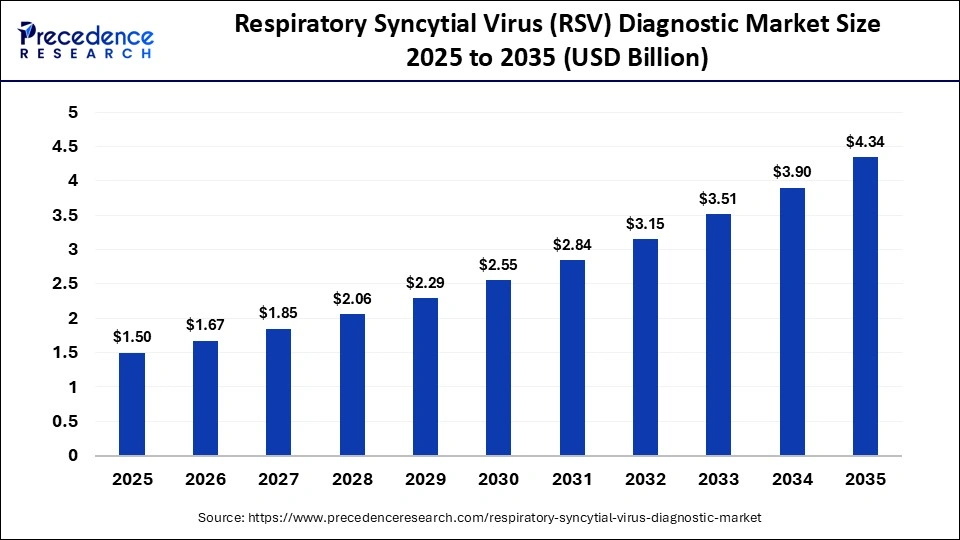
The global respiratory syncytial virus diagnostic market is experiencing rapid growth, driven by the rising burden of respiratory infections and the increasing need for early, accurate detection. The market was valued at USD 1.50 billion in 2025 and is projected to grow from USD 1.67 billion in 2026 to USD 4.34 billion by 2035, expanding at a CAGR of 11.20%.
RSV is a highly contagious virus that significantly impacts infants, older adults, and immunocompromised individuals. With seasonal outbreaks and increasing hospitalization rates, the demand for advanced diagnostic solutions has become critical for timely intervention and effective disease management.
Read Also: Cholestatic Pruritus Market
What is RSV and Why is Diagnosis Critical?
Respiratory syncytial virus (RSV) is one of the leading causes of lower respiratory tract infections worldwide. It is particularly dangerous for:
- Infants and young children
- Elderly populations
- Individuals with weakened immune systems
Early and accurate diagnosis is essential for:
- Timely treatment and clinical decision-making
- Preventing disease progression
- Reducing hospital admissions
- Controlling seasonal outbreaks
Modern diagnostic technologies such as molecular testing, rapid antigen detection, and point-of-care solutions are enabling faster and more reliable detection.
Respiratory Syncytial Virus Diagnostic Market Dynamics
Key Growth Drivers
Rising Prevalence of Respiratory Infections
The increasing incidence of RSV infections globally is a major factor driving market growth. Seasonal outbreaks continue to create strong demand for rapid diagnostic solutions.
Growing Neonatal and Geriatric Population
The rising number of vulnerable populations, including infants and elderly individuals, is significantly increasing the need for RSV diagnostics.
Expansion of Point-of-Care Testing
The shift toward decentralized healthcare has accelerated the adoption of portable and rapid diagnostic tools, enabling faster clinical decisions.
Increasing Preventive Therapies and Vaccines
With the introduction of RSV vaccines and monoclonal antibodies, diagnostics are becoming essential for screening and treatment eligibility.
Role of AI in the RSV Diagnostic Market
Artificial intelligence is transforming the RSV diagnostic landscape by enabling predictive and data-driven healthcare solutions.
AI algorithms are being used to analyze epidemiological trends, weather patterns, and hospital data to predict RSV outbreaks before they occur, allowing healthcare systems to prepare proactively.
Additionally, AI enhances diagnostic accuracy by improving the interpretation of multiplex testing results, especially in cases where RSV symptoms overlap with influenza or COVID-19. This improves clinical decision-making and reduces diagnostic errors.
Key Market Trends
Shift Toward Multiplex Testing
Healthcare providers are increasingly adopting multiplex diagnostic panels capable of detecting multiple respiratory pathogens, including RSV, in a single test.
Rise of Point-of-Care Molecular Platforms
Compact molecular diagnostic devices are enabling PCR-level accuracy outside traditional laboratory settings.
Integration of Real-Time Surveillance Systems
Diagnostic tools are becoming part of connected healthcare systems, enabling real-time monitoring and faster public health responses.
Pediatric-Focused Innovation
Manufacturers are developing infant-friendly diagnostic tools with less invasive sampling and faster turnaround times.
Market Segmentation Analysis
By Product & Service
- Kits and assays (reagents) dominate the market due to consistent demand during testing cycles.
- Software and services are expected to grow fastest due to increased reliance on data analytics and reporting systems.
- Instruments and analyzers remain essential but grow at a slower pace due to high costs.
By Technology
| Technology | 2025 Share | 2035 Forecast |
|---|---|---|
| Molecular Diagnostics | 55.0% | 61.5% |
| Rapid Antigen Tests | 27.0% | 23.5% |
| Immunoassays | 12.0% | 10.5% |
| Others | 6.0% | 4.5% |
Molecular diagnostics dominate due to their superior accuracy and ability to detect multiple pathogens simultaneously.
By End-User
| End-User | 2025 Share |
|---|---|
| Hospitals & Clinics | 43.1% |
| Diagnostic Laboratories | 31.5% |
| Point-of-Care Centers | 18.2% |
| Home Care | 7.2% |
Hospitals and clinics lead due to high patient volumes and the need for rapid diagnosis.
Regional Analysis
North America
North America dominates the market with a 39.2% share, driven by:
- Advanced diagnostic infrastructure
- Strong surveillance systems
- High adoption of molecular technologies
Asia Pacific
Asia Pacific is the fastest-growing region, supported by:
- Expanding healthcare infrastructure
- Increasing awareness of respiratory diseases
- Rising adoption of molecular diagnostics
Europe
Europe is witnessing steady growth due to:
- Government initiatives for infectious disease control
- Increasing healthcare investments
- Adoption of advanced diagnostic technologies
Competitive Landscape
The RSV diagnostic market is highly competitive, with major companies focusing on innovation and strategic expansion.
Key Players
- Abbott Laboratories
- F. Hoffmann-La Roche Ltd.
- Becton, Dickinson and Company
- Danaher Corporation (Cepheid)
- Thermo Fisher Scientific Inc.
- bioMérieux SA
- QIAGEN N.V.
- Siemens Healthineers
- Bio-Rad Laboratories
- DiaSorin S.p.A.
Challenges in the Market
Despite strong growth, the market faces several challenges:
- High cost of molecular diagnostic platforms
- Limited accessibility in developing regions
- Regulatory concerns around at-home testing
- Need for skilled professionals
Get a Sample Copy: https://www.precedenceresearch.com/sample/8321
For inquiries regarding discounts, bulk purchases, or customization requests, please contact us at [email protected]