
The global exotic pets sector is expanding as more consumers look beyond traditional cats and dogs for companionship. Rising interest in distinctive animal species, greater access to specialized pet products, expanding veterinary services, and the growth of online resources are creating new opportunities across the ecosystem.
The global exotic pets sector was valued at USD 15.15 billion in 2025 and is projected to increase from USD 16.39 billion in 2026 to approximately USD 33.31 billion by 2035, expanding at a CAGR of 8.20% from 2026 to 2035.
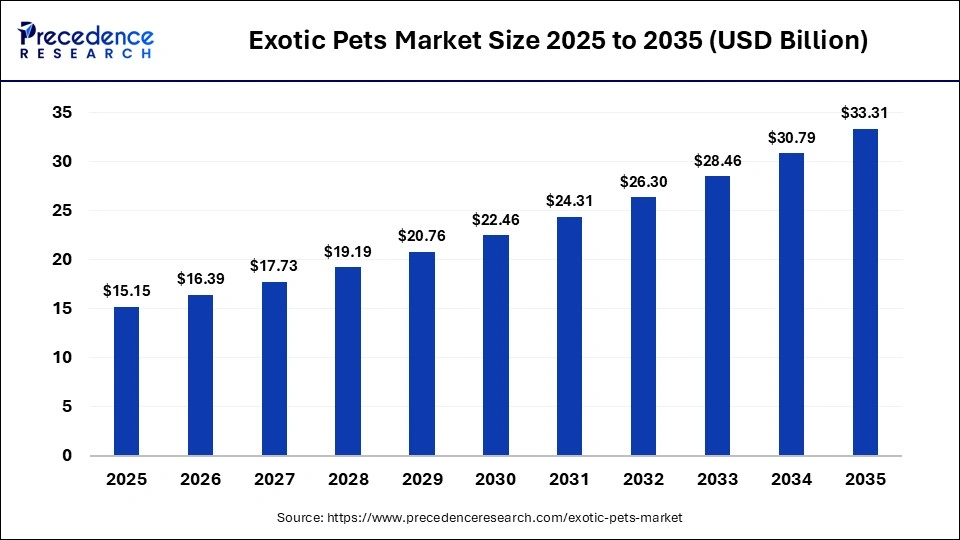
The expansion is being supported by pet humanization, urban lifestyles, growing awareness of species-specific care, improved access to veterinary services, and the increasing availability of specialized products through e-commerce.
Download a Sample Report: https://www.precedenceresearch.com/sample/7345
Compact Scope Table of Exotic Pets
| Report Coverage | Details |
|---|---|
| Sector Size in 2025 | USD 15.15 Billion |
| Sector Size in 2026 | USD 16.39 Billion |
| Sector Size by 2035 | USD 33.31 Billion |
| Growth Rate from 2026 to 2035 | CAGR of 8.20% |
| Leading Region | North America |
| Fastest-Growing Region | Asia Pacific |
| Leading Pet Type | Reptiles & Amphibians |
| Fastest-Growing Pet Type | Small Mammals |
| Leading Product & Service Type | Pet Food & Nutrition Products |
| Fastest-Growing Product & Service Type | Healthcare & Veterinary Services |
| Leading End User | Individual/Households |
| Fastest-Growing End User | Pet Adoption & Rescue Centers |
| Base Year | 2025 |
| Forecast Period | 2026–2035 |
What Are Exotic Pets
Exotic pets are non-traditional companion animals that are kept primarily for companionship, personal interest, or hobby purposes.
They can include reptiles, amphibians, birds, small mammals, aquatic species, and other specialty animals.
Unlike conventional household pets, many exotic species have highly specific requirements involving nutrition, temperature, habitat design, lighting, handling, and veterinary care.
This creates an ecosystem of specialized products and services.
The sector therefore extends beyond animal ownership to include species-specific food, enclosures, equipment, veterinary services, grooming products, behavioral support, adoption services, and educational resources.
Why Exotic Pets Are Becoming More Popular
One of the strongest drivers is the growing desire for unique companionship.
Some consumers are attracted to animals with distinctive appearances, behaviors, and care requirements. Reptiles, birds, amphibians, and small mammals can provide an alternative to conventional pet ownership.
Urbanization is another important factor.
Certain exotic species require relatively limited space and can be suitable for apartment environments. Their quiet nature and different daily-care patterns can also appeal to consumers with busy lifestyles.
Younger consumers are increasingly discovering exotic animals through social media, online communities, educational content, and specialty pet platforms.
At the same time, greater awareness of responsible ownership is encouraging demand for species-specific food, habitat equipment, and veterinary services.
Pet Humanization Is Expanding Spending on Care
Pet humanization is increasingly influencing exotic pet ownership.
Owners are treating companion animals as members of the family and are becoming more willing to spend on premium nutrition, specialized habitats, preventive healthcare, and professional veterinary services.
This shift is particularly important for exotic species because appropriate care can require specialized products that differ significantly from those used for conventional pets.
Owners may invest in temperature-control systems, lighting, habitat equipment, species-specific nutritional products, supplements, and regular health assessments.
The result is a broader and more specialized spending ecosystem.
AI Is Transforming Exotic Pet Care
Artificial intelligence is creating new opportunities for animal health and responsible pet ownership.
AI-enabled cameras and wearable devices can track activity, movement, feeding behavior, and other indicators that may help owners recognize changes in normal behavior.
This can be particularly valuable for exotic species because early signs of illness or stress may be subtle and difficult for inexperienced owners to recognize.
In veterinary settings, AI can assist professionals by analyzing medical images, laboratory information, and patient histories.
Algorithms can help identify abnormalities such as tumors, fractures, or other conditions and support veterinarians in making more informed assessments.
Smart monitoring systems can also create digital health records that help owners and veterinarians track an animal’s condition over time.
Beyond healthcare, artificial intelligence can support responsible ownership by improving education, care recommendations, habitat monitoring, and species-specific information.
Key Trends Shaping Exotic Pet Ownership
Reptiles and Amphibians Remain Highly Popular
Reptiles and amphibians accounted for approximately 28% of the pet type segment in 2025.
Their popularity is supported by their relatively quiet nature, suitability for certain urban environments, distinctive appearance, and growing availability of specialized care products.
Species such as lizards, snakes, turtles, tortoises, frogs, and salamanders attract consumers who prefer less conventional companion animals.
Online content is also making it easier for potential owners to learn about species-specific habitats and care requirements.
Small Mammals Are Growing Rapidly
Small mammals are expected to record the fastest growth among pet types.
Animals such as hedgehogs, ferrets, sugar gliders, and specialty rabbit breeds can appeal to consumers looking for compact companions.
Urbanization and smaller living spaces are supporting interest in animals that can be housed in relatively limited areas.
Growing availability of specialized food and habitat products through e-commerce is also making ownership more accessible.
Species-Specific Nutrition Is Becoming More Important
Exotic animals often have highly specialized dietary needs.
As owners become more informed, demand is increasing for species-specific food, nutritional supplements, vitamins, and feeding products.
Online veterinary resources and specialized pet communities are making nutritional information more accessible.
This is helping shift ownership toward more informed and preventive care practices.
Veterinary Services Are Becoming More Specialized
Veterinary care is one of the fastest-growing areas of the ecosystem.
Traditional veterinary clinics may not have sufficient expertise to treat every exotic species, creating demand for veterinarians and facilities with specialized training.
The expansion of exotic-animal veterinary services is reducing a major barrier to ownership by giving consumers greater confidence that appropriate medical support is available.
Reptiles and Amphibians Lead Pet Types
Reptiles and amphibians represented approximately 28% of the pet type segment in 2025.
Their leading position is supported by their distinctive appeal and suitability for certain urban lifestyles.
Many reptiles can live in controlled indoor habitats and do not require the same level of daily interaction as dogs.
Their specialized care requirements are also generating demand for enclosures, heating systems, lighting equipment, specialized diets, substrate materials, and veterinary services.
Small Mammals Offer Strong Growth Potential
Small mammals are expected to grow at the fastest rate.
Their compact size makes them attractive to consumers living in apartments or smaller homes.
They can also appeal to families and first-time owners seeking alternatives to larger pets.
The expansion of online specialty retailers is improving access to species-specific food, habitats, supplies, and educational resources.
Pet Food and Nutrition Products Dominate Spending
Pet food and nutrition products accounted for approximately 34% of the product and service segment in 2025.
Exotic species frequently require diets that are significantly different from those of conventional household pets.
Birds, reptiles, amphibians, and small mammals may require carefully balanced combinations of proteins, vitamins, minerals, insects, vegetables, fruits, seeds, or other species-specific foods.
The growing emphasis on preventive care is encouraging owners to purchase higher-quality nutrition products.
Subscription services and online ordering are also making recurring purchases more convenient.
Healthcare and Veterinary Services Are Growing Fastest
Healthcare and veterinary services are expected to record the fastest growth.
Greater awareness of exotic animal health and the growing number of specialized veterinary practices are encouraging owners to seek preventive checkups and professional treatment.
AI-assisted diagnostics, digital health monitoring, and wearable technologies can further improve access to specialized care.
Veterinary practices are also developing greater expertise in reptiles and other non-traditional species.
Individual Households Remain the Largest End User
Individual and household owners accounted for approximately 81% in 2025.
The dominant position reflects the fact that exotic pets are primarily kept as personal companions.
Pet humanization is encouraging owners to spend more on nutrition, veterinary care, habitat equipment, and enrichment.
Many exotic species are also perceived as suitable for urban consumers because they can require less space or different levels of daily attention compared with traditional pets.
Adoption and Rescue Centers Are Expanding
Pet adoption and rescue centers are expected to grow at a strong pace.
Increasing awareness of animal welfare is creating greater interest in responsible rehoming and adoption.
Specialized rescue organizations can also provide expertise for animals that require complex habitats or experienced ownership.
Online adoption platforms and virtual events are improving access to available animals and educational information.
North America Remains the Leading Region
North America accounted for approximately 36% of the global sector in 2025.
The region benefits from high disposable incomes, strong pet-ownership culture, specialized veterinary infrastructure, extensive product availability, and widespread e-commerce adoption.
The presence of specialized exotic-animal veterinarians and veterinary hospitals is particularly important.
Consumers can also access a wide range of species-specific food, enclosures, lighting, healthcare products, and educational resources through online channels.
Social media is further influencing ownership by increasing awareness of exotic species and specialized care practices.
The U.S. Is a Major Contributor
The U.S. exotic pets sector was valued at approximately USD 4.09 billion in 2025 and is projected to reach nearly USD 9.18 billion by 2035, expanding at a CAGR of 8.42% from 2026 to 2035.
The country has a large pet-owner population and a developed ecosystem of animal healthcare, specialty products, online retailers, and veterinary services.
The regulatory landscape for exotic species varies significantly by state and local jurisdiction.
Federal frameworks such as the Lacey Act and Animal Welfare Act interact with state-level rules governing ownership, transportation, and trade.
This makes legal compliance and responsible sourcing particularly important for owners, breeders, retailers, and service providers.
Asia Pacific Is Growing Fastest
Asia Pacific is expected to record the fastest growth between 2026 and 2035.
Rising disposable incomes, rapid urbanization, expanding middle-class populations, and growing interest in pet ownership are strengthening demand.
Consumers are increasingly viewing companion animals as part of the household, encouraging higher spending on nutrition, habitats, healthcare, and enrichment.
The expansion of e-commerce is also making specialized products more accessible.
Countries such as China, India, Japan, and South Korea are becoming increasingly important contributors.
India Is an Emerging Growth Center
India’s exotic pet ecosystem is developing alongside rising urbanization and disposable income.
Consumers in major cities are increasingly interested in distinctive companion animals and specialized pet products.
However, ownership and trade of exotic species are subject to important wildlife and conservation requirements.
India is a party to CITES, and its wildlife regulations impose restrictions and compliance requirements involving protected species and wildlife trade.
The increasing emphasis on registration and responsible ownership is likely to encourage greater transparency within the sector.
Europe Is Strengthening Specialized Pet Care
Europe is expected to experience steady growth as consumers develop greater interest in non-traditional companion animals.
The region benefits from established veterinary infrastructure, growing availability of specialist care, and increasing consumer awareness of responsible pet ownership.
Online retailers are also expanding access to specialized food, habitats, equipment, and healthcare products.
Germany Offers a Strong Specialized Care Ecosystem
Germany is an important European contributor.
The country has developed veterinary and pet-care capabilities that support specialist animal services.
Demand for smart habitats, connected monitoring products, and species-specific nutrition is also increasing as owners become more knowledgeable about exotic pet requirements.
Latin America Is Expanding
Latin America is expected to record continued growth as urbanization and disposable income increase.
Brazil is an important contributor, supported by its large consumer base and expanding pet-care ecosystem.
Affordable and compact products can be particularly attractive in urban areas.
The development of specialized veterinary services is also improving access to healthcare for non-traditional companion animals.
Middle East and Africa Offer New Opportunities
The Middle East and Africa region is expected to expand as rising incomes, urbanization, and growing interest in companion animals support demand.
South Africa and the UAE are important contributors.
The availability of specialist veterinary care and premium pet products is helping strengthen the ecosystem.
Growing awareness of animal welfare and responsible ownership is also likely to influence future development.
The Exotic Pet Value Chain
The exotic pet value chain extends from animal breeding and responsible sourcing to nutrition, habitat equipment, veterinary care, adoption, and digital services.
Food and Nutrition
Specialized food manufacturers develop diets based on the nutritional requirements of particular species.
This segment includes prepared food, supplements, vitamins, feeds, and specialized treats.
Habitat and Equipment
Owners require enclosures, temperature-control equipment, lighting systems, filtration equipment, substrates, enrichment products, and other habitat accessories.
Technology is increasingly being integrated into these products through smart monitoring and automated environmental controls.
Veterinary Services
Specialized veterinarians provide preventive care, diagnostics, treatment, surgery, medication, and long-term health management.
Growing expertise in exotic species is reducing barriers to responsible ownership.
Retail and E-Commerce
Specialty retailers and online platforms provide access to food, equipment, healthcare products, habitats, and educational resources.
E-commerce is particularly important because many specialized products may not be readily available through conventional pet stores.
Major Companies in Exotic Pet Care
The competitive landscape includes specialized nutrition providers, veterinary companies, pet-care manufacturers, and habitat-equipment businesses.
Key participants include:
- Zoo Med Laboratories
- Oxbow Animal Health
- Mazuri (PMI Nutrition International)
- Versele Laga
- Vetafarm
- Kaytee (Central Garden & Pet)
- Arcadia Reptile
- The Birdcare Company
- Merck Animal Health
- Zoetis Inc.
Competition is increasingly focused on species-specific nutrition, specialized veterinary support, product quality, responsible ownership, digital services, and convenience.
AI and Smart Technology Are Creating New Opportunities
Connected pet-care products are becoming an important part of the ecosystem.
Smart cameras can monitor activity and behavior, while environmental sensors can track temperature, humidity, lighting, and other habitat conditions.
For species requiring tightly controlled environments, automated habitat monitoring can help owners maintain appropriate conditions.
Wearable technologies may also provide information about movement or activity patterns.
When combined with AI, these systems could help identify changes that indicate potential illness or stress and encourage earlier veterinary attention.
The long-term opportunity is to develop integrated digital platforms that combine health data, habitat information, nutrition, activity, and veterinary records.
Responsible Ownership Is Becoming More Important
The growth of exotic pet ownership also creates important responsibilities.
Not every species is suitable for private ownership, and legal requirements vary by country, state, and species.
Some exotic animals have highly specialized environmental and nutritional requirements that can be difficult to meet without adequate knowledge and resources.
Responsible sourcing, legal compliance, species-specific education, veterinary access, and appropriate habitat management are therefore essential.
Rescue and adoption organizations can also play an important role by supporting animals that can no longer be cared for by their previous owners.
Recent Industry Developments
In April 2025, Zoetis received U.S. FDA approval for a new label indication for Simparica Trio related to prevention of Dipylidium caninum infections in treated dogs by eliminating vector fleas.
In October 2025, Acasta Health launched MYPETFIT, an AI-powered pet health and wellness assessment platform in India designed to provide personalized preventive-care insights.
In January 2025, Revelation Pharma announced Revelation Animal Health, a dedicated animal-health division offering customized compounded medications for companion and exotic animals as well as animals in zoological and aquatic settings.
These developments demonstrate the broader evolution of animal healthcare toward personalized services, digital assessment, and specialized veterinary support.
Challenges Facing Exotic Pet Ownership
Despite strong growth potential, the sector faces several challenges.
Regulatory complexity is one of the most important issues because ownership, breeding, transportation, and trade requirements vary significantly by species and jurisdiction.
Animal welfare is another major consideration. Some exotic species require highly specialized environments and care that may not be readily available to inexperienced owners.
Access to specialized veterinary professionals can also be limited, especially outside major urban centers.
The environmental and conservation implications of wildlife collection and illegal trade make responsible sourcing particularly important.
Finally, misinformation can spread quickly through social media and online communities, increasing the importance of credible veterinary and species-specific education.
What Pet-Care Companies Should Watch
Pet-care businesses, veterinary providers, manufacturers, investors, and technology companies should closely monitor:
- Species-specific nutrition
- Exotic animal veterinary services
- AI-powered pet health monitoring
- Smart habitat systems
- Wearable animal health devices
- E-commerce for specialty products
- Pet adoption and rescue services
- Responsible exotic animal ownership
- Digital veterinary platforms
- Preventive animal healthcare
- Sustainable pet-care products
- Wildlife-trade compliance
The Road Ahead
The exotic pets sector is moving toward a more specialized, technology-enabled, welfare-focused, and digitally connected future.
Reptiles and amphibians will continue to represent an important portion of ownership, while small mammals are likely to attract increasing attention from urban consumers seeking compact companions.
Nutrition will remain a major recurring category, but veterinary services are expected to gain importance as owners become more willing to invest in preventive care and specialized treatment.
AI and connected technologies could further change ownership by making it easier to monitor behavior, habitat conditions, and potential health problems.
At the same time, responsible ownership will become increasingly important. Legal compliance, ethical sourcing, proper habitat management, specialist veterinary access, and animal welfare will remain central to sustainable development.
The biggest opportunity lies in creating an ecosystem where specialized nutrition, veterinary care, smart technology, responsible ownership, and convenient digital services work together.
As consumer interest in distinctive companionship continues to expand, the exotic pet ecosystem is positioned for continued growth through 2035.
Buy this report: https://www.precedenceresearch.com/checkout/7345
About Us
Healthcare Prism is a dedicated healthcare insights and outreach platform, operating as an extension of Precedence Research. We share relevant perspectives, industry developments, emerging trends, and research-driven insights across the global healthcare sector. Our content is built on the knowledge, research standards, and expertise of Precedence Research, with a focus on making healthcare information clear, accessible, and useful for industry professionals, businesses, researchers, and healthcare stakeholders. Healthcare Prism serves as a focused platform to extend the reach of Precedence Research’s healthcare insights and connect them with a broader professional audience.
You can place an order or ask any questions, please feel free to contact us at [email protected]
Quick Contact:
Europe Region: +44 778 256 0738
North America Region: +1 8044 4193 44
APAC Region: +91 9356 9282 04 and +65 31065601
Visit Our Website: Precedence Research – Advisory, Research & Reports