
The global inhaler solution sector is expanding as respiratory diseases become more prevalent and healthcare providers increasingly adopt convenient drug-delivery technologies. Inhalation therapies play an important role in managing asthma, chronic obstructive pulmonary disease, cystic fibrosis, and other respiratory conditions.
The global inhaler solution sector was valued at USD 28.03 billion in 2025 and is projected to increase from USD 30.21 billion in 2026 to approximately USD 59.40 billion by 2035, expanding at a CAGR of 7.80% from 2026 to 2035.
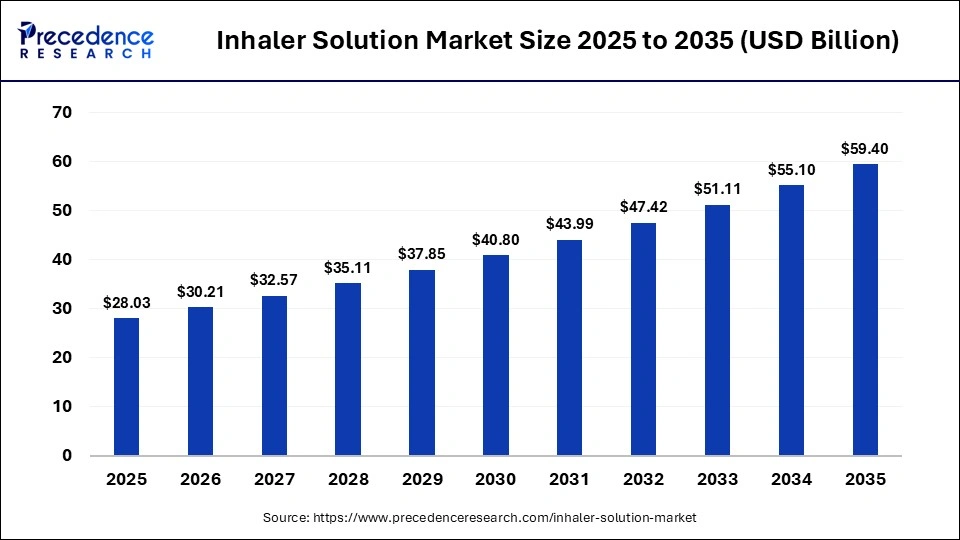
Growth is being supported by increasing demand for pressurized metered-dose inhalers, rising respiratory disease prevalence, expanding pharmaceutical manufacturing, greater availability of inhalers through digital channels, and advancements in smart and connected inhalation technologies.
Download a Sample Report: https://www.precedenceresearch.com/sample/7349
Compact Scope Table of Inhaler Solution
| Report Coverage | Details |
|---|---|
| Sector Size in 2025 | USD 28.03 Billion |
| Sector Size in 2026 | USD 30.21 Billion |
| Sector Size by 2035 | USD 59.40 Billion |
| Growth Rate from 2026 to 2035 | CAGR of 7.80% |
| Leading Region | North America |
| Fastest-Growing Region | Asia Pacific |
| Leading Product Type | Bronchodilators |
| Fastest-Growing Product Type | Combination Therapies |
| Leading Route | Metered-Dose Inhaler Solutions |
| Fastest-Growing Route | Nebulizer Solutions |
| Leading Patient Type | Adult Population |
| Fastest-Growing Patient Type | Pediatric Population |
| Leading Disease Indication | Asthma |
| Fastest-Growing Disease Indication | COPD |
| Leading Distribution Channel | Hospital Pharmacies |
| Fastest-Growing Distribution Channel | Online Pharmacies & E-Commerce |
| Leading End User | Hospitals & Clinics |
| Fastest-Growing End User | Homecare Settings |
| Base Year | 2025 |
| Forecast Period | 2026–2035 |
What Are Inhaler Solutions
Inhaler solutions are pharmaceutical and drug-delivery products designed to deliver medication directly into the respiratory system.
Common formats include:
- Metered-dose inhalers
- Dry powder inhalers
- Soft mist inhalers
- Nebulizer solutions
- Combination inhalation therapies
These technologies are used to deliver bronchodilators, corticosteroids, combination therapies, and other respiratory medicines.
Direct delivery to the lungs can provide rapid therapeutic effects while allowing treatment to be administered in hospitals, clinics, pharmacies, and homecare settings.
The increasing adoption of inhalation therapy is closely connected with the rising prevalence of respiratory diseases and the growing preference for convenient and patient-friendly drug delivery.
Why Inhaler Solution Growth Is Accelerating
Asthma and COPD remain two of the most important contributors to demand for inhalation therapies.
The increasing prevalence of chronic respiratory diseases is generating long-term demand for both rescue and maintenance treatments.
Cystic fibrosis is another important contributor, particularly in regions where diagnosis and access to specialized respiratory care are improving.
Healthcare providers are also increasingly focused on treatment adherence and convenient drug delivery.
Inhalers can allow patients to manage chronic respiratory conditions outside hospital environments, supporting the wider shift toward home-based healthcare.
Growing investment in pharmaceutical manufacturing is further strengthening the supply of inhalation products.
At the same time, e-commerce and online pharmacy platforms are making a wider range of respiratory therapies accessible to consumers.
AI Is Transforming Inhaler Technology
Artificial intelligence is creating new opportunities for smarter inhalation therapy.
AI-enabled inhalers can potentially provide personalized treatment recommendations, track medication use, monitor adherence, and identify changes in respiratory patterns.
Connected devices can collect information about inhaler usage and transmit it to mobile applications or healthcare platforms.
AI algorithms can then analyze these data to identify patterns associated with missed doses, worsening symptoms, or increased risk of exacerbation.
For healthcare professionals, this can provide additional information between clinical visits.
AI is also being applied to manufacturing processes, where automation and predictive analytics can improve production efficiency and reduce dependence on manual processes.
The combination of connected inhalers, mobile applications, wearable devices, and AI is therefore creating a more data-driven approach to respiratory care.
In January 2025, Cipla introduced CipAir, an AI-based mobile application designed to simplify asthma management in India, highlighting the growing connection between digital technology and respiratory care.
Key Trends Shaping Inhaler Solutions
Growing Demand for Combination Therapies
Combination therapies are expected to record strong growth through 2035.
These treatments can combine different mechanisms, such as a bronchodilator and corticosteroid, within a single therapeutic approach.
Combination inhalers can simplify treatment regimens and may improve convenience for patients who require multiple respiratory medicines.
Pharmaceutical companies are therefore investing in new formulations and delivery technologies that can provide effective combination therapy.
Smart and Connected Inhalers Are Emerging
Connected inhalers can provide information about medication use and treatment patterns.
Some systems can record inhalation timing, frequency, and other usage information.
When integrated with mobile applications, these technologies can provide reminders and feedback that support adherence.
The longer-term opportunity lies in combining inhaler data with clinical records, wearable information, and AI-driven analytics.
Nebulizer Solutions Are Expanding
Nebulizer solutions are expected to grow at the fastest pace among the major administration routes.
Nebulizers convert liquid medication into an aerosol that can be inhaled through a mask or mouthpiece.
They can be particularly useful for certain patients who have difficulty using conventional inhalers.
The growing prevalence of COPD, cystic fibrosis, and other chronic respiratory conditions is supporting demand for nebulized treatments.
Online Distribution Is Becoming More Important
Hospital pharmacies remain the leading distribution channel, but online pharmacies and e-commerce are expected to expand rapidly.
Digital ordering can improve convenience and provide access to a broader range of respiratory products.
Online channels can also support prescription refill reminders, home delivery, and recurring medication services.
Bronchodilators Lead Product Demand
Bronchodilators accounted for approximately 36% of the product segment in 2025.
These medicines are widely used in asthma and COPD management because they help relax airway muscles and improve airflow.
Both short-acting and long-acting bronchodilators remain important components of respiratory treatment.
The high prevalence of chronic respiratory conditions and increasing diagnosis rates are sustaining demand.
Combination Therapies Offer Strong Growth
Combination therapies are expected to record remarkable growth during the forecast period.
They can combine complementary mechanisms within a single treatment, potentially simplifying treatment schedules.
Increasing pharmaceutical R&D investment and the need for more effective respiratory management are supporting this segment.
Metered-Dose Inhalers Continue to Lead
Metered-dose inhaler solutions accounted for approximately 42% of the administration route segment in 2025.
MDIs remain popular because they are portable, relatively easy to distribute, and capable of delivering consistent medication doses.
They are widely used for asthma and COPD and can support both acute symptom relief and long-term disease management.
Advances in formulation and inhaler-device design are also improving dose consistency and usability.
Nebulizers Are Growing Quickly
Nebulizer solutions are expected to record the fastest growth through 2035.
The technology can be useful for patients who have difficulty coordinating inhalation with conventional inhaler actuation.
Increasing respiratory disease burden and continued investment in nebulizer technologies are supporting expansion.
Adults Represent the Largest Patient Group
The adult population accounted for approximately 58% in 2025.
Adults represent a large portion of patients requiring long-term treatment for asthma, COPD, and other chronic respiratory conditions.
Pharmaceutical companies continue to develop therapies designed to improve efficacy, convenience, adherence, and usability for adult patients.
Pediatric Inhalation Care Is Expanding
The pediatric population is expected to grow at a considerable pace.
Respiratory illnesses among children create demand for treatments that are easy to administer and suitable for younger patients.
Advances in pediatric-friendly inhalation devices, nebulizers, masks, and formulations are supporting improved treatment accessibility.
Growing investment in pediatric healthcare infrastructure is also contributing to demand.
Asthma Remains the Leading Disease Indication
Asthma accounted for approximately 39% of disease-indication demand.
The prevalence of asthma across multiple countries continues to support strong utilization of rescue and maintenance inhalers.
Research into improved asthma management is also encouraging innovation in combination therapies, smart inhalers, and digital support tools.
COPD Is the Fastest-Growing Indication
COPD is expected to expand at the fastest pace during the forecast period.
The increasing burden of COPD, particularly among aging populations, is creating sustained demand for bronchodilators, combination therapies, nebulizers, and other inhaled treatments.
Growth in Asia Pacific is particularly important as respiratory disease prevalence and healthcare access increase.
Hospital Pharmacies Remain the Leading Channel
Hospital pharmacies accounted for approximately 47% of distribution in 2025.
Hospitals remain important points of care for patients receiving diagnosis, treatment, and medication management for respiratory conditions.
Hospital pharmacies can provide prescribed inhalers under professional guidance while supporting medication counseling and treatment continuity.
Online Pharmacies Are Growing Rapidly
Online pharmacies and e-commerce are expected to record the fastest distribution growth.
Consumers increasingly value the convenience of digital ordering and home delivery.
Online channels can also make recurring purchases more efficient for patients receiving long-term respiratory treatment.
Hospitals and Clinics Lead End Use
Hospitals and clinics accounted for approximately 51% of end use in 2025.
These facilities manage large volumes of patients with asthma, COPD, cystic fibrosis, and other respiratory disorders.
Healthcare professionals can evaluate symptoms, prescribe appropriate therapies, demonstrate inhaler technique, and monitor treatment response.
Homecare Is Becoming More Important
Homecare settings are expected to record the fastest growth.
Chronic respiratory conditions often require long-term management, making home-based treatment increasingly valuable.
Smart inhalers, portable nebulizers, digital monitoring systems, and virtual healthcare services are improving the ability of patients to manage respiratory conditions outside traditional clinical settings.
North America Remains the Largest Region
North America accounted for approximately 38% of the global sector in 2025.
The region benefits from advanced healthcare infrastructure, high healthcare expenditure, established pharmaceutical companies, strong respiratory disease awareness, and widespread access to inhalation therapies.
The North America inhaler solution sector was valued at approximately USD 10.65 billion in 2025 and is projected to reach around USD 22.87 billion by 2035, expanding at a CAGR of 7.94% from 2026 to 2035.
The United States represents the largest contributor within the region.
The U.S. Is a Major Contributor
The U.S. inhaler solution sector was valued at approximately USD 7.99 billion in 2025 and is projected to reach nearly USD 17.27 billion by 2035, expanding at a CAGR of 8.01% from 2026 to 2035.
The country’s strong pharmaceutical and biotechnology ecosystem supports continued investment in respiratory drug development.
Demand is also supported by asthma, COPD, and other chronic respiratory conditions.
Innovation is increasingly focused on improved dose accuracy, formulation performance, smart-device integration, adherence monitoring, and patient convenience.
Asia Pacific Is Growing Fastest
Asia Pacific is projected to record the fastest growth from 2026 to 2035, with a reported 8.02% CAGR for the regional outlook.
Rising respiratory disease prevalence, growing healthcare expenditure, expanding pharmaceutical manufacturing, and increasing access to modern treatments are supporting development.
The region’s large and aging population also creates substantial long-term demand.
India, China, Japan, and South Korea are among the important contributors.
India Is Strengthening Inhaler Manufacturing
India is becoming an increasingly important center for pharmaceutical manufacturing.
Expansion of domestic production capabilities can improve access to inhaler therapies while supporting broader pharmaceutical development.
The increasing burden of asthma and COPD, combined with a growing healthcare system, is strengthening demand.
In August 2025, Iberia Pharmaceuticals announced plans for a new production center in Jhajjar, Haryana, with inhaler products included among the planned pharmaceutical offerings.
China Is Expanding Respiratory Care
China’s respiratory healthcare ecosystem is developing alongside increasing pharmaceutical investment and manufacturing capacity.
Domestic production of metered-dose and dry-powder inhalation therapies is expanding.
Hospital pharmacies and organized retail channels are also improving access to respiratory treatments.
Regulatory improvements and advances in formulation and delivery technologies are creating additional opportunities for local manufacturers.
Europe Continues to Develop Advanced Inhalation Therapies
Europe remains an important region for respiratory care and pharmaceutical innovation.
Countries such as Germany, France, the UK, and Italy benefit from established healthcare infrastructure and strong pharmaceutical research capabilities.
Interest in dry-powder inhalers, soft-mist inhalers, combination therapies, and environmentally improved inhaler technologies is increasing.
The region’s healthcare systems also emphasize patient adherence and effective long-term disease management.
Germany Supports Respiratory Technology Development
Germany combines advanced healthcare infrastructure with a strong pharmaceutical and medical technology ecosystem.
The country’s healthcare providers are adopting modern inhalation technologies while pharmaceutical companies continue investing in new formulations and delivery systems.
The Inhaler Solution Value Chain
The inhaler solution value chain extends from pharmaceutical research and formulation development through device manufacturing, regulatory approval, distribution, and patient use.
Drug and Formulation Development
Pharmaceutical companies develop active ingredients, formulations, and delivery systems designed to achieve consistent respiratory drug deposition.
Research focuses on improving efficacy, stability, dose consistency, and patient usability.
Device Manufacturing
Manufacturers produce inhaler devices, cartridges, propellant systems, metering components, valves, and related technologies.
Advanced manufacturing processes are increasingly incorporating automation and digital quality control.
Regulatory and Quality Management
Inhalation products must meet stringent requirements related to pharmaceutical quality, dose consistency, device performance, manufacturing, and patient safety.
Regulatory compliance is a critical component of commercialization.
Distribution and Patient Support
Products reach patients through hospital pharmacies, retail pharmacies, online pharmacies, specialty providers, and healthcare institutions.
Patient education around correct inhaler technique is also important because device effectiveness depends partly on appropriate use.
Major Companies in Inhaler Solutions
The competitive landscape includes global pharmaceutical companies, respiratory specialists, drug-delivery technology companies, and inhaler-device manufacturers.
Key participants include:
- Boehringer Ingelheim
- GSK
- AstraZeneca
- Novartis
- Chiesi Farmaceutici
- Vectura Group
- Kindeva Drug Delivery
- Mundipharma
- Orion Corporation
- Aptar Pharma
Competition is increasingly focused on drug efficacy, combination formulations, inhaler usability, device engineering, digital connectivity, dose consistency, sustainability, and patient adherence.
Recent Industry Developments
In December 2025, Cipla launched Afrezza, an orally inhaled rapid-acting insulin product, in India after approval by the country’s regulatory authority.
In December 2025, Amneal Pharmaceuticals received U.S. FDA approval for Albuterol Sulfate Inhalation Aerosol, expanding the availability of an inhaled respiratory treatment.
In May 2025, Ritedose Pharmaceuticals announced FDA approval for its Albuterol Sulfate Inhalation Solution, intended for the treatment of bronchospasm.
These developments demonstrate continued pharmaceutical investment in inhaled therapies and respiratory drug delivery.
Challenges Facing Inhaler Solutions
Despite strong growth potential, several challenges remain.
Correct inhaler technique can be difficult for some patients, particularly children, older adults, and individuals with limited dexterity or coordination.
Adherence is another challenge. Patients may forget doses or stop treatment when symptoms improve.
The cost of advanced inhalers and smart-device technologies can also limit access in some healthcare systems.
Environmental considerations are becoming increasingly important, particularly for propellant-based inhalers.
Pharmaceutical companies are therefore investing in lower-emission propellants, improved device designs, recyclable materials, and more sustainable manufacturing processes.
Regulatory requirements can also increase development costs and commercialization timelines.
What Healthcare Companies Should Watch
Pharmaceutical companies, medical device manufacturers, investors, healthcare providers, and digital health businesses should closely monitor:
- Smart inhalers
- AI-enabled respiratory care
- Combination therapies
- Metered-dose inhalers
- Dry-powder inhalers
- Nebulizer solutions
- COPD therapies
- Asthma management
- Pediatric inhalation systems
- Homecare respiratory technologies
- Online pharmacy distribution
- Patient adherence platforms
- Sustainable inhaler technologies
The Road Ahead
The inhaler solution sector is moving toward a more connected, personalized, convenient, and sustainable future.
Bronchodilators and metered-dose inhalers will remain important because of their broad clinical use and established delivery infrastructure.
At the same time, combination therapies, nebulizer solutions, smart inhalers, and digital respiratory platforms are creating new opportunities.
AI will become increasingly valuable in monitoring adherence, predicting respiratory deterioration, analyzing treatment patterns, and supporting personalized care.
Homecare will also play a larger role as healthcare systems seek to manage chronic respiratory diseases outside hospitals.
The biggest opportunity lies in combining effective respiratory medicines with advanced delivery devices, AI, digital monitoring, and patient-centered support.
As respiratory disease prevalence increases and pharmaceutical technologies continue to evolve, inhaler solutions will remain a critical component of long-term respiratory care through 2035.
Buy this report: https://www.precedenceresearch.com/checkout/7349
About Us
Healthcare Prism is a dedicated healthcare insights and outreach platform, operating as an extension of Precedence Research. We share relevant perspectives, industry developments, emerging trends, and research-driven insights across the global healthcare sector. Our content is built on the knowledge, research standards, and expertise of Precedence Research, with a focus on making healthcare information clear, accessible, and useful for industry professionals, businesses, researchers, and healthcare stakeholders. Healthcare Prism serves as a focused platform to extend the reach of Precedence Research’s healthcare insights and connect them with a broader professional audience.
You can place an order or ask any questions, please feel free to contact us at [email protected]
Quick Contact:
Europe Region: +44 778 256 0738
North America Region: +1 8044 4193 44
APAC Region: +91 9356 9282 04 and +65 31065601
Visit Our Website: Precedence Research – Advisory, Research & Reports