
The global electrophysiology ablation sector is expanding rapidly as healthcare providers increasingly adopt minimally invasive approaches for the treatment of cardiac arrhythmias. Advances in catheter technologies, three-dimensional cardiac mapping, artificial intelligence, and newer energy sources are improving procedural precision and creating new opportunities for electrophysiology care.
The global electrophysiology ablation sector was valued at USD 7.17 billion in 2025 and is projected to increase from USD 8.01 billion in 2026 to approximately USD 21.86 billion by 2035, expanding at a CAGR of 11.80% from 2026 to 2035.
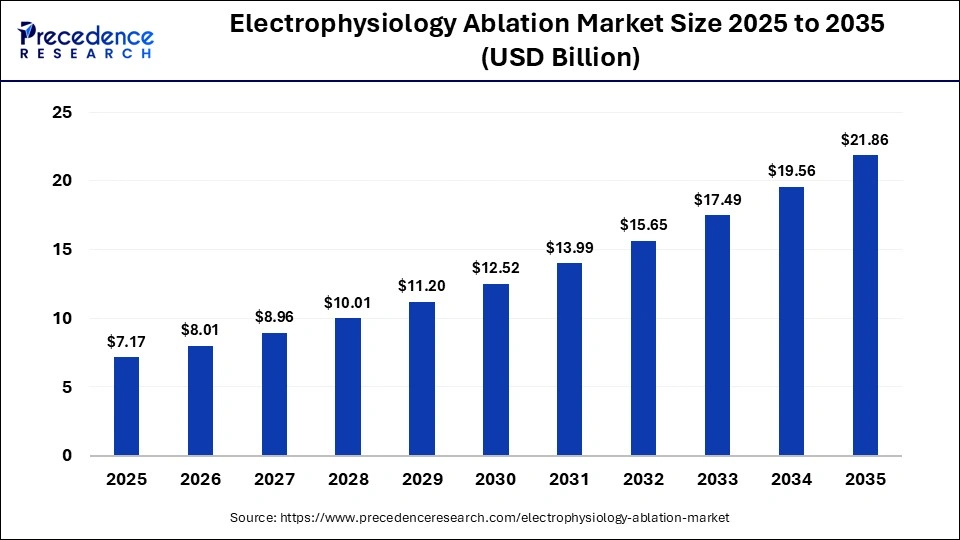
The expansion is being supported by the rising prevalence of atrial fibrillation and other arrhythmias, an aging population, increasing awareness of minimally invasive treatment, and continued investment in specialized electrophysiology laboratories.
Download a Sample Report: https://www.precedenceresearch.com/sample/7353
Compact Scope Table of Electrophysiology Ablation
| Report Coverage | Details |
|---|---|
| Sector Size in 2025 | USD 7.17 Billion |
| Sector Size in 2026 | USD 8.01 Billion |
| Sector Size by 2035 | USD 21.86 Billion |
| Growth Rate from 2026 to 2035 | CAGR of 11.80% |
| Leading Region | North America |
| Fastest-Growing Region | Asia Pacific |
| Leading Technology | Radiofrequency Ablation |
| Fastest-Growing Technology | Pulsed Field Ablation |
| Leading Indication | Atrial Fibrillation |
| Fastest-Growing Indication | Ventricular Tachycardia |
| Leading Product Type | Ablation Catheters |
| Fastest-Growing Product Type | Mapping & Navigation Systems |
| Leading End User | Hospitals & Cardiac Centers |
| Fastest-Growing End User | Ambulatory Surgical Centers |
| Base Year | 2025 |
| Forecast Period | 2026–2035 |
What Is Electrophysiology Ablation
Electrophysiology ablation is a minimally invasive procedure used to treat abnormal electrical signals in the heart.
During catheter-based ablation, a specialized catheter is guided into the heart to identify and treat tissue responsible for abnormal electrical activity.
Different energy technologies can be used to create controlled lesions that interrupt problematic electrical pathways.
Major technologies include:
- Radiofrequency ablation
- Cryoablation
- Pulsed field ablation
- Laser and other ablation technologies
These procedures are commonly used for atrial fibrillation, atrial flutter, supraventricular tachycardia, ventricular tachycardia, and other cardiac rhythm disorders.
The growing preference for catheter-based treatment is reducing reliance on long-term medication alone for selected patients and creating sustained demand for advanced electrophysiology technologies.
Why Electrophysiology Ablation Is Growing
Cardiac arrhythmias are becoming an increasingly important healthcare concern as populations age and risk factors such as hypertension, obesity, diabetes, and cardiovascular disease become more prevalent.
Atrial fibrillation is particularly important because it can increase the risk of stroke, heart failure, and reduced quality of life.
For appropriate patients, catheter ablation can offer a minimally invasive treatment approach that targets the underlying electrical source of an arrhythmia.
Growing awareness among physicians and patients is therefore supporting greater adoption.
Healthcare systems are also expanding dedicated electrophysiology laboratories, investing in mapping systems, advanced catheters, imaging technologies, and specialized clinical staff.
AI Is Transforming Electrophysiology Ablation
Artificial intelligence is becoming increasingly important in cardiac ablation procedures.
AI-enabled three-dimensional mapping systems can analyze electrical signals and anatomical information to help clinicians identify arrhythmogenic tissue.
Machine learning algorithms can also analyze patient characteristics and procedural data to identify factors associated with treatment success or recurrence.
Another application is energy-delivery optimization.
Advanced systems can use real-time measurements and procedural information to help clinicians deliver energy more consistently while maintaining safety.
Predictive analytics can also support post-procedure monitoring by helping identify patients who may require closer follow-up.
The combination of AI, mapping, navigation, imaging, and catheter technologies is moving electrophysiology toward more personalized and data-driven treatment.
Key Trends Shaping Electrophysiology Ablation
Minimally Invasive Catheter Ablation Is Expanding
Catheter-based ablation is increasingly being considered for patients with symptomatic arrhythmias.
Compared with open surgical approaches, catheter procedures can offer shorter recovery times and less invasive access.
The growing experience of electrophysiologists and improvements in catheter design are further supporting adoption.
Three-Dimensional Mapping Is Becoming Essential
Advanced mapping and navigation systems allow clinicians to create detailed representations of cardiac anatomy and electrical activity.
These technologies can improve targeting accuracy and reduce dependence on conventional fluoroscopy in appropriate procedures.
Improved mapping can also support complex procedures involving multiple arrhythmogenic sites.
Pulsed Field Ablation Is Gaining Momentum
Pulsed field ablation is one of the most important emerging technologies in electrophysiology.
It uses short electrical pulses to selectively affect cardiac tissue and is designed to reduce unintended damage to surrounding structures compared with some thermal ablation approaches.
Potential benefits include procedural efficiency, improved tissue selectivity, and shorter treatment times.
Expanding clinical experience and continued technology development are supporting increasing adoption.
Earlier Treatment of Atrial Fibrillation Is Receiving Attention
The use of ablation earlier in the management of atrial fibrillation is becoming more important.
Earlier intervention can potentially help reduce the progression of arrhythmia burden in appropriate patients.
Improved mapping, catheter design, imaging, and energy delivery are making procedures increasingly precise.
Electrophysiology Laboratories Are Expanding
Hospitals and cardiac centers are investing in specialized electrophysiology laboratories.
Growing procedural volumes are supporting demand for sophisticated equipment, trained electrophysiologists, imaging systems, mapping technologies, and ablation catheters.
Expansion of outpatient cardiac care is also creating opportunities outside large tertiary hospitals.
Radiofrequency Ablation Remains the Leading Technology
Radiofrequency ablation accounted for approximately 48% of the technology segment in 2025.
RF ablation has a long history of clinical use and extensive supporting evidence.
Its predictable lesion formation and familiarity among electrophysiologists have helped establish it as a standard technology for several arrhythmia procedures.
RF systems can also be integrated with advanced three-dimensional mapping and navigation platforms, improving procedural control.
Pulsed Field Ablation Is Growing Fastest
Pulsed field ablation is expected to achieve strong growth through 2035.
Its ability to selectively target cardiac tissue is attracting interest among clinicians seeking effective alternatives to conventional thermal energy.
PFA can potentially simplify certain procedures and reduce the risk of unintended injury to adjacent structures.
As clinical evidence and regulatory experience expand, adoption is expected to increase.
Atrial Fibrillation Leads Indications
Atrial fibrillation accounted for approximately 56% of indications in 2025.
AF is one of the most common cardiac arrhythmias and becomes increasingly prevalent with age.
The potential complications associated with AF, including stroke and heart failure, make effective rhythm management important.
The availability of RF ablation, cryoablation, and newer PFA approaches is providing clinicians with multiple procedural options.
AI-powered mapping and advanced navigation systems are also improving treatment planning and execution.
Ventricular Tachycardia Represents a High-Growth Opportunity
Ventricular tachycardia is expected to grow at the fastest rate among the major indications.
VT can be particularly dangerous because it can lead to hemodynamic instability or sudden cardiac death.
Treatment is technically complex because clinicians may need to identify abnormal electrical circuits within damaged or scarred ventricular tissue.
Advanced mapping, imaging, navigation, and improved ablation catheters are therefore becoming increasingly important.
Ablation Catheters Lead Product Demand
Ablation catheters represented approximately 47% of the product segment in 2025.
Catheters are central to electrophysiology procedures because they provide the physical interface for mapping, navigation, energy delivery, and tissue treatment.
Continuous improvements include:
- Steerable catheter tips
- Contact-force sensing
- Irrigated catheter designs
- Improved lesion control
- Robotic navigation compatibility
- Integration with advanced mapping
These innovations are improving procedural precision while expanding the capabilities of electrophysiologists.
Mapping and Navigation Systems Are Growing Rapidly
Mapping and navigation systems are expected to record the fastest product growth.
These platforms provide detailed information about cardiac anatomy and electrical activity.
Three-dimensional visualization can help clinicians precisely identify abnormal pathways and reduce unnecessary energy application.
Advanced navigation systems can also reduce reliance on fluoroscopy in suitable procedures, supporting efforts to limit radiation exposure.
Hospitals and Cardiac Centers Remain the Leading End Users
Hospitals and cardiac centers accounted for approximately 63% of end use in 2025.
Complex ablation procedures require specialized infrastructure, trained electrophysiologists, anesthesia capabilities, patient monitoring, imaging, and emergency support.
Large hospitals can also accommodate patients with more complicated cardiovascular conditions.
Investment in dedicated electrophysiology laboratories continues to strengthen this segment.
Ambulatory Surgical Centers Offer Strong Growth Potential
Ambulatory surgical centers are expected to grow rapidly.
As healthcare systems shift appropriate procedures toward outpatient settings, ASCs can provide shorter stays, potentially lower treatment costs, and greater convenience.
Advances in catheter technology and procedural safety are making selected electrophysiology procedures increasingly suitable for outpatient environments.
North America Leads the Global Landscape
North America accounted for approximately 41% of the global sector in 2025.
The region benefits from advanced cardiovascular infrastructure, high healthcare expenditure, widespread access to electrophysiology laboratories, and strong adoption of minimally invasive cardiac procedures.
The North America electrophysiology ablation sector was valued at approximately USD 2.94 billion in 2025 and is projected to reach around USD 9.07 billion by 2035, expanding at a CAGR of 11.92% from 2026 to 2035.
The United States is the major contributor.
The U.S. Is a Major Center for Electrophysiology Innovation
The U.S. electrophysiology ablation sector was valued at approximately USD 2.20 billion in 2025 and is projected to reach nearly USD 6.85 billion by 2035, expanding at a CAGR of 12.03% from 2026 to 2035.
The country has a strong network of cardiac centers, specialized electrophysiologists, clinical research institutions, and medical technology companies.
RF ablation remains widely established, while PFA, advanced mapping, robotic navigation, and AI-assisted technologies are creating new opportunities.
Strong reimbursement infrastructure and ongoing clinical research are also supporting adoption.
Asia Pacific Is Growing Fastest
Asia Pacific is expected to record the fastest growth between 2026 and 2035.
The regional sector is projected to increase from approximately USD 1.58 billion in 2025 to around USD 4.92 billion by 2035, expanding at a reported CAGR of 12.03%.
Growth is being supported by increasing healthcare expenditure, expanding cardiac infrastructure, growing awareness of arrhythmia treatment, and rising adoption of minimally invasive procedures.
China, India, Japan, and Southeast Asian countries are investing in specialized electrophysiology laboratories and physician training.
China Is Expanding Cardiac Care
China is strengthening cardiovascular infrastructure and investing in modern electrophysiology facilities.
Hospitals are increasingly adopting RF and pulsed field technologies along with advanced three-dimensional mapping.
Clinical collaborations between international device manufacturers and Chinese healthcare institutions are supporting technology transfer, physician training, and clinical research.
Europe Continues to Strengthen Electrophysiology Services
Europe is expected to experience steady growth.
The region benefits from established healthcare systems, strong cardiac research capabilities, and increasing adoption of advanced ablation technologies.
Germany, France, the UK, Italy, and other European countries are investing in electrophysiology services and minimally invasive cardiovascular treatment.
Clinical guidelines and improvements in specialist care are also supporting continued adoption.
The Electrophysiology Ablation Value Chain
The value chain extends from device research and development through manufacturing, clinical deployment, and long-term patient follow-up.
Research and Development
Medical technology companies develop advanced catheters, mapping systems, energy sources, imaging technologies, and navigation platforms.
R&D increasingly focuses on improving precision, reducing procedure times, minimizing complications, and integrating AI.
Device Manufacturing
Manufacturers produce ablation catheters, sensors, mapping equipment, generators, navigation systems, and supporting accessories.
Quality management and regulatory compliance are critical because these devices are used during high-risk cardiac procedures.
Distribution and Healthcare Procurement
Devices reach hospitals, cardiac centers, clinics, and surgical facilities through direct manufacturer sales, distributors, and healthcare procurement networks.
Clinical Deployment and Patient Follow-Up
Electrophysiology teams use ablation systems to diagnose and treat arrhythmias.
Post-procedure monitoring and follow-up are increasingly supported by remote monitoring, digital health platforms, and predictive analytics.
Major Companies in Electrophysiology Ablation
The competitive landscape includes cardiovascular device manufacturers, specialized electrophysiology companies, imaging providers, and navigation technology developers.
Key participants include:
- Medtronic plc
- Abbott Laboratories
- Boston Scientific Corporation
- Biosense Webster, part of Johnson & Johnson
- Philips Healthcare
- Siemens Healthineers
- Biotronik SE & Co. KG
- MicroPort Scientific Corporation
- Acutus Medical, Inc.
- AtriCure, Inc.
- CardioFocus, Inc.
- Stereotaxis, Inc.
- CathRx Ltd.
- Imricor Medical Systems, Inc.
- Lepu Medical Technology Co., Ltd.
- Baylis Medical Company, Inc.
Competition is increasingly focused on energy technology, catheter design, mapping accuracy, navigation, AI integration, procedure time, safety, clinical evidence, and interoperability.
Recent Industry Developments
In May 2025, Abbott introduced the TactiFlex Sensor Enabled Ablation Catheter, incorporating contact-force technology to support more controlled cardiac ablation procedures.
In August 2023, Biosense Webster received regulatory clearance for advanced atrial fibrillation ablation products designed to support fluoroscopy-free procedures in appropriate settings, helping reduce radiation exposure.
In May 2023, Abbott received U.S. FDA approval for its TactiFlex Ablation Catheter, Sensor Enabled, an atrial fibrillation treatment device designed to improve procedural control and efficiency.
These developments demonstrate the industry’s continuing focus on catheter innovation, reduced radiation exposure, improved procedural precision, and safer minimally invasive cardiac treatment.
Challenges Facing Electrophysiology Ablation
Despite strong growth, electrophysiology ablation remains a technically demanding area of cardiac care.
Advanced mapping systems, navigation platforms, ablation catheters, and specialized laboratories require substantial capital investment.
The availability of trained electrophysiologists can also limit access, particularly in emerging regions.
Complex procedures involving ventricular arrhythmias may require significant clinical expertise and sophisticated infrastructure.
Regulatory requirements, clinical validation, reimbursement, and training requirements can also influence technology adoption.
As AI and connected systems become more important, cybersecurity and integration with hospital information systems will require greater attention.
What Healthcare Companies Should Watch
Medical device manufacturers, hospitals, cardiac centers, investors, and healthcare technology providers should closely monitor:
- Pulsed field ablation
- Radiofrequency ablation
- Advanced ablation catheters
- AI-powered 3D cardiac mapping
- Robotic catheter navigation
- Fluoroscopy-free procedures
- Atrial fibrillation ablation
- Ventricular tachycardia treatment
- Ambulatory electrophysiology procedures
- Remote cardiac monitoring
- Connected electrophysiology laboratories
- AI-assisted procedural planning
The Road Ahead
Electrophysiology ablation is moving toward a more precise, minimally invasive, intelligent, and patient-centered future.
Radiofrequency ablation will remain an important foundation because of its extensive clinical history and established use.
However, pulsed field ablation is emerging as a major technology opportunity, particularly as healthcare providers seek more selective and efficient approaches to treating atrial fibrillation and other arrhythmias.
Advanced mapping and navigation systems will become increasingly important as procedures become more complex and clinicians seek greater visualization of electrical activity.
AI will add another layer of intelligence by helping with patient selection, procedural planning, real-time mapping, energy optimization, and post-procedure risk assessment.
The expansion of ambulatory surgical centers could also bring selected ablation procedures closer to outpatient care.
The biggest opportunity lies in combining advanced energy sources, precise catheters, three-dimensional mapping, AI, imaging, and minimally invasive workflows.
As the global burden of cardiac arrhythmias increases and electrophysiology technologies continue to advance, ablation will remain an increasingly important component of modern cardiac care through 2035.
Buy this report: https://www.precedenceresearch.com/checkout/7353
About Us
Healthcare Prism is a dedicated healthcare insights and outreach platform, operating as an extension of Precedence Research. We share relevant perspectives, industry developments, emerging trends, and research-driven insights across the global healthcare sector. Our content is built on the knowledge, research standards, and expertise of Precedence Research, with a focus on making healthcare information clear, accessible, and useful for industry professionals, businesses, researchers, and healthcare stakeholders. Healthcare Prism serves as a focused platform to extend the reach of Precedence Research’s healthcare insights and connect them with a broader professional audience.
You can place an order or ask any questions, please feel free to contact us at [email protected]
Quick Contact:
Europe Region: +44 778 256 0738
North America Region: +1 8044 4193 44
APAC Region: +91 9356 9282 04 and +65 31065601
Visit Our Website: Precedence Research – Advisory, Research & Reports