
The global membrane chromatography sector is entering a powerful growth phase as pharmaceutical and biotechnology companies accelerate the production of biologics, vaccines, monoclonal antibodies, and advanced therapies. Valued at approximately USD 382.04 billion in 2025, the sector is projected to reach USD 435.91 billion in 2026 and approximately USD 1,428.78 billion by 2035, expanding at a CAGR of 14.10% from 2026 to 2035.
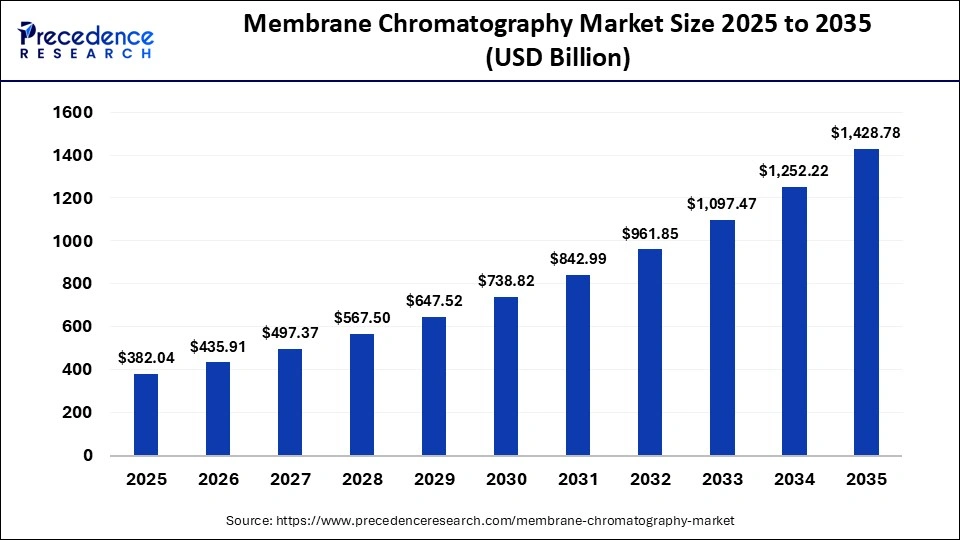
Growing demand for efficient downstream purification, single-use technologies, reduced buffer consumption, and scalable bioprocessing is creating significant opportunities for technology providers and biopharmaceutical manufacturers.
Download a Sample Report: https://www.precedenceresearch.com/sample/7725
Compact Scope Table
| Report Coverage | Details |
|---|---|
| 2025 Value | USD 382.04 Billion |
| 2026 Value | USD 435.91 Billion |
| 2035 Value | USD 1,428.78 Billion |
| CAGR 2026–2035 | 14.10% |
| Leading Region | North America |
| Fastest-Growing Region | Asia Pacific |
| Leading Product Type | Capsules, Cassettes & Cartridges |
| Fastest-Growing Product Type | Membrane Plates/Filters/Other |
| Leading Technique | Ion Exchange Membrane Chromatography |
| Fastest-Growing Technique | Affinity Membrane Chromatography |
| Leading Operation Mode | Single-Use/Consumables |
| Leading End User | Pharmaceutical & Biotechnology Companies |
| Fastest-Growing End User | Contract Research/CDMOs/CROs |
Biopharmaceutical Production Is Driving Demand
Membrane chromatography combines membrane filtration and chromatographic purification to separate and purify biomolecules efficiently. Compared with conventional column chromatography, the technology can provide higher flow rates, shorter processing times, and lower buffer consumption.
The growing production of monoclonal antibodies, vaccines, recombinant proteins, and viral vectors is increasing the need for scalable downstream purification technologies.
As biopharmaceutical pipelines become more complex, manufacturers are looking for processes that can improve productivity while maintaining product quality and reducing operational costs.
Single-Use Systems Are Reshaping Bioprocessing
Single-use and consumable systems accounted for approximately 65% share in 2025 and are expected to maintain strong growth at around 12.8% CAGR through 2035.
Disposable membrane capsules, cassettes, and cartridges can reduce cross-contamination risks, cleaning requirements, and validation activities. They also provide greater flexibility when manufacturers need to process different products or smaller production batches.
This is particularly important for personalized medicines, cell and gene therapies, and contract manufacturing facilities that require flexible production environments.
AI and Automation Are Improving Purification
Artificial intelligence, advanced sensors, and automated process controls are introducing new capabilities into membrane chromatography.
AI-driven systems can monitor operating conditions, detect membrane fouling, analyze process performance, and support predictive maintenance. Real-time monitoring can help manufacturers identify deviations earlier and optimize purification parameters.
Automation is also reducing manual intervention, improving process consistency, and supporting greater scalability across biopharmaceutical production facilities.
The combination of AI, sensors, automation, and single-use processing is helping move downstream purification toward more intelligent and data-driven operations.
Affinity Technology Is Creating a High-Growth Opportunity
Ion exchange membrane chromatography accounted for approximately 49% share in 2025, supported by its widespread use for protein purification, impurity removal, and polishing applications.
However, affinity membrane chromatography is expected to grow at the fastest pace as pharmaceutical companies seek highly selective purification technologies for complex biomolecules.
Affinity systems can selectively bind target proteins or antibodies, enabling efficient purification while reducing processing steps. This can be particularly valuable for high-value biologics where productivity and purity are critical.
CDMOs Are Expanding Their Role
Pharmaceutical and biotechnology companies represented approximately 58% share in 2025, making them the leading end-user group.
At the same time, contract research organizations, CDMOs, and CROs are expected to experience rapid growth, supported by increasing outsourcing of biopharmaceutical development and manufacturing.
CDMOs are investing in flexible downstream processing platforms to support multiple clients and a wider range of biologic products. Membrane chromatography provides an attractive option because it can deliver high throughput while requiring less infrastructure than some traditional purification approaches.
North America Leads While Asia Pacific Accelerates
North America accounted for approximately 43% of the global share in 2025, supported by a mature biopharmaceutical ecosystem, strong R&D investment, advanced manufacturing facilities, and high demand for biologics.
The North American sector is projected to increase from approximately USD 164.28 billion in 2025 to USD 621.52 billion by 2035, expanding at a 14.23% CAGR.
The U.S. remains the major contributor due to its large pharmaceutical and biotechnology base, extensive investment in advanced therapies, and strong adoption of single-use bioprocessing.
Asia Pacific is expected to record the fastest growth at approximately 14.4% CAGR, supported by expanding biopharmaceutical manufacturing, increasing vaccine and biosimilar production, and rising investment in healthcare infrastructure.
China is emerging as a particularly important contributor as domestic biotechnology companies expand production capacity and adopt scalable purification technologies.
Companies Are Advancing Purification Technology
Major companies including Sartorius, Merck KGaA, Danaher, Thermo Fisher Scientific, 3M, GE HealthCare, Parker Hannifin, Repligen, Bio-Rad Laboratories, Pall Corporation, Purilogics, Porex, and Membrane Solutions are contributing to the development of advanced membrane-based purification technologies.
Competition is increasingly focused on single-use processing, membrane performance, scalability, automation, purity, processing speed, and lower operating costs.
Recent industry activity also demonstrates continued innovation in downstream bioprocessing. In April 2025, BioProcess360 Partners announced the formation of ChromaGenix, focused on advancing downstream purification technologies for emerging biotherapeutics.
The Road Ahead
The future of membrane chromatography will increasingly be shaped by single-use technologies, advanced membrane materials, AI-enabled process monitoring, automation, affinity purification, and expanding biopharmaceutical production.
As biologics and advanced therapies become more prominent, efficient downstream purification will remain a critical component of pharmaceutical manufacturing.
With the sector projected to reach approximately USD 1,428.78 billion by 2035, companies that combine high-throughput purification, flexible systems, intelligent automation, and strong quality performance are positioned to capture significant opportunities across the global biopharmaceutical ecosystem.
Buy this report: https://www.precedenceresearch.com/checkout/7725
About Us
Healthcare Prism is a dedicated healthcare insights and outreach platform, operating as an extension of Precedence Research. We share relevant perspectives, industry developments, emerging trends, and research-driven insights across the global healthcare sector. Our content is built on the knowledge, research standards, and expertise of Precedence Research, with a focus on making healthcare information clear, accessible, and useful for industry professionals, businesses, researchers, and healthcare stakeholders. Healthcare Prism serves as a focused platform to extend the reach of Precedence Research’s healthcare insights and connect them with a broader professional audience.
You can place an order or ask any questions, please feel free to contact us at [email protected]
Quick Contact:
Europe Region: +44 778 256 0738
North America Region: +1 8044 4193 44
APAC Region: +91 9356 9282 04 and +65 31065601
Visit Our Website: Precedence Research – Advisory, Research & Reports