
The global sleep aid supplements sector is witnessing steady expansion as consumers become increasingly aware of the importance of healthy sleep and seek convenient solutions for sleep-related concerns. Valued at USD 7.57 billion in 2025, the sector is projected to reach USD 7.95 billion in 2026 and approximately USD 12.46 billion by 2035, expanding at a CAGR of 5.11% from 2026 to 2035.
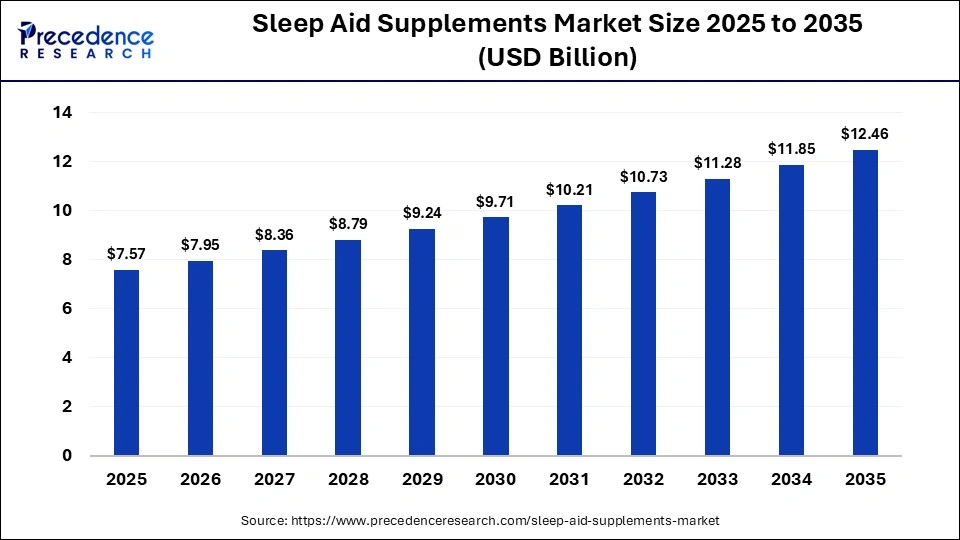
The rising prevalence of sleep disorders, increasing stress and screen exposure, changing lifestyles, and growing preference for natural and herbal wellness products are creating strong opportunities for supplement manufacturers and healthcare providers.
Download a Sample Report: https://www.precedenceresearch.com/sample/7697
Compact Scope Table
| Report Coverage | Details |
|---|---|
| 2025 Value | USD 7.57 Billion |
| 2026 Value | USD 7.95 Billion |
| 2035 Value | USD 12.46 Billion |
| CAGR 2026-2035 | 5.11% |
| Leading Region | North America |
| Fastest-Growing Region | Asia Pacific |
| Leading Ingredient | Melatonin |
| Fastest-Growing Ingredient | Amino Acids & Neurotransmitter Precursors |
| Leading Form | Tablets & Capsules |
| Fastest-Growing Form | Gummies/Chewable Forms |
| Leading Route | Oral Supplements |
| Fastest-Growing Route | Sublingual/Bucco-Adhesive Forms |
| Leading End User | Individual/Household Consumers |
Growing Sleep Concerns Are Supporting Demand
Poor sleep is increasingly associated with demanding work schedules, stress, excessive screen exposure, travel, irregular routines, and changing lifestyles. As awareness of sleep health grows, consumers are increasingly incorporating supplements into their nighttime wellness routines.
The demand is also moving beyond occasional sleep support. Consumers are exploring products designed to promote relaxation, support healthy sleep cycles, and improve overall nighttime wellness.
Natural ingredients such as valerian root, chamomile, passionflower, lavender, and magnesium are gaining attention among consumers who prefer plant-based and wellness-oriented solutions.
Melatonin Remains a Leading Ingredient
The melatonin segment accounted for approximately 30% share in 2025. Melatonin is widely used to support the body’s sleep-wake cycle and is available in multiple formats, including tablets, capsules, gummies, liquids, and sprays.
However, consumers are increasingly exploring alternatives to melatonin. The amino acids and neurotransmitter precursors segment is expected to experience the fastest growth as ingredients such as L-theanine, glycine, GABA, and tryptophan gain attention for relaxation and stress-related sleep support.
This shift is encouraging manufacturers to develop non-melatonin formulations that target broader sleep and wellness needs.
Gummies and Innovative Formats Are Changing Consumer Preferences
Tablets and capsules led the product form segment with approximately 52% share in 2025, supported by accurate dosing, stability, affordability, and established consumer familiarity.
At the same time, gummies and chewable forms are expected to grow rapidly. Their taste, convenience, and ease of consumption make them attractive to consumers who dislike swallowing traditional pills.
Powders, drink mixes, liquid drops, and other innovative formats are also becoming part of nighttime wellness routines, giving manufacturers more opportunities to differentiate their products.
AI Is Bringing Personalization to Sleep Support
Artificial intelligence is gradually creating new opportunities in sleep wellness and supplement development.
AI can analyze data from wearable devices, sleep trackers, consumer surveys, and product reviews to identify common sleep patterns, behavioral triggers, and changing consumer preferences.
Manufacturers can use these insights to improve formulations and develop products for specific consumer needs. AI and predictive modeling can also support the evaluation of ingredient combinations, potential interactions, dosage responses, and formulation performance.
The integration of AI with digital sleep monitoring could eventually enable more personalized supplement recommendations based on individual sleep patterns and lifestyle factors.
Digital Commerce Is Expanding Access
Individual and household consumers accounted for approximately 71% share in 2025, reflecting the widespread use of sleep supplements for self-managed wellness.
Online purchasing is becoming particularly important because consumers can compare products, review ingredient information, access educational content, and receive products at home.
Healthcare practitioners and clinics are also expected to become an increasingly important end-user segment as awareness of sleep-related health risks encourages more consumers to seek professional guidance.
North America Leads While Asia Pacific Accelerates
North America accounted for approximately 38% of the global share in 2025, supported by strong consumer awareness of sleep health, established supplement distribution networks, widespread e-commerce adoption, and high demand for natural wellness products.
The North American sector is projected to increase from USD 2.88 billion in 2025 to approximately USD 4.80 billion by 2035, expanding at a 5.24% CAGR.
The U.S. remains a major contributor, with strong demand for melatonin, magnesium, herbal blends, gummies, powders, and other convenient formats.
Asia Pacific is expected to record the fastest growth as urbanization, long working hours, academic pressure, smartphone use, and rising health awareness increase interest in sleep support products.
China is an important contributor as domestic brands increasingly combine traditional herbal concepts with modern supplement formats and online distribution.
Companies Are Driving Product Innovation
The competitive landscape includes Nature’s Bounty, Natrol, Church & Dwight, NOW Foods, Herbalife, OLLY, Gaia Herbs, GNC, Life Extension, Pure Encapsulations, Solgar, Thorne HealthTech, Amway, Blackmores, By-Health, and PharmaNord.
Companies are increasingly competing through natural ingredients, convenient formats, clean-label formulations, specialized blends, digital engagement, and direct-to-consumer distribution.
Recent product launches demonstrate this evolution. In August 2025, a healthy lifestyle brand launched LTH Dream, a melatonin-free sleep support powder featuring multiple forms of magnesium and calming nutrients.
In May 2025, Delhi-based Fytika Health Products introduced melatonin-based gummies, highlighting the growing popularity of convenient chewable formats in sleep wellness.
Sustainability and Natural Formulations Are Gaining Importance
Consumers are increasingly interested in supplements that combine sleep support with broader wellness benefits. This is encouraging manufacturers to focus on plant-based ingredients, clean-label formulations, transparent ingredient sourcing, and products designed around specific lifestyle needs.
The shift toward natural formulations is also increasing competition in botanical extracts, minerals, amino acids, and combination products.
The Road Ahead
The future of sleep aid supplements will increasingly focus on natural ingredients, non-melatonin formulations, personalized recommendations, innovative delivery formats, digital health integration, and AI-supported product development.
As consumers become more proactive about sleep health, supplement companies will have greater opportunities to combine science, convenience, technology, and wellness-focused formulation strategies.
With the global sector projected to reach USD 12.46 billion by 2035, the strongest opportunities are expected to emerge from products that provide convenient and personalized sleep support while fitting naturally into modern health and wellness routines.
Buy this report: https://www.precedenceresearch.com/checkout/7697
About Us
Healthcare Prism is a dedicated healthcare insights and outreach platform, operating as an extension of Precedence Research. We share relevant perspectives, industry developments, emerging trends, and research-driven insights across the global healthcare sector. Our content is built on the knowledge, research standards, and expertise of Precedence Research, with a focus on making healthcare information clear, accessible, and useful for industry professionals, businesses, researchers, and healthcare stakeholders. Healthcare Prism serves as a focused platform to extend the reach of Precedence Research’s healthcare insights and connect them with a broader professional audience.
You can place an order or ask any questions, please feel free to contact us at [email protected]
Quick Contact:
Europe Region: +44 778 256 0738
North America Region: +1 8044 4193 44
APAC Region: +91 9356 9282 04 and +65 31065601
Visit Our Website: Precedence Research – Advisory, Research & Reports