
The global keloid treatment sector is steadily expanding as awareness of abnormal scar formation increases and patients seek earlier, more effective treatment options. Valued at USD 4.12 billion in 2025, the sector is projected to reach USD 4.28 billion in 2026 and approximately USD 6.10 billion by 2035, expanding at a CAGR of 4.00% from 2026 to 2035.
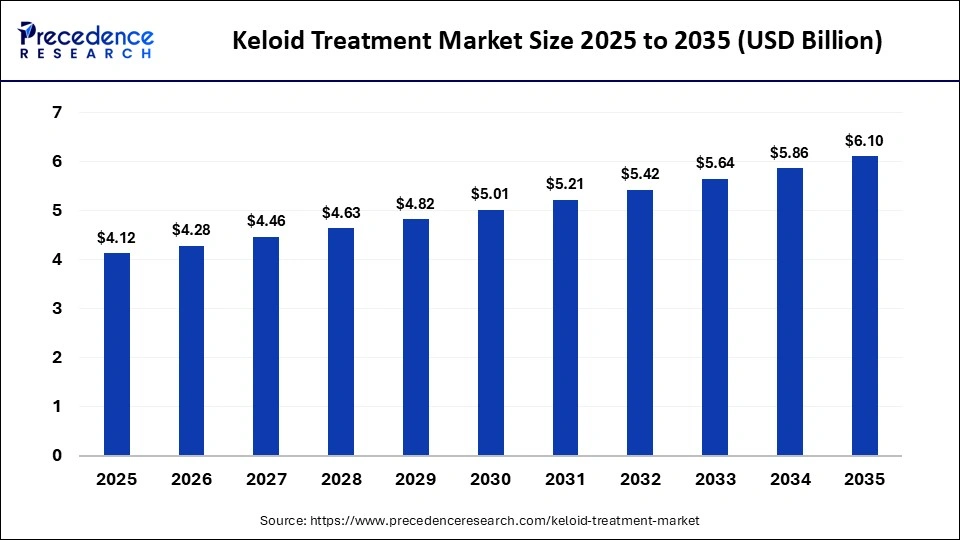
Growing demand for aesthetic scar correction, advances in dermatology technologies, wider adoption of combination treatment protocols, and expanding access to specialized care are supporting long-term growth.
Download a Sample Report: https://www.precedenceresearch.com/sample/7739
Compact Scope Table
| Report Coverage | Details |
|---|---|
| 2025 Value | USD 4.12 Billion |
| 2026 Value | USD 4.28 Billion |
| 2035 Value | USD 6.10 Billion |
| CAGR 2026-2035 | 4.00% |
| Leading Region | North America |
| Fastest-Growing Region | Asia Pacific |
| Leading Product Type | Topical Products |
| Fastest-Growing Product Type | Laser and Energy-Based Devices |
| Leading Treatment Type | Intralesional Corticosteroids |
| Fastest-Growing Treatment Type | Laser Therapy |
| Leading End User | Hospitals and Specialized Clinics |
| Fastest-Growing End User | Dermatology Centers |
Early Scar Intervention Is Creating New Demand
Growing awareness of keloid formation is encouraging patients to seek treatment earlier rather than waiting for scars to become larger, thicker, or more symptomatic.
Topical products accounted for approximately 42% share in 2025, supported by their accessibility and widespread use as adjunctive scar-care solutions. Silicone-based products and topical therapies are particularly relevant for ongoing scar management and symptom control.
At the same time, increasing cosmetic awareness is encouraging more patients to pursue treatment for visible scars, particularly across urban dermatology and aesthetic care centers.
Intralesional Corticosteroids Remain a Leading Treatment
Intralesional corticosteroids held approximately 48% share in 2025, supported by their established role in dermatology practices and their ability to reduce scar thickness and associated symptoms.
However, laser therapy is expected to grow at the fastest pace as pulsed dye laser and fractional CO₂ technologies continue to advance. These systems can support vascular targeting and controlled collagen remodeling, creating new possibilities for patients seeking minimally invasive scar refinement.
Combination therapies are also becoming increasingly important. Dermatologists can combine injections, laser procedures, silicone products, and other approaches depending on scar characteristics and patient response.
AI Is Advancing Personalized Keloid Care
Artificial intelligence is introducing new opportunities in scar diagnosis and treatment planning.
AI-powered imaging can analyze lesion morphology and help differentiate keloids from hypertrophic scars. Predictive analytics may also assist clinicians in assessing disease progression and identifying patients who may benefit from earlier intervention.
Energy-based treatment platforms are also becoming more intelligent. AI-enabled parameter optimization can support more precise energy delivery during laser procedures, potentially improving treatment consistency while reducing unnecessary exposure.
As digital dermatology develops, AI could become increasingly useful for monitoring scar response across multiple treatment sessions.
Hospitals Lead as Dermatology Centers Expand
Hospitals and specialized clinics accounted for approximately 55% share in 2025. Complex or recurrent keloids may require multidisciplinary management involving dermatologists, plastic surgeons, radiation specialists, and other professionals.
Hospitals also provide access to advanced procedures, surgical intervention, and post-treatment monitoring, supporting their continued leadership.
Meanwhile, dermatology centers are expected to grow at the fastest rate as patients increasingly seek outpatient scar correction, aesthetic treatment, laser therapy, and personalized care. Dedicated centers can provide specialized services with shorter appointment cycles and convenient outpatient treatment.
North America Leads While Asia Pacific Accelerates
North America accounted for approximately 38% of the global share in 2025, supported by advanced dermatology infrastructure, strong patient awareness, established treatment pathways, and widespread use of minimally invasive technologies.
The North American sector is projected to increase from USD 1.57 billion in 2025 to approximately USD 2.35 billion by 2035, expanding at a 4.12% CAGR.
The U.S. remains the largest contributor, supported by a large dermatology workforce, strong adoption of laser technologies, and advanced multidisciplinary scar-management services.
Asia Pacific is expected to experience the fastest growth as specialist dermatology services expand, healthcare access improves, and cosmetic awareness increases. Growing healthcare expenditure across emerging economies is also supporting greater access to advanced scar treatment.
Companies Are Accelerating Treatment Innovation
The competitive landscape includes Alliance Pharma, Avita Medical, Bausch Health Companies, Candela Medical, Cynosure, Lumenis, Merz Pharma, Mölnlycke Health Care, Perrigo, Sensus Healthcare, Smith & Nephew, Sonoma Pharmaceuticals, and Suneva Medical.
Companies are competing through topical formulations, wound-care products, laser and energy-based devices, injectable therapies, and advanced treatment platforms.
Recent developments highlight the increasing focus on personalized and technology-enabled dermatology. In February 2026, BirchBioMed received Canadian regulatory clearance for its FS2 (KynA) topical cream, enabling over-the-counter distribution in Canada.
Also in February 2026, Alma, the energy-based device brand of Sisram Medical, presented its Intelligent Aesthetics framework at the IMCAS World Congress, emphasizing personalized treatment planning and evidence-based energy-based technologies.
Clinical Evidence Is Strengthening Treatment Strategies
Treatment protocols are increasingly evolving from single interventions toward multimodal care.
Evidence from recent clinical research continues to examine surgical excision, laser therapy, corticosteroid injections, botulinum toxin, cryotherapy, and combination approaches. This growing evidence base is helping clinicians better understand recurrence risks and identify treatment strategies suited to individual scar characteristics.
The emphasis on recurrence management is especially important because keloids can return following treatment. As a result, healthcare providers are placing greater attention on prevention, long-term monitoring, and combination protocols.
The Road Ahead
The future of keloid treatment will increasingly focus on early intervention, personalized therapy, advanced laser technologies, AI-assisted diagnosis, combination treatment, and outpatient dermatology care.
With the sector projected to reach USD 6.10 billion by 2035, opportunities are expanding for pharmaceutical companies, medical device manufacturers, dermatology centers, and specialized healthcare providers.
The next phase of innovation will be defined not only by reducing scar appearance, but also by improving patient comfort, minimizing recurrence, and delivering more precise treatment based on the biology and characteristics of each scar.
Buy this report: https://www.precedenceresearch.com/checkout/7739
About Us
Healthcare Prism is a dedicated healthcare insights and outreach platform, operating as an extension of Precedence Research. We share relevant perspectives, industry developments, emerging trends, and research-driven insights across the global healthcare sector. Our content is built on the knowledge, research standards, and expertise of Precedence Research, with a focus on making healthcare information clear, accessible, and useful for industry professionals, businesses, researchers, and healthcare stakeholders. Healthcare Prism serves as a focused platform to extend the reach of Precedence Research’s healthcare insights and connect them with a broader professional audience.
You can place an order or ask any questions, please feel free to contact us at [email protected]
Quick Contact:
Europe Region: +44 778 256 0738
North America Region: +1 8044 4193 44
APAC Region: +91 9356 9282 04 and +65 31065601
Visit Our Website: Precedence Research – Advisory, Research & Reports