
The global mRNA synthesis raw materials sector is entering a powerful growth phase as pharmaceutical and biotechnology companies expand mRNA vaccine, therapeutic, and personalized medicine programs. Valued at USD 2.22 billion in 2025, the sector is projected to reach USD 2.53 billion in 2026 and approximately USD 8.37 billion by 2035, expanding at a CAGR of 14.21% from 2026 to 2035.
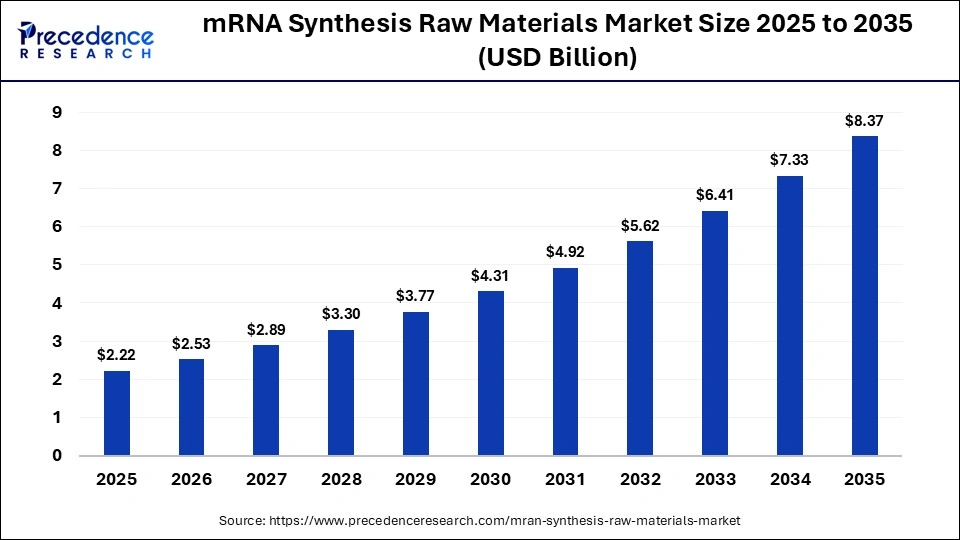
Growing investment in biotechnology, infectious disease preparedness, oncology research, rare disease therapies, and scalable mRNA manufacturing is creating strong demand for high-quality enzymes, nucleotides, capping reagents, DNA templates, and other critical inputs.
Download a Sample Report: https://www.precedenceresearch.com/sample/7362
Compact Scope Table
| Report Coverage | Details |
|---|---|
| 2025 Value | USD 2.22 Billion |
| 2026 Value | USD 2.53 Billion |
| 2035 Value | USD 8.37 Billion |
| CAGR 2026-2035 | 14.21% |
| Leading Region | North America |
| Fastest-Growing Region | Asia Pacific |
| Leading Product Type | Nucleotides / Enzymes |
| Fastest-Growing Product Type | Capping Reagents & Analogues |
| Leading Raw Material Grade | GMP-Grade Raw Materials |
| Leading Application | mRNA Vaccines |
| Fastest-Growing Application | mRNA Therapeutics |
| Leading End User | Biopharmaceutical & Biotechnology Companies |
| Fastest-Growing End User | CDMOs |
mRNA Manufacturing Is Expanding Beyond Vaccines
The success of mRNA vaccines has created a strong manufacturing foundation, but the technology is increasingly moving into broader therapeutic applications.
mRNA vaccines accounted for approximately 46% share in 2025, supported by continued infectious disease research and preparedness programs. However, mRNA therapeutics are expected to expand at a faster pace as developers investigate applications across oncology, rare genetic disorders, autoimmune conditions, and personalized medicine.
Therapeutic programs often require specialized mRNA constructs and highly controlled production processes, increasing demand for advanced and high-purity raw materials.
Enzymes and Nucleotides Remain Critical Inputs
Enzymes play an essential role in in-vitro transcription and mRNA production. RNA polymerases, RNase inhibitors, DNases, and other enzymes are required to support efficient synthesis, structural integrity, and product quality.
The growing scale of commercial and clinical mRNA manufacturing is increasing demand for high-performance enzymes with consistent activity and strong batch-to-batch reliability.
Nucleotides and modified nucleotides also remain fundamental because they form the building blocks of mRNA molecules. Modified nucleotides can improve mRNA stability and help reduce unwanted immune responses, making them increasingly important for next-generation therapeutic platforms.
Meanwhile, capping reagents and analogues are expected to experience rapid growth as manufacturers focus on improving translation efficiency, stability, and overall therapeutic performance.
GMP-Grade Materials Are Becoming Increasingly Important
GMP-grade raw materials accounted for approximately 58% share in 2025. Their importance is increasing as more mRNA candidates progress from research and development into clinical and commercial manufacturing.
GMP-grade enzymes, nucleotides, and reagents provide greater traceability, consistency, and regulatory assurance. As regulatory expectations increase, suppliers capable of delivering reliable GMP-quality inputs can gain an important competitive advantage.
At the same time, research-use-only materials are expected to grow as academic institutions, biotechnology companies, and research laboratories continue expanding early-stage mRNA projects.
Single-Use Manufacturing and Advanced Delivery Are Supporting Growth
The development of mRNA manufacturing is increasingly connected to advances in downstream processing and delivery technologies.
Lipid nanoparticles remain an important delivery platform for many mRNA products. Improvements in formulation, encapsulation, and manufacturing are creating additional demand for high-quality mRNA raw materials that can support more efficient production.
Biopharmaceutical companies are also increasing investment in in-house manufacturing capabilities to improve supply security and reduce dependence on external suppliers.
At the same time, CDMOs are expanding specialized capacity to support emerging biotechnology companies that lack internal manufacturing infrastructure.
North America Leads While Asia Pacific Accelerates
North America accounted for approximately 41% of the global share in 2025, supported by a mature biotechnology ecosystem, established pharmaceutical infrastructure, strong R&D investment, and early adoption of mRNA technologies.
The North American sector is projected to increase from approximately USD 910 million in 2025 to USD 3.45 billion by 2035, expanding at a 14.25% CAGR.
The U.S. remains the primary contributor due to its large biopharmaceutical base, advanced research infrastructure, and strong investment in mRNA vaccines and therapeutic programs.
Asia Pacific is expected to experience rapid growth at approximately 14.4% CAGR, supported by expanding biotechnology infrastructure, government investment, growing vaccine production, and increasing research activity across China, India, Japan, South Korea, and other economies.
China is becoming an important contributor through expanding domestic mRNA research, vaccine development, gene therapy programs, and biopharmaceutical manufacturing.
Companies Are Strengthening the mRNA Supply Chain
The competitive ecosystem includes Thermo Fisher Scientific, Merck KGaA, Maravai LifeSciences, Roche, New England Biolabs, Jena Bioscience, Yeasen Biotechnology, Promega, GenScript, Sartorius, Takara Bio, Lonza, ST Pharm, Creative Biogene, and Creative Enzymes.
These companies are competing through high-purity raw materials, GMP manufacturing, specialized enzymes, capping technologies, DNA templates, technical support, and scalable supply capabilities.
Recent product development is highlighting the growing importance of integrated solutions. In May 2025, TriLink BioTechnologies introduced its first mRNA synthesis kit incorporating CleanCap capping technology, providing an all-in-one IVT solution designed to support higher yields and lower double-stranded RNA levels for research and therapeutic development.
In September 2025, Elegen introduced ENFINIA IVT Ready DNA, a cell-free linear DNA template designed to accelerate mRNA-related development by eliminating the need for bacterial cloning.
CDMOs Are Creating a New Growth Channel
Biopharmaceutical and biotechnology companies represented approximately 47% share in 2025, making them the leading end-user group.
However, contract development and manufacturing organizations are expected to experience strong growth as smaller biotechnology companies increasingly outsource mRNA synthesis and manufacturing.
CDMOs can provide specialized equipment, regulatory expertise, scalable production, quality systems, and access to validated manufacturing processes. This enables developers to advance programs without building complete internal production infrastructure.
As the mRNA pipeline becomes more diversified, flexible external manufacturing capacity is likely to become increasingly valuable.
The Road Ahead
The future of mRNA synthesis raw materials will increasingly be shaped by GMP-grade inputs, modified nucleotides, advanced capping technologies, high-performance enzymes, scalable manufacturing, and growing therapeutic applications.
As mRNA expands beyond vaccines into oncology, rare diseases, personalized medicine, and other therapeutic areas, demand for specialized raw materials will continue to increase.
With the sector projected to reach approximately USD 8.37 billion by 2035, suppliers that combine high purity, regulatory compliance, manufacturing consistency, technical innovation, and reliable global supply will be well positioned to support the next generation of mRNA development.
Buy this report: https://www.precedenceresearch.com/checkout/7362
About Us
Healthcare Prism is a dedicated healthcare insights and outreach platform, operating as an extension of Precedence Research. We share relevant perspectives, industry developments, emerging trends, and research-driven insights across the global healthcare sector. Our content is built on the knowledge, research standards, and expertise of Precedence Research, with a focus on making healthcare information clear, accessible, and useful for industry professionals, businesses, researchers, and healthcare stakeholders. Healthcare Prism serves as a focused platform to extend the reach of Precedence Research’s healthcare insights and connect them with a broader professional audience.
You can place an order or ask any questions, please feel free to contact us at [email protected]
Quick Contact:
Europe Region: +44 778 256 0738
North America Region: +1 8044 4193 44
APAC Region: +91 9356 9282 04 and +65 31065601
Visit Our Website: Precedence Research – Advisory, Research & Reports