
The U.S. medical devices industry is undergoing a major transformation as healthcare providers adopt advanced technologies to improve diagnosis, treatment, monitoring, and patient outcomes. From surgical robotics and cardiovascular implants to AI-enabled imaging and wearable devices, innovation is becoming an important part of modern healthcare delivery.
The U.S. medical devices sector was valued at USD 191.20 billion in 2025 and is projected to reach approximately USD 346.19 billion by 2035, expanding at a CAGR of 6.20% from 2026 to 2035.
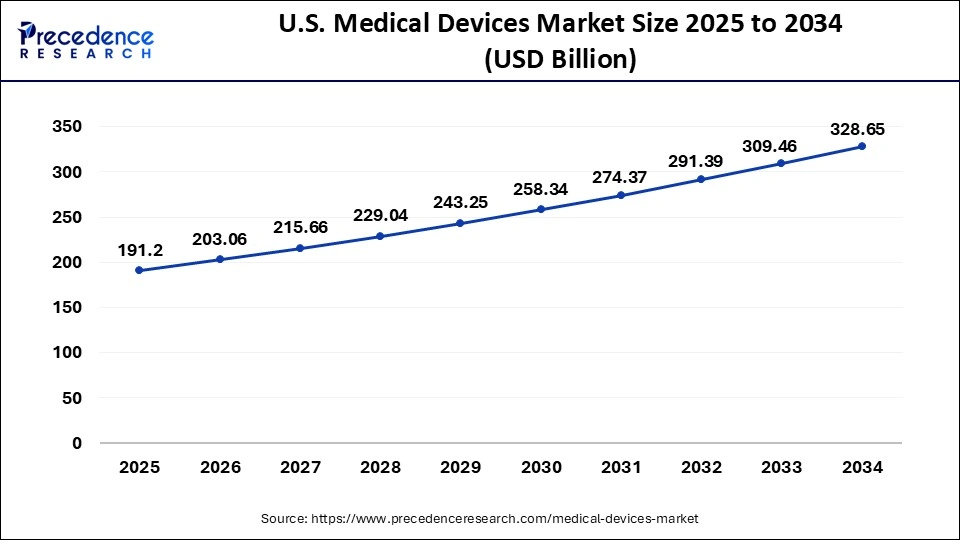
The growth is not being driven by one technology alone. Increasing chronic disease prevalence, aging populations, hospital technology investments, minimally invasive procedures, digital healthcare, and artificial intelligence are collectively reshaping the U.S. medical device landscape.
Download a Sample Report: https://www.precedenceresearch.com/sample/8503
Why the U.S. Medical Devices Industry Is Growing
Healthcare providers are facing increasing demand for faster diagnosis, more precise procedures, continuous monitoring, and better long-term disease management.
Medical devices are becoming essential across almost every stage of care. Imaging systems help physicians identify diseases, cardiovascular devices support patients with heart conditions, surgical technologies improve procedural precision, and remote monitoring devices allow patients to receive care outside hospitals.
Chronic conditions such as cardiovascular disease, cancer, diabetes, respiratory disorders, and orthopedic conditions are also creating sustained demand for diagnostic and therapeutic technologies.
At the same time, the aging population is increasing the need for mobility aids, rehabilitation systems, hearing technologies, monitoring devices, and other solutions that support independent living.
AI Is Changing Medical Device Innovation
Artificial intelligence is becoming one of the strongest technology trends shaping the U.S. medical devices industry.
AI-enabled imaging systems can assist clinicians in identifying abnormalities and prioritizing cases. Machine learning can analyze large amounts of medical data and help identify patterns that may be difficult to detect through conventional workflows.
In surgical care, AI is increasingly being integrated with robotic and navigation technologies to support greater precision.
Patient monitoring is another major area of development. AI can continuously analyze physiological data and alert healthcare professionals when readings move outside expected patterns.
This is changing the role of medical devices from passive equipment into more intelligent systems that can support clinical decision-making.
Key Trends Shaping the U.S. Medical Devices Sector
Therapeutic Devices Continue to Lead
Therapeutic devices accounted for the largest product share in 2025.
Hospitals and specialty care centers continue to invest in cardiovascular devices, orthopedic implants, surgical systems, infusion technologies, respiratory equipment, and other treatment-focused devices.
Strong procedure volumes across cardiology, orthopedics, oncology, and other specialties are supporting demand.
Assistive and Rehabilitation Devices Are Gaining Momentum
The assistive and rehabilitation devices segment is expected to grow at the fastest pace during the forecast period.
The increasing number of people living with disabilities, neurological disorders, musculoskeletal conditions, and age-related mobility challenges is creating demand for wheelchairs, prosthetics, exoskeletons, robotic rehabilitation systems, and other supportive technologies.
According to the Centers for Disease Control and Prevention, more than 61 million adults in the United States live with a disability, highlighting the importance of accessible assistive and rehabilitation solutions.
Home Healthcare Is Expanding
Hospitals currently account for the largest end-user share, but home healthcare settings are becoming increasingly important.
Wearable devices, remote patient monitoring systems, connected diagnostic tools, and digital health platforms are allowing some aspects of care to move closer to the patient.
This shift can support chronic disease management while reducing unnecessary hospital visits.
Online Sales Are Becoming More Important
Direct sales through distributors and dealers currently lead the sales channel segment because hospitals and healthcare organizations often rely on established procurement and distribution networks.
However, online sales are expected to grow rapidly as healthcare organizations become more comfortable with digital procurement and manufacturers expand their B2B e-commerce capabilities.
How Leading Companies Are Positioning
The U.S. medical devices landscape includes large multinational manufacturers, specialized innovators, healthcare technology companies, and component suppliers.
Medtronic continues to strengthen its presence across cardiovascular, surgical, diabetes, neurological, and monitoring technologies. Its Hugo robotic-assisted surgery platform is becoming an important area of development.
Stryker maintains a strong position in orthopedics, surgical equipment, neurovascular technologies, and medical systems while continuing to invest in advanced surgical solutions.
Johnson & Johnson MedTech is expanding across surgery, cardiovascular care, orthopedics, and vision technologies. Its broad portfolio allows the company to participate across multiple high-growth areas of healthcare.
Abbott has a diversified portfolio spanning cardiovascular devices, diabetes technologies, diagnostics, and remote health solutions. The company continues to focus on connected technologies and minimally invasive treatment options.
Boston Scientific is strongly positioned in cardiovascular and minimally invasive procedures, with innovation focused on interventional technologies and complex disease management.
Becton, Dickinson and Company (BD) remains important in medication delivery, diagnostics, vascular access, and infection prevention technologies used throughout healthcare facilities.
Danaher operates across diagnostics, life sciences, and medical technologies through a broad portfolio of companies and platforms.
GE HealthCare continues to advance medical imaging, patient monitoring, ultrasound, and digital healthcare technologies, with AI becoming increasingly integrated into clinical workflows.
Competition is increasingly influenced by technological innovation, regulatory capabilities, clinical evidence, cybersecurity, software integration, and the ability to provide complete solutions rather than standalone devices.
Segment Highlights
Therapeutic Devices Hold the Largest Share
Therapeutic devices led the product category in 2025 as hospitals continue investing in technologies that directly support treatment.
Cardiovascular devices, surgical systems, orthopedic products, respiratory devices, infusion pumps, and other therapeutic solutions remain important across healthcare facilities.
Hospitals Remain the Largest End User
Hospitals dominated end use in 2025 because they concentrate complex diagnostics, surgery, intensive care, treatment, and rehabilitation services.
The American Hospital Association reports more than 6,100 hospitals across the United States, creating a large installed base for medical technology.
However, the growth of home healthcare indicates a gradual shift toward decentralized care.
Assistive Technologies Represent a Long-Term Opportunity
The increasing focus on independent living and rehabilitation is creating opportunities for advanced mobility aids, exoskeletons, robotic rehabilitation systems, prosthetics, and wearable technologies.
These solutions are particularly relevant for patients recovering from surgery, stroke, neurological disorders, or severe injuries.
California Remains a Major Innovation Hub
California is one of the most important centers for medical technology innovation in the United States.
The state benefits from a strong combination of healthcare infrastructure, medical device manufacturers, universities, research organizations, venture capital, and technology companies.
Major companies including Abbott, Edwards Lifesciences, Intuitive Surgical, Hologic, and Penumbra have significant activities connected to the region.
California’s large healthcare system also creates an important testing and adoption environment for emerging medical technologies.
The combination of research, investment, technology talent, and healthcare demand continues to strengthen California’s role in the U.S. medical device ecosystem.
The Value Chain Is Becoming More Technology-Driven
Medical device development starts with specialized raw materials and electronic components such as medical-grade polymers, metals, sensors, semiconductors, and advanced electronics.
Companies then transform these materials into diagnostic, therapeutic, surgical, monitoring, and wearable systems.
The next stage involves assembly, testing, sterilization, quality control, cybersecurity validation, and regulatory compliance.
Finally, products are distributed through manufacturers, dealers, distributors, healthcare procurement systems, retail channels, and increasingly digital platforms.
Technology is influencing every stage of this process. Automation, AI, advanced analytics, digital manufacturing, and connected supply chains are helping manufacturers improve production efficiency and product quality.
Regulatory Requirements Remain a Major Consideration
Medical devices in the United States must meet demanding safety, quality, and regulatory requirements.
The approval and compliance process can increase development timelines and costs, particularly for innovative devices that combine hardware, software, AI, and connectivity.
Cybersecurity has also become more important as medical devices become increasingly connected.
A connected device may need to protect patient information while also ensuring that software updates, network access, and data transmission do not compromise clinical safety.
For manufacturers, regulatory readiness and cybersecurity are therefore becoming part of product development rather than issues addressed only after a device is completed.
Recent Developments
In June 2026, Medtronic announced important milestones for its Hugo robotic-assisted surgery system, including regulatory submissions covering general surgery, gynecologic surgery, and LigaSure robotic-assisted instruments. The company also reported progress on clinical studies and robotic-assisted hernia repair capabilities.
In June 2026, Johnson & Johnson announced a USD 1 billion investment in Jacksonville, Florida, aimed at expanding vision-related manufacturing and distribution capabilities, including production and distribution for ACUVUE contact lenses.
These developments reflect a broader industry focus on advanced manufacturing, robotic surgery, specialty healthcare technologies, and large-scale production capabilities.
What Should Medical Device Companies Watch?
Healthcare organizations, manufacturers, investors, and technology providers should closely monitor:
- AI-enabled medical devices
- Robotic-assisted surgery
- Cardiovascular technologies
- Wearable monitoring devices
- Home healthcare technologies
- Minimally invasive procedures
- Rehabilitation robotics
- Smart and connected devices
- Digital procurement
- Medical device cybersecurity
What Comes Next?
The U.S. medical devices industry is moving toward a model that combines advanced hardware, intelligent software, AI, connectivity, and patient-centered care.
The next generation of devices will increasingly be expected to do more than perform a single clinical function. They will need to generate useful data, connect with healthcare systems, support clinicians, and provide better experiences for patients.
Hospitals will remain major technology buyers, but growth in home healthcare, wearable monitoring, rehabilitation, and connected devices will continue shifting healthcare toward more decentralized care.
For manufacturers, the biggest opportunity lies in combining clinical value with technological intelligence.
As AI, robotics, digital health, and advanced manufacturing continue to develop, the U.S. medical device landscape is likely to become more precise, connected, personalized, and efficient.
Buy this report: https://www.precedenceresearch.com/checkout/8503
About Us
Healthcare Prism is a dedicated healthcare insights and outreach platform, operating as an extension of Precedence Research. We share relevant perspectives, industry developments, emerging trends, and research-driven insights across the global healthcare sector. Our content is built on the knowledge, research standards, and expertise of Precedence Research, with a focus on making healthcare information clear, accessible, and useful for industry professionals, businesses, researchers, and healthcare stakeholders. Healthcare Prism serves as a focused platform to extend the reach of Precedence Research’s healthcare insights and connect them with a broader professional audience.
You can place an order or ask any questions, please feel free to contact us at [email protected]
Quick Contact:
Europe Region: +44 778 256 0738
North America Region: +1 8044 4193 44
APAC Region: +91 9356 9282 04 and +65 31065601
Visit Our Website: Precedence Research – Advisory, Research & Reports