Neurological care is changing as healthcare providers look for better ways to monitor patients outside traditional hospital settings. The growing use of wearable devices, remote EEG systems, artificial intelligence, and cloud-based analytics is making continuous neurological monitoring more practical.
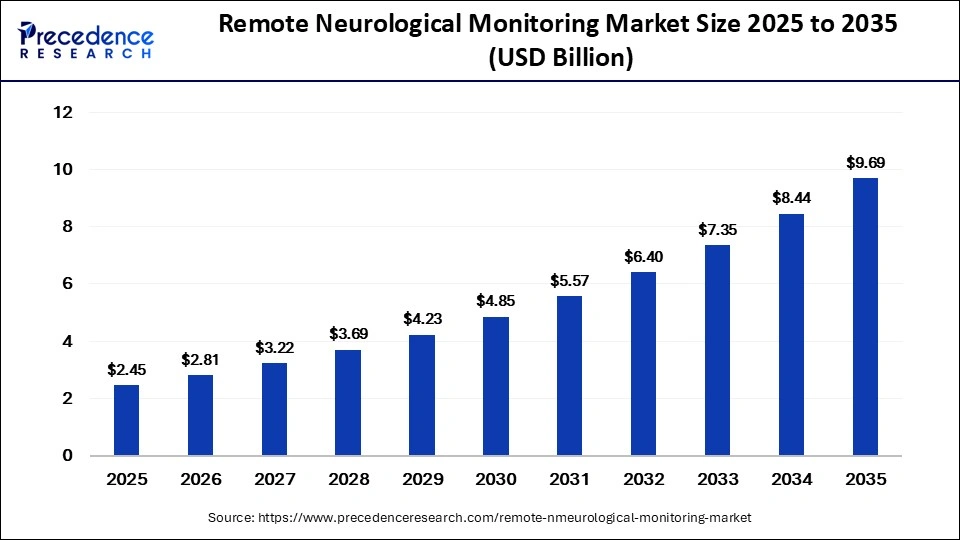
The global remote neurological monitoring sector was valued at USD 2.45 billion in 2025 and is projected to reach approximately USD 9.69 billion by 2035, expanding at a CAGR of 14.80% from 2026 to 2035.
The key shift is moving from occasional clinical assessments toward continuous monitoring that can capture changes in brain activity, movement, and other neurological signals in a patient’s everyday environment.
Download a Sample Report: https://www.precedenceresearch.com/sample/8480
Why Remote Neurological Monitoring Matters
Conditions such as epilepsy, Parkinson’s disease, stroke, Alzheimer’s disease, and other neurological disorders often require regular observation.
Traditional monitoring can require repeated hospital or clinic visits, which may be difficult for older adults, patients with mobility limitations, and people living far from specialized neurological centers.
Remote neurological monitoring can help bridge this gap.
Wearable sensors, mobile platforms, EEG systems, and connected devices can collect neurological information outside the hospital and transmit it to healthcare professionals.
This can give clinicians access to more continuous information and help them understand how symptoms change throughout the day rather than relying only on a short clinical appointment.
AI Is Making Neurological Monitoring Smarter
Artificial intelligence is becoming one of the most important technologies in remote neurological care.
AI algorithms can analyze large amounts of data generated by wearable devices, EEG systems, movement sensors, and digital health platforms. Instead of requiring clinicians to manually review every data point, AI can identify unusual patterns and highlight information that may require attention.
For epilepsy patients, AI can assist with identifying abnormal brain activity and potential seizure patterns.
For Parkinson’s disease, machine learning can analyze movement data to track tremors, gait changes, and motor fluctuations.
AI is also being explored for Alzheimer’s disease and dementia monitoring, where speech, typing, cognitive assessments, and behavioral patterns can provide additional insights into disease progression.
The combination of remote monitoring and AI is creating a more continuous and data-driven approach to neurological care.
Key Trends Shaping Remote Neurological Monitoring
Wearable Devices Are Moving Neurological Monitoring Home
Wearable neurological monitoring devices accounted for 34% in 2025, making them the leading product category.
Smaller sensors, improved battery life, wireless connectivity, and cloud platforms are making neurological monitoring more comfortable and practical for patients.
Devices can track brain activity, movement, sleep, and other neurological indicators while patients continue their normal routines.
Remote EEG Is Expanding
Remote EEG monitoring systems represented 29% in 2025.
EEG remains an important technology for monitoring electrical brain activity, particularly in epilepsy care. New portable and wearable EEG systems are making longer-duration monitoring possible outside traditional clinical environments.
This can reduce the need for prolonged hospital stays while providing clinicians with additional information about a patient’s neurological activity.
Parkinson’s Monitoring Is Becoming More Continuous
The Parkinson’s disease monitoring segment is projected to grow at a 16.7% CAGR.
Wearables and smartphone-based tools can track tremors, gait, movement speed, and other symptoms over time.
This continuous information may provide a clearer understanding of symptom fluctuations and help clinicians adjust treatment plans more effectively.
Homecare Is Becoming a Major Growth Area
Homecare settings accounted for 23% in 2025 and are projected to grow at the fastest rate, with a 19.5% CAGR from 2026 to 2035.
Patients increasingly want to receive care without frequent hospital visits. Remote neurological monitoring makes this more practical by allowing healthcare professionals to receive patient data remotely.
For chronic neurological conditions, this can improve convenience while helping clinicians maintain regular oversight.
How Leading Companies Are Positioning
The remote neurological monitoring ecosystem includes medical device companies, neurological technology specialists, digital health firms, and healthcare technology providers.
Medtronic offers technologies across neurological care and continues to invest in connected monitoring and neuromodulation capabilities.
NeuroPace focuses on responsive neurostimulation technology and brain activity monitoring for epilepsy, supporting more personalized neurological management.
Natus Medical provides EEG and neurodiagnostic technologies widely used by hospitals and neurological care providers.
Compumedics develops EEG and sleep diagnostic systems that support neurological monitoring and clinical assessment.
Masimo is expanding its connected monitoring capabilities, including wearable and remote patient monitoring technologies.
Philips continues to develop connected healthcare and remote monitoring solutions that support clinicians in managing patients beyond traditional care environments.
GE HealthCare is strengthening its neurological imaging and digital healthcare ecosystem through software, monitoring, and imaging technologies.
BioSerenity focuses on connected neurological diagnostics, including wearable EEG technologies that enable remote patient monitoring.
Ceribell is developing rapid EEG solutions designed to help clinicians identify and monitor neurological conditions, particularly in acute care settings.
Empatica is another important player in wearable health monitoring, using sensor-based technologies to collect physiological and behavioral information remotely.
Competition is increasingly centered on smaller devices, better data quality, AI-powered analytics, cloud connectivity, and the ability to integrate remote monitoring into existing clinical workflows.
Segment Highlights
Brain Activity Monitoring Leads
Brain activity monitoring accounted for 31% in 2025, supported by the increasing need for continuous neurological assessment.
EEG-based systems remain important, while miniaturized sensors and AI-enabled platforms are making monitoring more portable and accessible.
AI-Enabled Analytics Are Growing Rapidly
AI-enabled neurological analytics accounted for 16% in 2025 and are expected to expand at a 20.4% CAGR.
The growing volume of neurological data makes automated analysis increasingly valuable for identifying abnormalities, supporting clinical decisions, and reducing the workload on specialists.
Epilepsy Remains the Leading Application
Epilepsy accounted for 29% of applications in 2025.
Continuous seizure monitoring remains one of the strongest use cases for remote neurological technology, particularly as portable EEG and AI-based analysis continue to improve.
The Alzheimer’s disease and dementia segment is projected to grow at a 17.4% CAGR, reflecting increasing interest in remote cognitive and behavioral monitoring.
North America Leads the Sector
North America held the largest share at 39% in 2025.
The region benefits from advanced healthcare infrastructure, strong adoption of digital health technologies, established reimbursement pathways, and a high concentration of medical technology companies.
The U.S. is a major center for remote neurological monitoring innovation, particularly in wearable EEG, AI-based analytics, telemedicine, and remote patient monitoring.
Asia Pacific Is Growing Fastest
Asia Pacific accounted for 24% in 2025 and is expected to grow at the fastest rate, with a projected 18.2% CAGR from 2026 to 2035.
A large neurological patient population, increasing healthcare expenditure, expanding digital health infrastructure, and growing smartphone and wearable adoption are supporting the region.
China is investing heavily in digital healthcare and AI-enabled medical technologies, while other countries across the region are strengthening telehealth and remote monitoring capabilities.
Europe Continues to Expand Digital Neurology
Europe held approximately 27% in 2025.
The region benefits from established healthcare systems and strong digital health initiatives. Germany’s Digital Healthcare Act has also helped create a stronger pathway for digital health technologies to enter clinical care and reimbursement systems.
The UK is focusing on community-based healthcare and remote care models, creating additional opportunities for home-based neurological monitoring.
Challenges to Overcome
Remote neurological monitoring still faces several barriers.
Advanced monitoring equipment can require significant upfront investment, particularly for smaller clinics and healthcare providers.
Data privacy and cybersecurity are also important because remote systems continuously collect sensitive health information.
Another challenge is ensuring that remote monitoring data can be integrated smoothly into existing electronic health records and clinical workflows.
Healthcare professionals also need clear protocols for responding to alerts. Generating large volumes of data is useful only when clinicians can interpret it and take appropriate action.
What Should Healthcare Companies Watch?
Healthcare providers, medical device companies, digital health firms, and investors should closely monitor:
- Wearable neurological monitoring
- Portable EEG technologies
- AI-enabled neurological analytics
- Remote seizure monitoring
- Parkinson’s movement tracking
- Digital cognitive assessment
- Cloud-based neurological platforms
- Remote patient monitoring
- Home-based neurological care
- Integration with electronic health records
What Comes Next?
Remote neurological monitoring is moving from an optional digital tool toward an increasingly important part of modern neurological care.
The combination of wearable sensors, EEG technology, AI, cloud analytics, and telehealth is allowing clinicians to monitor patients in more natural settings and collect information over longer periods.
The next stage will likely focus on making these systems more accurate, easier to use, and better integrated with clinical decision-making.
The biggest opportunity is not simply monitoring patients remotely. It is creating a continuous neurological care model where important changes can be identified earlier, treatment can be adjusted more quickly, and patients can receive more care without depending entirely on hospital visits.
As neurological disorders become more prevalent and healthcare systems face increasing pressure, remote monitoring could become an important bridge between specialist care and everyday patient life.
Buy this report: https://www.precedenceresearch.com/checkout/8480
About Us
Healthcare Prism is a dedicated healthcare insights and outreach platform, operating as an extension of Precedence Research. We share relevant perspectives, industry developments, emerging trends, and research-driven insights across the global healthcare sector. Our content is built on the knowledge, research standards, and expertise of Precedence Research, with a focus on making healthcare information clear, accessible, and useful for industry professionals, businesses, researchers, and healthcare stakeholders. Healthcare Prism serves as a focused platform to extend the reach of Precedence Research’s healthcare insights and connect them with a broader professional audience.
You can place an order or ask any questions, please feel free to contact us at [email protected]
Quick Contact:
Europe Region: +44 778 256 0738
North America Region: +1 8044 4193 44
APAC Region: +91 9356 9282 04 and +65 31065601
Visit Our Website: Precedence Research – Advisory, Research & Reports