
The global single use disposable medical devices sector is expanding as healthcare providers place greater emphasis on infection prevention, patient safety, operational efficiency, and convenient treatment delivery. Disposable devices are increasingly used across hospitals, diagnostic laboratories, outpatient centers, surgical facilities, and home healthcare environments.
The global single-use disposable medical devices sector was valued at USD 177.26 billion in 2025 and is projected to increase from USD 187.51 billion in 2026 to approximately USD 310.92 billion by 2035, expanding at a CAGR of 5.78% from 2026 to 2035.
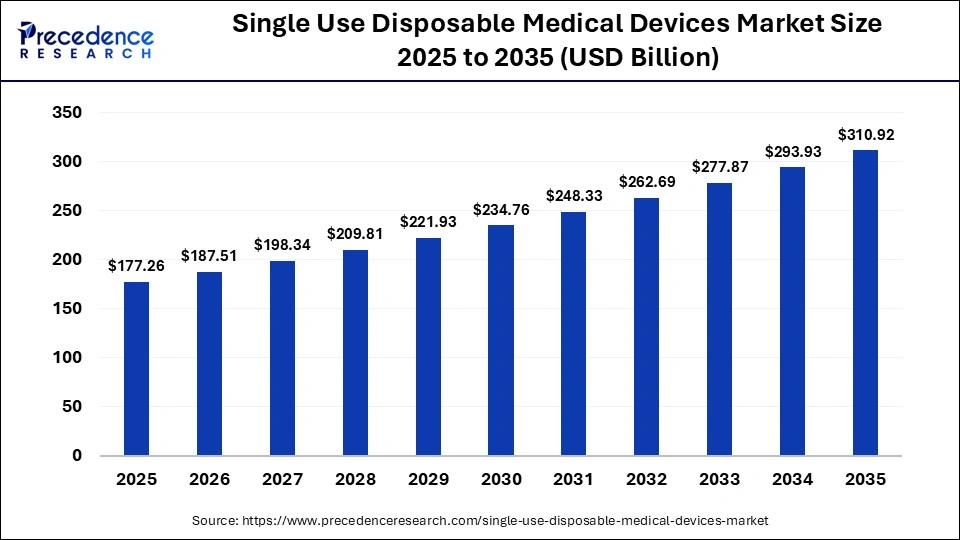
The growth is being supported by the rising prevalence of chronic diseases, increasing surgical and diagnostic procedures, stricter infection-control practices, expanding home healthcare, and continued development of advanced disposable technologies.
Download a Sample Report: https://www.precedenceresearch.com/sample/7446
Compact Scope Table of Single Use Disposable Medical Devices
| Report Coverage | Details |
|---|---|
| Sector Size in 2025 | USD 177.26 Billion |
| Sector Size in 2026 | USD 187.51 Billion |
| Sector Size by 2035 | USD 310.92 Billion |
| Growth Rate from 2026 to 2035 | CAGR of 5.78% |
| Leading Region | North America |
| Fastest-Growing Region | Asia Pacific |
| Leading Product Type | Disposable Syringes & Needles |
| Fastest-Growing Product Type | Catheters & Tubing Systems |
| Leading Clinical Use | General Surgery |
| Fastest-Growing Clinical Use | Respiratory |
| Leading End User | Hospitals |
| Fastest-Growing End User | Home Healthcare |
| Leading Material | Plastics |
| Fastest-Growing Material | Biodegradable Materials |
| Base Year | 2025 |
| Forecast Period | 2026–2035 |
What Are Single Use Disposable Medical Devices
Single use disposable medical devices are healthcare products designed for one-time use before being safely discarded.
They include syringes, needles, catheters, tubing systems, surgical instruments, diagnostic consumables, gloves, IV sets, dressings, and other products used during medical procedures.
Their primary advantage is infection prevention. Using a sterile device for a single procedure can reduce the possibility of contamination and cross-infection associated with reuse and reprocessing.
These products also simplify clinical workflows because healthcare facilities do not need to sterilize and prepare every device for repeated use.
Growing concern about healthcare-associated infections, increasing procedure volumes, and strict hygiene protocols are therefore supporting continued adoption.
Why Single-Use Devices Are Becoming More Important
Healthcare systems are treating growing numbers of patients with chronic conditions such as diabetes, cardiovascular disease, respiratory disorders, and infectious diseases.
These conditions frequently require injections, diagnostic testing, catheterization, monitoring, and other procedures where disposable medical products are routinely used.
The continued expansion of surgery and minimally invasive procedures is another important factor.
Operating rooms, diagnostic laboratories, outpatient centers, and specialty clinics require reliable supplies of sterile medical consumables.
The expansion of home healthcare is also changing demand. Patients increasingly receive treatments outside hospitals, creating greater requirements for products that are easy to use, sterile, portable, and convenient for patients and caregivers.
Infection Prevention Remains a Major Driver
Infection control is one of the strongest reasons healthcare providers prefer single-use products.
Reusable medical devices require cleaning, disinfection, sterilization, inspection, storage, and maintenance before they can be safely used again.
Single-use devices eliminate many of these reprocessing steps.
Syringes and needles are particularly important because they come into direct contact with blood and other biological materials. Using sterile disposable products can significantly reduce the risk of transmitting bloodborne pathogens when appropriate infection-control practices are followed.
Hospitals are therefore continuing to prioritize disposable products as part of broader patient-safety strategies.
Chronic Diseases Are Supporting Long-Term Demand
The increasing prevalence of chronic disease is creating sustained demand for disposable medical devices.
Diabetes, for example, requires regular blood glucose monitoring and medication administration.
Cardiovascular and respiratory conditions can require injections, catheter-based procedures, oxygen-delivery systems, monitoring, and long-term supportive care.
As populations age, demand for catheterization, wound care, diagnostic services, and home-based treatment is also increasing.
This creates a broad and recurring need for disposable products across different stages of healthcare.
AI Is Bringing Intelligence Into Disposable Devices
Artificial intelligence is beginning to influence the development of smarter disposable medical devices.
AI-enabled disposable wearables can continuously collect information such as heart rate, ECG signals, oxygen levels, temperature, and other physiological measurements.
Connected systems can transmit these readings to smartphones, cloud platforms, or clinical dashboards for analysis.
AI algorithms can then identify unusual patterns and support earlier clinical attention.
One example is the integration of continuous glucose monitoring with digital platforms. Real-time glucose readings can be transmitted to connected devices and analyzed to support diabetes management.
Smart disposable drug-delivery systems are also being developed to improve dosing accuracy, treatment adherence, and patient monitoring.
The combination of disposable hardware and intelligent software is creating new opportunities beyond traditional consumables.
Key Trends Shaping Single-Use Medical Devices
Rising Demand for Infection-Control Products
Hospitals are placing greater emphasis on infection prevention and sterile clinical environments.
This is increasing demand for disposable syringes, needles, gloves, surgical products, IV sets, tubing, dressings, and other consumables.
The preference for single-use products is also reducing dependence on complex reprocessing workflows.
Growth of Surgical Procedures
Increasing numbers of surgical and interventional procedures are supporting demand for disposable medical supplies.
General surgery alone requires a large range of disposable products, including gloves, drapes, syringes, blades, tubing, dressings, and other sterile consumables.
The growth of outpatient procedures is further increasing requirements for convenient, ready-to-use medical products.
Expansion of Home Healthcare
Healthcare is increasingly moving into homes.
Patients with chronic diseases can receive certain treatments and monitoring services without remaining in hospitals.
This is increasing demand for portable and easy-to-use disposable devices that can be safely handled by patients or caregivers.
Development of Smart Disposable Devices
Connected sensors and wearable disposable products are adding digital capabilities to traditional medical consumables.
These devices can collect data continuously and transfer information to digital platforms.
The integration of AI and remote monitoring can create faster feedback loops between patients, caregivers, and healthcare professionals.
Sustainability Is Becoming More Important
Medical disposables create significant waste because they are intentionally used once.
This is encouraging manufacturers to explore biodegradable materials, alternative polymers, recyclable components, and more sustainable production processes.
The shift toward environmentally responsible healthcare products is likely to become increasingly important as healthcare organizations seek to balance infection prevention with sustainability objectives.
Disposable Syringes and Needles Lead Product Demand
Disposable syringes and needles represented approximately 40% of the product segment in 2025.
Their widespread use across vaccination, medication delivery, blood collection, diagnostic procedures, and chronic disease management supports their leading position.
They are relatively inexpensive, easy to use, widely available, and suitable for high-volume clinical environments.
Single-use syringes and needles also help reduce the risk of cross-contamination compared with inappropriate reuse.
Catheters and Tubing Systems Are Growing Fastest
Catheters and tubing systems are projected to grow at a 7.1% CAGR from 2026 to 2035.
These products are used across intravenous therapy, urinary drainage, dialysis, respiratory care, and other procedures.
An aging population and increasing prevalence of chronic diseases are supporting utilization.
Single-use catheter and tubing systems also reduce the need for reprocessing and can simplify clinical workflows.
General Surgery Remains the Leading Clinical Use
General surgery accounted for approximately 35% of clinical use in 2025.
The high number of routine and emergency procedures creates consistent demand for disposable medical products.
Nearly every surgical procedure requires multiple consumables to maintain sterile conditions and support safe treatment.
Disposable gloves, gowns, drapes, syringes, blades, tubing, dressings, and other products contribute to substantial recurring demand.
Respiratory Care Is Growing Rapidly
The respiratory segment is expected to grow at the fastest rate, reaching a projected 7.4% CAGR during the forecast period.
The increasing prevalence of chronic respiratory disorders, aging populations, and long-term patient care is supporting demand for disposable respiratory products.
These include tubing systems, oxygen-delivery products, airway devices, and other supportive equipment.
Growing hospital admissions and demand for respiratory support are strengthening the segment.
Hospitals Remain the Largest End User
Hospitals accounted for approximately 65% of end use in 2025.
Hospitals manage large patient populations and perform high volumes of surgery, diagnosis, emergency care, and chronic disease treatment.
The need to maintain sterile clinical environments makes disposable products essential across almost every hospital department.
Hospitals also have significant procurement requirements for syringes, catheters, gloves, IV sets, surgical consumables, and other products.
Home Healthcare Is Expanding
Home healthcare is expected to experience rapid growth during the forecast period.
Patients are increasingly receiving chronic disease management, monitoring, injections, wound care, and other treatments outside traditional hospital environments.
Single-use devices can support this transition because they are generally straightforward to deploy and do not require complex sterilization infrastructure.
Portable medical technologies, connected devices, and remote patient monitoring are further strengthening demand.
Plastics Continue to Dominate Materials
Plastic accounted for approximately 65% of the material segment in 2025.
Plastics are widely used because they are lightweight, relatively inexpensive, durable, and can be molded into complex shapes.
They are suitable for products such as syringes, catheters, tubing, diagnostic components, packaging, and other disposable medical products.
The availability of medical-grade polymers and established manufacturing processes also supports large-scale production.
Biodegradable Materials Offer a Sustainable Alternative
Biodegradable materials are expected to grow rapidly, with a projected 8.5% CAGR over the forecast period.
Healthcare organizations and manufacturers are becoming more conscious of the environmental impact associated with disposable medical products.
Biodegradable materials could help reduce the long-term environmental burden of certain products while maintaining required safety and performance characteristics.
Research is increasingly focused on developing alternatives that balance sterility, durability, biocompatibility, and environmental performance.
North America Remains the Largest Region
North America accounted for approximately 45% of the global sector in 2025.
The region benefits from advanced healthcare infrastructure, high healthcare expenditure, a large installed base of hospitals and diagnostic facilities, and strong infection-control practices.
The United States represents the primary contributor.
The region’s large number of surgical procedures, chronic disease treatments, diagnostic tests, and outpatient services creates substantial recurring demand for disposable medical products.
Strict healthcare protocols and strong regulatory oversight also support widespread adoption of sterile single-use devices.
The U.S. Is a Major Contributor
The U.S. single-use disposable medical devices sector was valued at approximately USD 59.83 billion in 2025 and is projected to reach nearly USD 106.81 billion by 2035, expanding at a CAGR of 5.97% from 2026 to 2035.
The country has an extensive network of hospitals, surgical centers, diagnostic laboratories, outpatient facilities, and home healthcare providers.
The high prevalence of diabetes, cardiovascular disease, respiratory conditions, and other chronic disorders is sustaining demand for injections, monitoring, catheterization, and related procedures.
Regulatory requirements and strong infection-prevention practices are also encouraging healthcare providers to maintain significant use of sterile disposable products.
Asia Pacific Is Growing Fastest
Asia Pacific is expected to record the fastest growth, with a projected 8.5% CAGR during the forecast period.
The region is benefiting from expanding healthcare infrastructure, rising healthcare expenditure, increasing urbanization, and growing awareness of infection prevention.
Governments are investing in hospitals, public healthcare programs, diagnostic facilities, and disease prevention.
The growing number of surgical and diagnostic procedures is increasing demand for disposable devices.
China and India are particularly important because of their large populations, expanding healthcare networks, and strong manufacturing capabilities.
China Strengthens Both Production and Consumption
China plays an important role as both a major producer and consumer of disposable medical devices.
Expanding hospital networks and increasing healthcare spending are strengthening domestic demand.
China’s manufacturing capabilities also support large-scale production of syringes, catheters, diagnostic products, and other medical consumables for domestic and international markets.
India Offers Strong Long-Term Potential
India is experiencing increasing demand for single-use medical products as public and private healthcare infrastructure expands.
Vaccination programs, rural healthcare initiatives, diagnostic laboratories, and private hospitals are supporting consumption.
The affordability and convenience of disposable devices make them particularly suitable for high-volume healthcare environments.
Europe Emphasizes Safety and Sustainability
Europe is expected to experience steady growth supported by established healthcare systems and strong regulatory requirements.
Germany, the UK, France, and Italy are important contributors.
The region’s emphasis on infection prevention continues to support demand for sterile disposable products.
At the same time, environmental considerations are encouraging interest in recyclable and biodegradable alternatives.
Germany Remains an Important Healthcare Manufacturing Center
Germany combines advanced healthcare infrastructure with a strong medical technology manufacturing ecosystem.
Hospitals and diagnostic facilities rely on disposable devices to maintain hygiene and support high-volume healthcare delivery.
Manufacturers are also increasingly exploring innovative technologies and sustainable materials.
Latin America Is Expanding Healthcare Access
Latin America is expected to record notable growth as healthcare infrastructure develops and access to medical services expands.
Brazil and Mexico are important contributors.
Government initiatives supporting healthcare access and sports and wellness programs, alongside increasing healthcare investment, are supporting demand for medical supplies.
Private healthcare facilities are also upgrading their equipment and increasing the use of sterile disposable products.
Brazil Is Expanding Diagnostic Capabilities
Brazil is developing its diagnostic and healthcare infrastructure, creating opportunities for disposable syringes, catheters, diagnostic products, and surgical consumables.
The country’s large healthcare system and increasing emphasis on infection prevention are supporting demand.
Middle East and Africa Offer New Growth Opportunities
The Middle East and Africa region is expected to expand as healthcare infrastructure improves and governments increase healthcare investment.
Private hospitals and specialty healthcare facilities are adopting more advanced medical technologies.
Increasing awareness of infection prevention and greater access to modern healthcare are supporting disposable product adoption.
The Single-Use Medical Device Value Chain
The value chain begins with raw materials and product development and extends through manufacturing, sterilization, distribution, clinical use, and patient support.
Research and Development
R&D focuses on designing sterile devices that can provide safety, reliability, ease of use, and improved clinical performance.
Companies such as Johnson & Johnson, Cardinal Health, and Baxter International participate across different areas of product development and healthcare technology.
Manufacturing and Sterilization
Manufacturers transform medical-grade plastics, metals, glass, and other materials into finished disposable devices.
Products then undergo processes such as assembly, quality testing, packaging, and sterilization.
Clinical Use and Procurement
Hospitals, clinics, diagnostic laboratories, and home healthcare providers procure products through manufacturers, distributors, wholesalers, and direct sales networks.
Distribution and Patient Support
Medical distributors help ensure timely delivery, appropriate storage, and availability of disposable products.
Patient support can include product education, training, usage guidance, and assistance with appropriate device handling.
Major Companies in Single-Use Disposable Medical Devices
The competitive landscape includes diversified healthcare companies, medical device manufacturers, and specialized disposable-product suppliers.
Key participants include:
- Johnson & Johnson
- BD (Becton Dickinson)
- Cardinal Health, Inc.
- Medline Industries, LP
- 3M Company
- Baxter International Inc.
- Medtronic plc
- Terumo Corporation
- B. Braun SE
- Smith & Nephew plc
- Mölnlycke Health Care AB
- Teleflex Incorporated
- ICU Medical, Inc.
- Boston Scientific Corporation
- Coloplast A/S
Competition is increasingly focused on product safety, sterility, affordability, supply reliability, material innovation, sustainability, and integration with connected healthcare technologies.
Recent Industry Developments
In December 2025, Cipla launched Afrezza, an inhaled insulin delivery option, in India following approval from the country’s drug regulator. The product represents an alternative to conventional injectable insulin delivery and highlights ongoing interest in more convenient drug-administration approaches.
In September 2025, Microbot Medical announced U.S. FDA clearance for its LIBERTY Endovascular Robotic System, a disposable robotic platform designed for minimally invasive vascular procedures. The development demonstrates how single-use technologies are expanding beyond traditional consumables toward more sophisticated procedural systems.
In March 2025, Hindustan Syringes and Medical Devices introduced DispoJAKT single-use syringes with built-in safety needles designed to help reduce needlestick injuries among healthcare workers.
Challenges Facing Single-Use Disposable Medical Devices
Despite strong demand, the sector faces several challenges.
The most significant is environmental impact. Large volumes of disposable medical products contribute to healthcare waste, creating pressure on manufacturers to develop more sustainable materials and recycling approaches.
Raw material costs can also influence manufacturing expenses, particularly for plastic-based products.
Supply-chain disruptions can affect the availability of critical medical consumables because hospitals require consistent supplies of essential products.
Regulatory requirements are another consideration. Manufacturers must demonstrate product safety, sterility, performance, and quality before products can be widely adopted.
Cybersecurity and data protection are becoming increasingly relevant as disposable devices incorporate connected sensors and digital technologies.
What Healthcare Companies Should Watch
Healthcare providers, medical device manufacturers, investors, and technology companies should closely monitor:
- Disposable syringes and needles
- Catheters and tubing systems
- Smart disposable medical devices
- AI-enabled monitoring
- Home healthcare devices
- Respiratory consumables
- Single-use surgical instruments
- Biodegradable medical materials
- Infection-control technologies
- Connected disposable wearables
- Remote patient monitoring
- Sustainable medical-device manufacturing
The Road Ahead
The single-use disposable medical devices sector is moving toward a safer, smarter, more connected, and increasingly sustainable future.
Traditional products such as syringes, needles, catheters, tubing, gloves, and IV sets will remain essential because of their widespread clinical applications and infection-control benefits.
At the same time, the next generation of disposable devices will increasingly incorporate sensors, connectivity, intelligent analytics, and AI.
Home healthcare will become another major growth area as more patients receive treatment and monitoring outside hospitals.
Sustainability will also become increasingly important. Manufacturers will need to find ways to maintain sterility and safety while reducing the environmental footprint of disposable products.
The biggest opportunity lies in combining single-use safety with smart technology, patient convenience, sustainable materials, and reliable supply chains.
As healthcare systems continue to prioritize infection prevention, decentralized care, and technological innovation, single-use disposable medical devices will remain an essential part of modern healthcare delivery through 2035.
Buy this report: https://www.precedenceresearch.com/checkout/7446
About Us
Healthcare Prism is a dedicated healthcare insights and outreach platform, operating as an extension of Precedence Research. We share relevant perspectives, industry developments, emerging trends, and research-driven insights across the global healthcare sector. Our content is built on the knowledge, research standards, and expertise of Precedence Research, with a focus on making healthcare information clear, accessible, and useful for industry professionals, businesses, researchers, and healthcare stakeholders. Healthcare Prism serves as a focused platform to extend the reach of Precedence Research’s healthcare insights and connect them with a broader professional audience.
You can place an order or ask any questions, please feel free to contact us at [email protected]
Quick Contact:
Europe Region: +44 778 256 0738
North America Region: +1 8044 4193 44
APAC Region: +91 9356 9282 04 and +65 31065601
Visit Our Website: Precedence Research – Advisory, Research & Reports