
The global bispecific antibody therapeutics contract manufacturing sector is entering a period of rapid expansion as biopharmaceutical companies increasingly outsource complex development and manufacturing activities.
Bispecific antibodies are designed to bind to two different targets simultaneously, creating opportunities for more targeted therapeutic approaches across oncology, autoimmune disorders, infectious diseases, and other conditions. Their complex molecular structures, specialized manufacturing requirements, and growing clinical pipelines are increasing demand for experienced contract development and manufacturing organizations.
The global bispecific antibody therapeutics contract manufacturing sector was valued at USD 9.82 billion in 2025 and is projected to increase from USD 13.4 billion in 2026 to approximately USD 218.92 billion by 2035, expanding at a CAGR of 36.4% from 2026 to 2035.
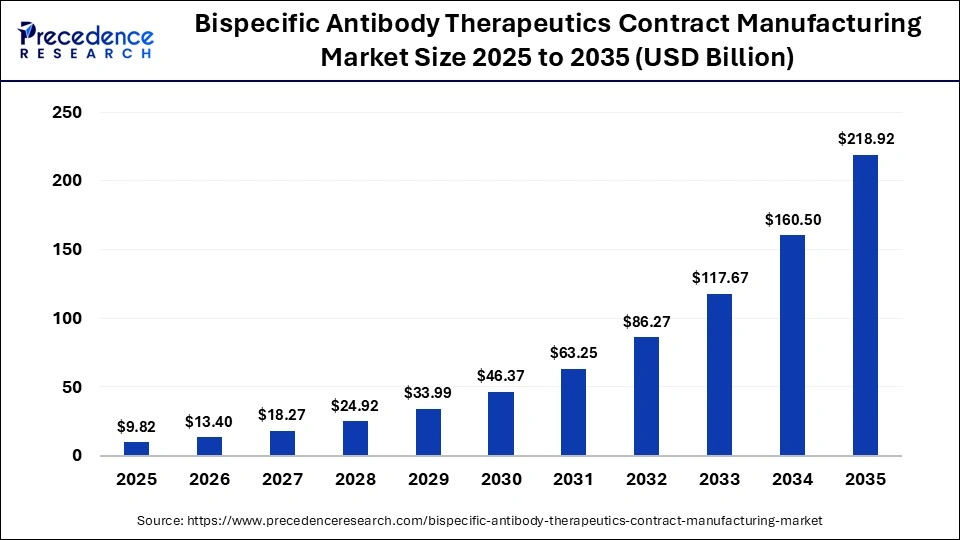
The strong expansion reflects increasing biopharmaceutical outsourcing, advances in antibody engineering, growing clinical development activity, and the need for specialized manufacturing infrastructure.
Download a Sample Report: https://www.precedenceresearch.com/sample/7444
Compact Scope Table of Bispecific Antibody Therapeutics Contract Manufacturing
| Report Coverage | Details |
|---|---|
| Sector Size in 2025 | USD 9.82 Billion |
| Sector Size in 2026 | USD 13.4 Billion |
| Sector Size by 2035 | USD 218.92 Billion |
| Growth Rate from 2026 to 2035 | CAGR of 36.4% |
| Leading Region | North America |
| Fastest-Growing Region | Asia Pacific |
| Leading Molecule Format | Full-Length IgG-Like Bispecifics |
| Leading Expression System | Mammalian Cell Systems |
| Leading Host Cell | CHO Cells |
| Leading Manufacturing Stage | Clinical Manufacturing |
| Leading Therapeutic Area | Oncology |
| Leading Route | Intravenous |
| Leading Contracting Model | Biotech Companies/Emerging Players |
| Base Year | 2025 |
| Forecast Period | 2026–2035 |
What Are Bispecific Antibody Therapeutics
Bispecific antibody therapeutics are engineered antibodies designed to recognize and bind to two different antigens or molecular targets.
This dual-targeting capability can create therapeutic mechanisms that are difficult to achieve with conventional monoclonal antibodies.
In oncology, for example, a bispecific antibody can be designed to connect immune cells with cancer cells or simultaneously target two disease-related pathways.
The growing number of bispecific candidates entering preclinical studies and clinical trials is creating more demand for specialized manufacturing services.
Unlike conventional antibodies, bispecific molecules can present additional challenges involving chain pairing, protein folding, stability, aggregation, expression, purification, and analytical characterization.
These complexities make experienced CDMOs increasingly important to pharmaceutical and biotechnology companies.
Why Contract Manufacturing Is Growing Rapidly
Biotechnology companies are increasingly outsourcing manufacturing because building specialized facilities internally can require significant capital, technical expertise, and regulatory resources.
CDMOs can provide cell line development, process development, analytical testing, clinical manufacturing, scale-up, formulation, fill-finish, and commercial production within established facilities.
This allows emerging biotechnology companies to focus more heavily on drug discovery and clinical development while relying on manufacturing partners for complex production requirements.
The expanding bispecific antibody pipeline is adding further pressure on available manufacturing capacity.
As candidates advance through clinical phases, developers need manufacturing partners capable of producing consistent, high-quality material while meeting increasingly demanding regulatory requirements.
AI Is Improving Bispecific Antibody Manufacturing
Artificial intelligence is becoming an important technology across bispecific antibody development and manufacturing.
AI and machine learning can support cell line development by helping researchers identify productive cell populations and optimize expression conditions.
Algorithms can also be used to predict protein stability, aggregation behavior, folding characteristics, and other attributes that influence manufacturing performance.
During production, AI-enabled process analytics can monitor bioreactor conditions and identify changes that could affect yield or product quality.
This can enable manufacturers to move toward more predictive and real-time process control.
AI may also help reduce development timelines by analyzing large quantities of experimental data and identifying promising process conditions more quickly.
For bispecific antibodies, AI-supported approaches are particularly valuable because the molecules can present complex structural and production challenges.
Key Technological Shift in Bispecific Manufacturing
The manufacturing ecosystem is undergoing a major technological shift as CDMOs adopt more sophisticated platforms for complex biologics.
Advanced cell-line engineering, synthetic biology, high-throughput screening, and improved purification technologies are helping manufacturers develop more efficient processes.
Single-use bioreactors are also becoming increasingly important because they can provide manufacturing flexibility while reducing cleaning and changeover requirements.
Continuous and perfusion-based manufacturing approaches are gaining attention as companies seek greater productivity from smaller production footprints.
Integrated analytics are another important development. Real-time monitoring can help manufacturers identify changes in process performance earlier and improve consistency.
Together, these technologies are helping CDMOs address the increasingly complicated requirements associated with bispecific antibody production.
Full-Length IgG-Like Bispecifics Lead Molecule Formats
Full-length IgG-like bispecifics represented approximately 60% of the molecule type segment in 2025.
Their leading position is supported by structural similarities to naturally occurring antibodies, established manufacturing processes, long half-lives, and strong therapeutic potential.
IgG-like formats can be particularly attractive for oncology and autoimmune applications where extended circulation and established antibody engineering platforms are valuable.
The segment benefits from growing clinical adoption and an expanding pipeline of candidates using established IgG-based architectures.
Fragment-Based and Non-IgG Formats Are Growing Rapidly
Fragment-based and non-IgG formats are expected to record the fastest growth during the forecast period.
These formats include technologies such as BiTEs, DARTs, TandAbs, nanobody-based structures, and other antibody-fragment configurations.
Their smaller structures can provide different pharmacokinetic and targeting characteristics and may offer advantages for selected therapeutic applications.
Increasing interest in alternative molecular architectures is encouraging additional research and outsourcing activity.
Mammalian Cell Systems Remain the Preferred Expression Platform
Mammalian cell systems dominated the expression system segment in 2025.
The primary advantage is their ability to perform complex post-translational modifications, achieve appropriate protein folding, and support the assembly of sophisticated antibody structures.
Mammalian systems can also provide glycosylation profiles that are important for antibody functionality, stability, and pharmacological behavior.
These characteristics make them particularly suitable for commercial-scale production of complex bispecific therapeutics.
CHO Cells Lead Mammalian Production
Within mammalian systems, CHO cells accounted for approximately 70% in 2025.
Chinese hamster ovary cells are widely used in biopharmaceutical manufacturing because of their scalability, established regulatory history, and ability to produce complex therapeutic proteins.
Their established manufacturing infrastructure makes CHO-based systems a preferred choice for many antibody development programs.
HEK293 and Human Cell Lines Offer Fast Growth
HEK293 and other human cell-line platforms are expected to grow at the fastest rate.
These systems can provide human-like post-translational processing and can be useful during early development and transient expression workflows.
Their speed and flexibility can be valuable for programs that require rapid generation of material for preclinical and early clinical studies.
Clinical Manufacturing Holds the Leading Position
Clinical manufacturing accounted for approximately 45% in 2025.
The strong position reflects the large number of bispecific antibody candidates progressing through clinical development.
Biotechnology companies frequently need flexible manufacturing support during Phase I and Phase II development as candidate formulations, processes, and batch requirements evolve.
CDMOs with strong clinical manufacturing capabilities can provide the technical expertise and flexible capacity needed during these stages.
Commercial Manufacturing Is Growing Fastest
Commercial manufacturing is expected to grow at the fastest pace as increasing numbers of bispecific therapies progress toward regulatory approval.
Successful clinical candidates eventually require larger production volumes, validated processes, robust quality systems, and reliable supply chains.
This is encouraging CDMOs to invest in larger bioreactors, automated systems, high-throughput purification, fill-finish capabilities, and dedicated biologics capacity.
Oncology Remains the Leading Therapeutic Area
Oncology accounted for approximately 55% of the sector in 2025.
Cancer remains the most important application area for bispecific antibodies because dual-targeting mechanisms can support immune-cell engagement and simultaneous targeting of disease pathways.
Bispecific T-cell engagers and IgG-like formats are being developed for hematological malignancies and solid tumors.
The growing number of oncology candidates in preclinical and clinical development is creating sustained demand for specialized contract manufacturing.
Autoimmune and Inflammatory Diseases Offer High Growth Potential
Autoimmune and inflammatory diseases are expected to represent the fastest-growing therapeutic area.
The expanding use of biologic treatments in chronic inflammatory conditions is creating additional opportunities for bispecific approaches that can address more than one disease-related pathway.
Increasing research activity in areas such as rheumatoid arthritis, psoriasis, and inflammatory bowel disease is supporting the development pipeline.
Intravenous Administration Continues to Lead
Intravenous administration represented approximately 65% in 2025.
IV delivery remains widely used because it enables rapid and reliable systemic exposure and is well established across hospital and specialist treatment settings.
This route is especially important for many oncology therapies where immediate therapeutic availability is desirable.
Subcutaneous Delivery Is Becoming More Important
Subcutaneous administration is expected to grow at the fastest pace.
SC delivery can provide greater convenience and may enable treatment outside infusion centers for suitable therapies.
The industry is therefore investing in bispecific formats and formulations capable of maintaining stability and therapeutic efficacy after subcutaneous administration.
The shift toward more patient-friendly delivery could eventually support greater use of home-based treatment models.
Biotech Companies and Emerging Players Lead Outsourcing Demand
Biotechnology companies and emerging players accounted for approximately 50% of the contracting model in 2025.
Smaller biotechnology companies often lack internal commercial manufacturing infrastructure and therefore depend heavily on CDMOs for process development, clinical production, analytical testing, and scale-up.
Strategic outsourcing allows these companies to access specialized expertise without making large investments in manufacturing facilities.
Large Pharmaceutical Companies Are Increasing Outsourcing
Large pharmaceutical companies are expected to record the fastest growth in outsourcing activity.
As pharmaceutical pipelines become more complex, large biopharmaceutical companies are increasingly using CDMOs to supplement internal capacity or access specialized technologies.
Outsourcing can also provide geographic diversification, additional manufacturing flexibility, and faster access to advanced production capabilities.
North America Remains the Dominant Region
North America accounted for approximately 68% of the global sector in 2025.
The region benefits from a highly developed biopharmaceutical ecosystem, advanced manufacturing infrastructure, strong R&D investment, and a large concentration of biotechnology companies.
The United States is particularly important because of its extensive clinical development activity and established CDMO infrastructure.
The high level of investment in advanced therapeutics is supporting continued demand for bispecific antibody manufacturing.
The U.S. Is a Major Manufacturing and Innovation Center
The United States accounted for a substantial portion of North American activity.
The U.S. benefits from established biologics manufacturing capabilities and a strong network of CDMOs.
Companies such as Lonza, Samsung Biologics, and WuXi Biologics contribute to the broader outsourcing ecosystem serving biopharmaceutical developers.
U.S. biotechnology companies are also investing in advanced manufacturing approaches such as AI-assisted development, single-use technologies, and flexible production systems.
The need for supply-chain resilience is further encouraging pharmaceutical companies to diversify manufacturing capacity and reduce concentration risk.
Asia Pacific Is Growing Fastest
Asia Pacific is expected to record the fastest growth through 2035.
The region benefits from lower manufacturing costs, expanding biopharmaceutical capabilities, skilled technical talent, and increasing government support for pharmaceutical R&D.
China, South Korea, Japan, and India are becoming increasingly important centers for biologics manufacturing and development.
South Korea has developed substantial large-scale biologics manufacturing capabilities, while China is rapidly expanding domestic biopharmaceutical capacity.
India is also strengthening its position through pharmaceutical manufacturing, biotechnology development, and global outsourcing partnerships.
The increasing availability of cost-competitive manufacturing services is likely to encourage more international outsourcing activity across Asia Pacific.
China Is Expanding Its Biopharmaceutical Capabilities
China has become an important contributor to the development of complex biologics.
Government support for pharmaceutical innovation, growing R&D expenditure, and partnerships between domestic and international companies are strengthening the country’s capabilities.
Collaborations involving companies such as Innovent Biologics and Duality Biologics illustrate the increasing sophistication of China’s biologics ecosystem.
As local companies expand their development pipelines, demand for specialized manufacturing and analytical services is likely to increase.
Europe Continues to Strengthen Biologics Manufacturing
Europe remains an important region for bispecific antibody development and contract manufacturing.
Countries including Germany, the UK, and France benefit from established pharmaceutical research capabilities and advanced biologics infrastructure.
Investment in single-use technologies and advanced antibody engineering is supporting regional competitiveness.
The presence of major biopharmaceutical manufacturers and specialized CDMOs is also enabling integrated development and manufacturing services.
Germany Benefits From a Strong Biopharmaceutical Base
Germany is an important European center for biopharmaceutical manufacturing and research.
Its established pharmaceutical ecosystem and technical capabilities provide a strong foundation for complex biologics development.
CDMOs operating in the country are expanding their ability to handle sophisticated molecular formats, creating additional outsourcing opportunities.
The Bispecific Antibody Manufacturing Value Chain
The value chain begins with molecule discovery and process development before progressing through cell-line engineering, clinical manufacturing, commercial production, and analytical testing.
Research and Development
Specialized R&D teams develop antibody formats, optimize molecular structures, select expression systems, and establish manufacturing processes.
Important participants include Lonza, WuXi Biologics, Samsung Biologics, AGC Biologics, and Creative Biolabs.
Clinical Development and Regulatory Support
Clinical manufacturing requires coordination between biotechnology companies, pharmaceutical developers, CDMOs, regulators, analytical laboratories, and clinical research organizations.
Manufacturing partners must demonstrate process consistency, product quality, traceability, and regulatory compliance.
Commercial Manufacturing
Once therapies receive approval, manufacturers must scale processes to commercial volumes while maintaining product quality.
Large CDMOs can provide production capacity, formulation, fill-finish, quality control, and release testing.
Patient and Lifecycle Support
Manufacturers and pharmaceutical companies may also provide services that support distribution, treatment continuity, safety monitoring, and product lifecycle management.
These services complement manufacturing and help maintain product availability throughout the therapy’s commercial life.
Major Companies Competing in Bispecific Antibody Manufacturing
The competitive landscape includes major CDMOs, biologics manufacturers, specialized technology providers, and pharmaceutical companies.
Key participants include:
- Lonza Group Ltd.
- WuXi Biologics
- Catalent, Inc.
- Fujifilm Diosynth Biotechnologies
- Boehringer Ingelheim BioXcellence
- Thermo Fisher Scientific (Patheon)
- AbbVie Contract Manufacturing
- Abzena Plc
- KBI Biopharma
- AGC Biologics
- Rentschler Biopharma SE
- Charles River Laboratories Biologics Division
- Bio-Techne / ProteinSimple
- CMAB Biopharma / WuXi STA
Competition is increasingly focused on manufacturing capacity, technical expertise, molecular-format flexibility, analytical capabilities, regulatory experience, process efficiency, and speed to clinical and commercial production.
Recent Industry Developments
In April 2025, Lotte Biologics launched a new antibody-drug conjugate manufacturing facility in Syracuse, New York, following an investment of approximately USD 100 million. The facility strengthens the company’s CDMO capabilities for complex antibody-based therapies.
In December 2024, Novo Holdings completed its previously announced acquisition of Catalent in an all-cash transaction with a total enterprise value of approximately USD 16.5 billion. The transaction highlights the strategic importance of large-scale biologics development and manufacturing infrastructure.
These developments reflect broader investment in specialized biologics manufacturing and the growing strategic importance of outsourced production capabilities.
Challenges Facing Bispecific Antibody Manufacturing
Despite its rapid expansion, bispecific antibody manufacturing presents significant technical and operational challenges.
The molecules can be more difficult to express and purify than conventional monoclonal antibodies.
Chain mispairing can create unwanted molecular variants, requiring sophisticated engineering and analytical processes to achieve consistent product quality.
Manufacturers must also manage aggregation, stability, yield, and product heterogeneity.
Scaling processes from laboratory or clinical production to commercial manufacturing can introduce additional challenges.
Regulatory requirements are another important factor. Bispecific therapeutics require extensive analytical characterization and process validation because of their complex structures.
High capital requirements for specialized facilities and shortages of experienced biologics manufacturing professionals can also constrain capacity expansion.
What Biopharmaceutical Companies Should Watch
Pharmaceutical companies, biotechnology firms, CDMOs, investors, and healthcare technology providers should closely monitor:
- Full-length IgG-like bispecifics
- BiTE and DART platforms
- Advanced antibody engineering
- CHO cell-line development
- HEK293 expression systems
- Single-use bioreactors
- Continuous and perfusion manufacturing
- AI-enabled process optimization
- Automated analytical testing
- Clinical manufacturing capacity
- Commercial-scale biologics production
- Subcutaneous bispecific formulations
- Oncology pipelines
- Autoimmune and inflammatory applications
- Asia Pacific manufacturing expansion
The Road Ahead
Bispecific antibody therapeutics contract manufacturing is moving into a high-growth, technology-intensive phase.
The expansion of clinical pipelines is increasing demand for specialized manufacturing partners that can manage complex molecular formats from early development through commercial production.
The next phase of growth will likely focus on improving manufacturing yields, reducing development timelines, strengthening analytical capabilities, and increasing production flexibility.
AI, advanced cell-line engineering, single-use systems, continuous processing, and real-time analytics will play increasingly important roles in this evolution.
The shift toward subcutaneous delivery could also expand the range of patient-friendly bispecific therapies, while commercial approvals will create additional demand for large-scale manufacturing infrastructure.
The biggest opportunity lies in developing integrated manufacturing platforms that combine antibody engineering, process development, clinical production, commercial scale-up, analytics, and regulatory support.
As the bispecific antibody pipeline continues to expand, experienced CDMOs with advanced technology platforms and flexible capacity will become increasingly important to the global biopharmaceutical ecosystem.
Buy this report: https://www.precedenceresearch.com/checkout/7444
About Us
Healthcare Prism is a dedicated healthcare insights and outreach platform, operating as an extension of Precedence Research. We share relevant perspectives, industry developments, emerging trends, and research-driven insights across the global healthcare sector. Our content is built on the knowledge, research standards, and expertise of Precedence Research, with a focus on making healthcare information clear, accessible, and useful for industry professionals, businesses, researchers, and healthcare stakeholders. Healthcare Prism serves as a focused platform to extend the reach of Precedence Research’s healthcare insights and connect them with a broader professional audience.
You can place an order or ask any questions, please feel free to contact us at [email protected]
Quick Contact:
Europe Region: +44 778 256 0738
North America Region: +1 8044 4193 44
APAC Region: +91 9356 9282 04 and +65 31065601
Visit Our Website: Precedence Research – Advisory, Research & Reports