
The mother and child healthcare sector is expanding as governments, healthcare providers, and families place greater emphasis on maternal wellness, newborn safety, preventive care, and pediatric health. Valued at USD 62.50 billion in 2025, the sector is projected to increase from USD 66.75 billion in 2026 to approximately USD 120.67 billion by 2035, growing at a CAGR of 6.80% from 2026 to 2035.
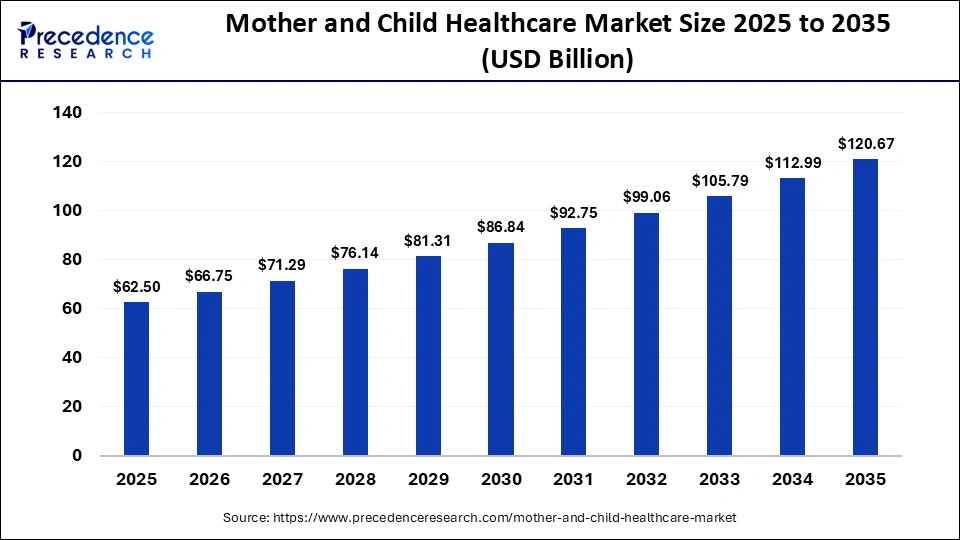
The growth is supported by rising awareness of prenatal and postnatal care, improvements in neonatal services, increasing use of digital healthcare, growing demand for specialized fertility solutions, and continued efforts to reduce maternal and infant mortality.
Download a Sample Report: https://www.precedenceresearch.com/sample/8280
Why Mother and Child Healthcare Is Gaining Strong Momentum
Mother and child healthcare covers a broad range of medical products, services, and support solutions designed for women during pregnancy, childbirth, and the postpartum period, as well as newborns and children.
The sector includes prenatal monitoring, maternal nutrition, fertility services, childbirth support, neonatal care, pediatric healthcare, family planning, immunization, and postnatal care. Hospitals remain central to this ecosystem because they offer comprehensive services and specialized professionals capable of managing routine as well as high-risk pregnancies.
At the same time, healthcare delivery is becoming more personalized and accessible. Telemedicine, wearable monitoring devices, digital health applications, and remote consultations are helping mothers and families receive care outside conventional hospital settings.
AI Is Revolutionizing Maternal and Child Healthcare
Artificial intelligence is becoming an important technology across maternal and pediatric healthcare. AI-powered systems can analyze patient histories, laboratory results, imaging data, and physiological measurements to support earlier identification of potential risks.
In maternal healthcare, AI can assist with:
- Risk prediction for pregnancy complications
- Fetal health monitoring
- Prenatal screening
- Personalized care planning
- Remote patient monitoring
- Clinical decision support
AI can also support pediatric care by helping healthcare professionals analyze patient data, monitor development, and identify potential health concerns earlier.
The growing integration of AI with electronic health records, wearable devices, and telehealth platforms could make maternal and child healthcare more proactive and data-driven.
Neonatal Care Holds a Leading Position
The neonatal care segment accounted for 30% in 2025, making it the leading application segment.
The growing need for specialized newborn care is supporting demand for neonatal intensive care units, incubators, ventilators, patient monitoring systems, and other specialized technologies. Increasing attention to premature births and newborn safety is also encouraging hospitals to strengthen neonatal infrastructure.
Prenatal care represented 28% in 2025 and remains an important area because regular screening and monitoring can help healthcare professionals identify pregnancy-related complications at earlier stages.
Child Healthcare Products Continue to Lead
The child healthcare products segment held 47% in 2025, supported by rising spending on pediatric nutrition, baby care products, preventive healthcare, and infant wellness.
Parents are increasingly looking for products that prioritize safety, quality, nutrition, and convenience. This includes infant formula, baby foods, pediatric devices, diapers, wipes, skincare products, and health supplements.
The maternal healthcare products segment, accounting for 45%, is also expanding as awareness of pregnancy nutrition, fertility care, maternal monitoring, and postpartum wellness increases.
Retail Remains a Major Distribution Channel
The retail segment accounted for 55% in 2025 and continues to play a major role in the distribution of maternal and child healthcare products.
Retail stores, pharmacies, supermarkets, and specialized outlets provide convenient access to baby care products, supplements, nutritional products, and routine healthcare essentials. Consumers also value the ability to physically evaluate products before purchasing them.
At the same time, online healthcare platforms are expanding rapidly. Digital channels are making it easier for families to access healthcare information, order products, schedule consultations, and receive ongoing support.
Hospitals Remain the Primary Care Setting
Hospitals represented 40% of the sector in 2025, supported by their ability to provide comprehensive maternal, neonatal, and pediatric services.
Hospitals offer specialized obstetric and pediatric departments, diagnostic infrastructure, intensive care units, surgical services, and emergency support. They are particularly important for high-risk pregnancies, complicated deliveries, premature births, and children requiring specialized treatment.
Private clinics, pharmacies, and online platforms are also gaining importance as healthcare becomes more distributed across different settings.
North America Maintains a Strong Leadership Position
North America accounted for approximately 38% in 2025, supported by advanced healthcare infrastructure, high healthcare expenditure, strong insurance systems, and widespread adoption of advanced maternal and neonatal technologies.
The United States remains a major contributor due to its well-developed hospital network, advanced fertility services, neonatal care capabilities, and strong adoption of digital healthcare.
Technologies such as AI-assisted diagnostics, wearable monitoring, telemedicine, and connected healthcare platforms are further improving accessibility and clinical efficiency.
Europe Is Emerging as a Fast-Growing Region
Europe is expected to experience strong growth during the forecast period, supported by public healthcare programs, advanced medical infrastructure, government initiatives, and increasing adoption of digital maternal and child healthcare.
Germany is an important contributor due to its comprehensive healthcare system, advanced medical technology ecosystem, and strong pharmaceutical and medical device sectors. Greater emphasis on maternal nutrition, newborn care, fertility treatment, and pediatric health is creating additional opportunities.
Asia Pacific Offers Significant Expansion Opportunities
Asia Pacific is supported by a large population base, improving healthcare infrastructure, increasing healthcare spending, and rising awareness of maternal and child wellness.
Countries such as India, China, and Japan are expanding access to prenatal care, neonatal services, fertility treatments, pediatric healthcare, and digital health solutions.
India is particularly important because government programs such as Janani Suraksha Yojana and Janani Shishu Suraksha Karyakram are supporting institutional deliveries and improving access to maternal and newborn services.
How Leading Companies Are Positioning
Leading companies are strengthening their positions through product innovation, specialized healthcare services, nutrition solutions, medical technologies, and digital platforms.
Johnson & Johnson and Abbott Laboratories maintain broad healthcare portfolios, while Philips Healthcare and GE Healthcare contribute advanced monitoring and medical technologies.
Danone, Nestlé Health Science, Medela, Kimberly-Clark, and Gerber focus on maternal and infant nutrition, baby care, and consumer wellness.
Companies are increasingly investing in digital health, connected monitoring, specialized nutrition, neonatal technologies, fertility solutions, and personalized healthcare services to meet evolving needs.
Recent Developments
In December 2025, Rainbow Children’s Hospital launched holistic mother and child healthcare services in Rajamahendravaram, aiming to expand access to specialized healthcare services across surrounding areas.
In December 2025, U.S. health regulators initiated renewed safety reviews of certain infant RSV preventive treatments, highlighting continued regulatory attention toward pediatric healthcare and preventive solutions.
The Future of Mother and Child Healthcare
The future of mother and child healthcare is moving toward earlier intervention, personalized care, connected monitoring, stronger neonatal support, and broader digital access.
AI, wearable technologies, telemedicine, advanced fertility solutions, and specialized neonatal equipment are expected to play a growing role in improving care delivery. Meanwhile, continued government efforts to reduce maternal and infant mortality will support investment in healthcare infrastructure and services.
As families become more informed and healthcare systems become more technology-driven, the sector is expected to evolve toward a more preventive, personalized, accessible, and technology-enabled model of care.
Buy this report: https://www.precedenceresearch.com/checkout/8280
About Us
Healthcare Prism is a dedicated healthcare insights and outreach platform, operating as an extension of Precedence Research. We share relevant perspectives, industry developments, emerging trends, and research-driven insights across the global healthcare sector. Our content is built on the knowledge, research standards, and expertise of Precedence Research, with a focus on making healthcare information clear, accessible, and useful for industry professionals, businesses, researchers, and healthcare stakeholders. Healthcare Prism serves as a focused platform to extend the reach of Precedence Research’s healthcare insights and connect them with a broader professional audience.
You can place an order or ask any questions, please feel free to contact us at [email protected]
Quick Contact:
Europe Region: +44 778 256 0738
North America Region: +1 8044 4193 44
APAC Region: +91 9356 9282 04 and +65 31065601
Visit Our Website: Precedence Research – Advisory, Research & Reports