
The enteric disease testing sector is expanding as healthcare providers, diagnostic laboratories, and public health organizations focus on faster and more accurate detection of gastrointestinal infections.
The global sector was valued at USD 4.30 billion in 2025 and is projected to reach USD 8.09 billion by 2035, growing at a CAGR of 6.52% from 2026 to 2035. Rising cases of bacterial, viral, and parasitic infections such as Salmonella, E. coli, Shigella, norovirus, rotavirus, Giardia, and Cryptosporidium are increasing demand for reliable diagnostic solutions. Growing investment in laboratory infrastructure, food-safety surveillance, and infectious disease monitoring is further supporting adoption.
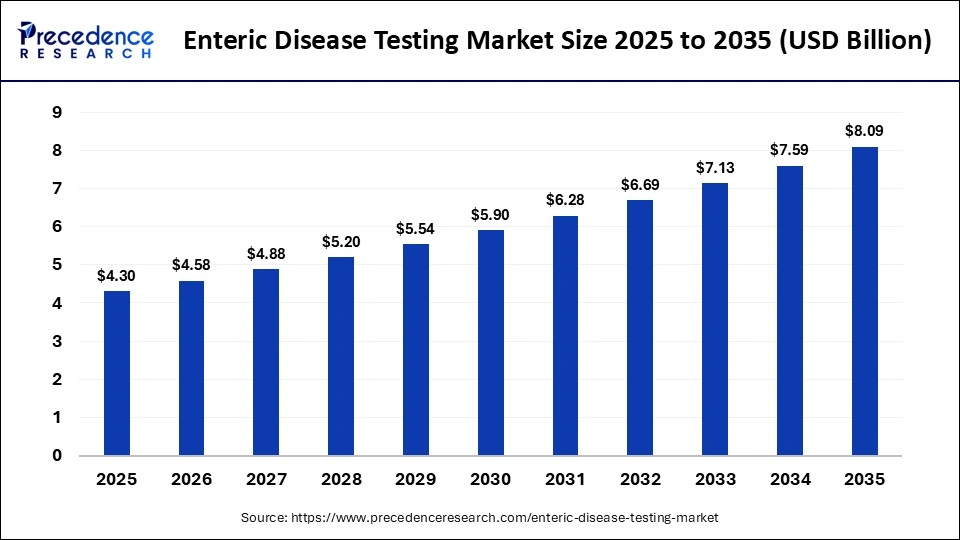
The sector is also shifting from conventional testing toward molecular diagnostics, automation, AI, and emerging CRISPR-based technologies. PCR and nucleic acid amplification testing can identify multiple pathogens from a single sample with high sensitivity and faster turnaround times, supporting timely treatment and infection control. AI can assist with stool sample analysis, pathogen identification, and outbreak surveillance by analyzing clinical, laboratory, and epidemiological data. Meanwhile, CRISPR-based platforms such as SHERLOCK and DETECTR are creating opportunities for rapid and potentially decentralized pathogen detection. Together, these innovations are making enteric disease testing faster, smarter, and more accessible across hospitals, laboratories, research institutions, and public health settings.
Download a Sample Report: https://www.precedenceresearch.com/sample/8259
Why Enteric Disease Testing Is Becoming More Critical
Enteric disease testing helps identify microorganisms responsible for gastrointestinal infections, including bacteria, viruses, and parasites. Testing methods range from traditional culture techniques to advanced PCR, nucleic acid amplification, immunoassays, and other molecular technologies.
As outbreaks of foodborne and waterborne diseases continue to place pressure on healthcare systems, rapid diagnosis is becoming increasingly important. Accurate pathogen identification helps healthcare professionals select appropriate treatment and supports broader infection-control and surveillance efforts.
AI Is Revolutionizing Enteric Disease Detection
Artificial intelligence is introducing new capabilities across enteric disease testing. AI-powered systems can support the analysis of stool samples, automate image-based parasite detection, and process complex diagnostic data more efficiently.
AI can also combine information from hospital records, epidemiological databases, and geographic data to identify infection patterns and support outbreak prediction. These capabilities can help laboratories improve testing efficiency while enabling faster responses to emerging infectious threats.
CRISPR Diagnostics Are Unlocking Powerful Opportunities
CRISPR-based diagnostic technologies are emerging as an important area of innovation. Platforms based on technologies such as SHERLOCK and DETECTR can potentially provide highly sensitive pathogen detection with rapid turnaround times.
The growing interest in portable and point-of-care diagnostics could make these solutions particularly valuable in areas where laboratory infrastructure is limited.
Molecular Diagnostics Continue to Lead
The molecular diagnostics segment accounted for 45% of the sector in 2025, supported by high sensitivity, accuracy, and shorter turnaround times.
PCR-based panels can identify multiple pathogens from a single sample, making them especially useful in hospitals and diagnostic laboratories. Their ability to support rapid differentiation between bacterial and viral infections is further increasing their clinical value.
Bacterial Enteric Diseases Hold the Largest Share
The bacterial enteric disease segment represented 55.1% in 2025, driven by the continued burden of infections caused by pathogens such as Salmonella, E. coli, and Shigella.
Meanwhile, viral enteric diseases are expected to experience strong growth as norovirus, rotavirus, and adenovirus continue to contribute to acute gastroenteritis, particularly among children.
Reagents and Consumables Remain Essential
The reagents and consumables segment held the leading position in 2025 because every diagnostic workflow depends on testing materials such as assay kits, culture media, reagents, and buffers.
Demand is rising alongside laboratory automation and the expansion of molecular testing. Manufacturers are increasingly developing higher-sensitivity consumables to support faster and more reliable pathogen detection.
Hospitals Remain the Primary Testing Hub
Hospital laboratories accounted for the largest share in 2025. Their access to advanced diagnostic infrastructure and integration with clinical care make them essential for rapid infectious disease detection.
Pharmaceutical and biotechnology companies are also expanding their role by using enteric disease testing in research, clinical trials, pathogen studies, and vaccine development.
North America Leads the Global Landscape
North America held approximately 38.5% of the sector in 2025, supported by advanced laboratory infrastructure, strong food-safety systems, and high adoption of molecular diagnostics.
The United States remains the major contributor, with strong participation from companies such as Hologic, Thermo Fisher Scientific, Bio-Rad Laboratories, Neogen, and Abbott.
Asia Pacific Is Accelerating Rapidly
Asia Pacific is expected to record the fastest growth during the forecast period. Rising infectious disease burdens, expanding healthcare infrastructure, and increasing investment in public health laboratories are supporting adoption.
China and India are particularly important growth areas as governments and private healthcare providers expand laboratory capabilities and introduce automated diagnostic technologies.
How Leading Companies Are Positioning
The competitive landscape includes major diagnostic technology providers, laboratory equipment manufacturers, and specialized testing companies.
Abbott, bioMérieux, Danaher, Thermo Fisher Scientific, Roche, Hologic, Bio-Rad Laboratories, QIAGEN, and QuidelOrtho are strengthening their positions through molecular diagnostics, automated laboratory platforms, rapid testing, and integrated data solutions.
Companies are increasingly focusing on multiplex testing, laboratory automation, AI-assisted diagnostics, CRISPR technologies, and faster pathogen identification to improve testing performance and expand clinical applications.
Recent Developments
In March 2026, Roche launched the Cobas MPX-E assay, expanding advanced pathogen screening capabilities for diagnostic laboratories.
In October 2025, Hologic received FDA approval for expanded Panther Fusion gastrointestinal bacterial assays, supporting detection of bacterial pathogens responsible for infectious gastroenteritis.
In August 2025, Bio-Rad Laboratories launched the EZ-Check Salmonella spp. Kit for Salmonella detection, strengthening rapid testing capabilities.
The Future of Enteric Disease Testing Is Becoming Faster and Smarter
The future of enteric disease testing is moving toward rapid molecular detection, AI-assisted analysis, portable diagnostics, and highly sensitive pathogen identification.
As infectious disease surveillance becomes more important, laboratories will increasingly adopt technologies that deliver faster results while reducing manual testing requirements. The combination of molecular diagnostics, automation, AI, and emerging CRISPR platforms is expected to reshape how enteric infections are detected and monitored globally.
Buy this report: https://www.precedenceresearch.com/checkout/8259
About Us
Healthcare Prism is a dedicated healthcare insights and outreach platform, operating as an extension of Precedence Research. We share relevant perspectives, industry developments, emerging trends, and research-driven insights across the global healthcare sector. Our content is built on the knowledge, research standards, and expertise of Precedence Research, with a focus on making healthcare information clear, accessible, and useful for industry professionals, businesses, researchers, and healthcare stakeholders. Healthcare Prism serves as a focused platform to extend the reach of Precedence Research’s healthcare insights and connect them with a broader professional audience.
You can place an order or ask any questions, please feel free to contact us at [email protected]
Quick Contact:
Europe Region: +44 778 256 0738
North America Region: +1 8044 4193 44
APAC Region: +91 9356 9282 04 and +65 31065601
Visit Our Website: Precedence Research – Advisory, Research & Reports