
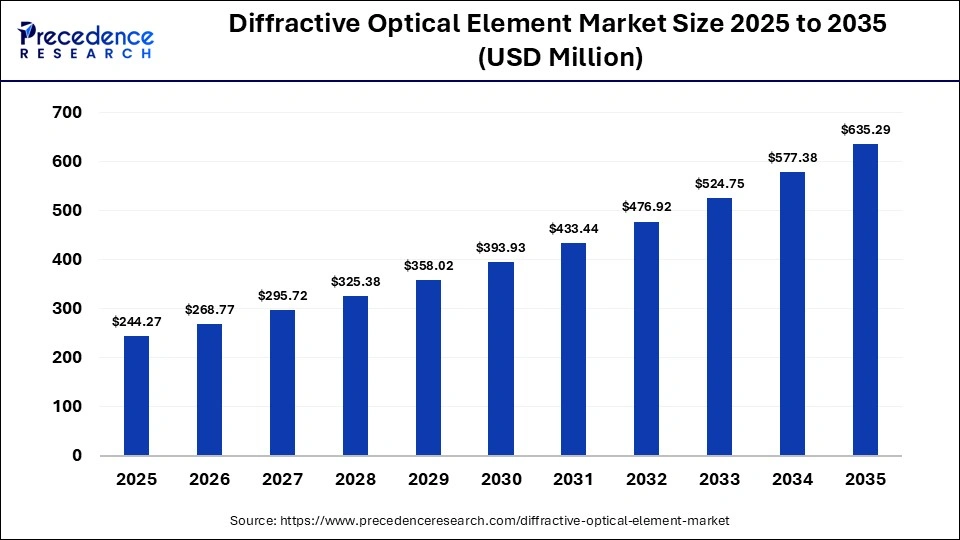
The global diffractive optical element sector was valued at USD 244.27 million in 2025 and is projected to reach USD 268.77 million in 2026 and approximately USD 635.29 million by 2035, expanding at a CAGR of 10.03% from 2026 to 2035.
Growth is being driven by rising demand for compact optical systems, increasing adoption of laser-based technologies, expansion of 3D sensing and LiDAR, and growing applications across automotive, healthcare, telecommunications, industrial manufacturing, and consumer electronics.
Download a Sample Report: https://www.precedenceresearch.com/sample/8119
Diffractive Optical Element Overview
Diffractive optical elements are engineered optical components that use microscopic surface structures to control the phase and direction of light. Unlike conventional lenses that primarily rely on refraction, DOEs manipulate light through diffraction, enabling precise beam shaping, splitting, homogenization, pattern generation, and wavelength control.
Common DOE types include beam shapers, beam splitters, diffusers and homogenizers, pattern generators, and diffractive gratings. These components can be manufactured using photolithography, nanoimprint lithography, electron-beam lithography, laser direct writing, and holographic techniques.
The technology is becoming increasingly important as industries demand optical systems that are smaller, lighter, more efficient, and capable of delivering highly precise light control.
Why Are Diffractive Optical Elements Gaining Strong Momentum?
The growing need for compact and high-performance optical components is creating significant opportunities for diffractive optical elements. DOEs can perform complex optical functions within very small footprints, making them particularly valuable for miniaturized devices.
Their adoption is increasing in laser material processing, medical lasers, fiber-optic communications, machine vision, LiDAR, AR/VR, robotics, and advanced imaging. The expansion of autonomous systems and connected devices is creating additional demand for components capable of controlling and distributing laser or light beams with high accuracy.
AI Is Revolutionizing Diffractive Optical Element Applications
Artificial intelligence is expanding the capabilities of diffractive optical elements by enabling more intelligent optimization of light patterns and optical systems. AI algorithms can analyze complex optical data and help determine optimal diffraction structures for specific applications.
In LiDAR and 3D sensing, AI can work alongside DOE-based optical systems to improve object detection, depth estimation, and environmental interpretation. In telecommunications, AI-assisted optical networks can use advanced components for beam alignment, signal routing, and wavelength management.
AI is also supporting optical design by allowing engineers to evaluate multiple configurations faster and identify structures that deliver improved efficiency and precision.
Powerful Trends Shaping Diffractive Optical Elements
AR and VR Are Accelerating Demand
AR and VR devices require lightweight and compact optical architectures. DOEs can provide precise light management in small form factors, making them attractive for wearable displays and head-up display technologies.
LiDAR and 3D Sensing Are Expanding Rapidly
DOEs are increasingly used to split and shape laser beams for depth sensing and LiDAR. Their ability to distribute light into controlled patterns supports applications in autonomous vehicles, robotics, smart devices, and industrial automation.
Nanoimprint Lithography Is Gaining Ground
Nanoimprint lithography is emerging as an efficient method for producing high-precision micro- and nanostructures. Its ability to replicate intricate optical patterns at scale can reduce manufacturing complexity and support cost-efficient production.
Flat Optics and Metasurfaces Are Opening New Possibilities
Metasurfaces and other flat-optical technologies are pushing optical miniaturization further. These structures can manipulate light properties such as phase and polarization while occupying significantly less physical space than traditional optical assemblies.
Beam Shapers Maintain Strong Leadership
The beam shapers segment held the largest share of approximately 26.70% in 2025. Beam shapers are widely used to transform laser beams into specific intensity profiles required for industrial and scientific applications.
Laser cutting, welding, marking, micromachining, medical equipment, semiconductor processing, and advanced imaging all benefit from precise beam control. Improvements in microfabrication and optical materials are further enhancing the performance and durability of these components.
The pattern generators segment is expected to grow at a CAGR of 11.20% between 2026 and 2035. Increasing adoption in holography, optical trapping, laser projection, biomedical research, and advanced imaging is strengthening demand.
Photolithography Remains a Major Manufacturing Technology
The photolithography segment accounted for 32.60% of the share in 2025. Photolithography provides the precision and repeatability required to produce intricate DOE structures for semiconductor, telecommunications, optical instrumentation, and laser applications.
The nanoimprint lithography segment is expected to expand at the fastest CAGR of 13.20%. NIL enables manufacturers to replicate nanoscale structures efficiently and can offer advantages in production speed, scalability, and material utilization.
Fused Silica Leads Substrate Materials
The fused silica segment held a leading 34.80% share in 2025. Fused silica offers excellent optical transmission, low thermal expansion, chemical resistance, and strong performance in demanding laser environments.
These properties make it suitable for high-power lasers, microscopy, lithography, precision instrumentation, and other applications requiring high optical stability.
The polymer segment is expected to grow at a CAGR of 12.30%. Lightweight construction, flexible manufacturing, lower production costs, and compatibility with high-volume replication methods are increasing the use of polymer-based DOEs.
Laser Material Processing Drives Major Demand
The laser material processing segment accounted for 28.60% of the share in 2025. DOEs help distribute and shape laser energy for cutting, welding, drilling, marking, and micromachining.
As manufacturing industries increasingly adopt automation and precision laser processing, DOEs are helping improve energy distribution, processing speed, accuracy, and production consistency.
The 3D sensing and LiDAR segment is expected to grow at a CAGR of 12.80% through 2035. Increasing adoption of autonomous vehicles, robotics, industrial automation, and smart sensing systems is strengthening demand for advanced beam-shaping optics.
Industrial Manufacturing Remains a Key End User
The industrial manufacturing segment held the largest share of 30.70% in 2025. Advanced manufacturing applications depend on precise optical systems for laser processing, inspection, metrology, and automation.
The automotive segment is expected to expand at the fastest CAGR of 13.10% during the forecast period. Increasing use of LiDAR, advanced driver-assistance systems, adaptive lighting, head-up displays, and autonomous driving technologies is generating strong demand for compact and precise optical components.
Asia Pacific Leads Global Adoption
Asia Pacific accounted for approximately 48.70% of the global share in 2025. The region benefits from large-scale electronics manufacturing, strong semiconductor production, automotive expansion, and a high concentration of optical component manufacturers.
China, Japan, and South Korea are major contributors, supported by investments in photonics, industrial automation, consumer electronics, automotive sensing, and semiconductor technologies.
North America is expected to grow at the fastest rate. Strong investments in photonics research, defense and aerospace technologies, LiDAR, optical communications, and advanced manufacturing are supporting rapid adoption.
Europe is also witnessing steady expansion through developments in automotive technology, telecommunications, medical optics, and industrial laser systems. Germany, France, and the UK remain important contributors to regional innovation.
Recent Developments
In February 2026, Milliken introduced a new range of polymers designed to deliver faster cycle times, improved aesthetics, and enhanced optical clarity.
In January 2026, Vuzix Corporation collaborated with Himax to develop optical glass technologies aimed at advancing AR capabilities.
In January 2025, Coherent Corp. introduced ultrabroadband UV-VIS and VIS-NIR diffraction gratings designed to improve optical systems across life science, medical, and industrial applications.
In January 2025, Radiant Opto-Electronics Corporation acquired NIL Technology, combining advanced nano-optical technologies with high-volume manufacturing capabilities to accelerate development of next-generation optical solutions.
Future Outlook for Diffractive Optical Elements
The future of diffractive optical elements is being shaped by miniaturization, advanced manufacturing, AI-assisted optical design, LiDAR, AR/VR, photonics, and precision laser processing. The technology offers an attractive combination of compact form factor, precise light manipulation, and scalable fabrication.
With the global sector projected to reach approximately USD 635.29 million by 2035, increasing adoption across automotive, industrial manufacturing, healthcare, telecommunications, consumer electronics, and advanced sensing is expected to create powerful opportunities for DOE manufacturers and photonics technology developers.
Buy this report: https://www.precedenceresearch.com/checkout/8119
About Us
Healthcare Prism is a dedicated healthcare insights and outreach platform, operating as an extension of Precedence Research. We share relevant perspectives, industry developments, emerging trends, and research-driven insights across the global healthcare sector. Our content is built on the knowledge, research standards, and expertise of Precedence Research, with a focus on making healthcare information clear, accessible, and useful for industry professionals, businesses, researchers, and healthcare stakeholders. Healthcare Prism serves as a focused platform to extend the reach of Precedence Research’s healthcare insights and connect them with a broader professional audience.
You can place an order or ask any questions, please feel free to contact us at [email protected]
Quick Contact:
Europe Region: +44 778 256 0738
North America Region: +1 8044 4193 44
APAC Region: +91 9356 9282 04 and +65 31065601
Visit Our Website: Precedence Research – Advisory, Research & Reports