
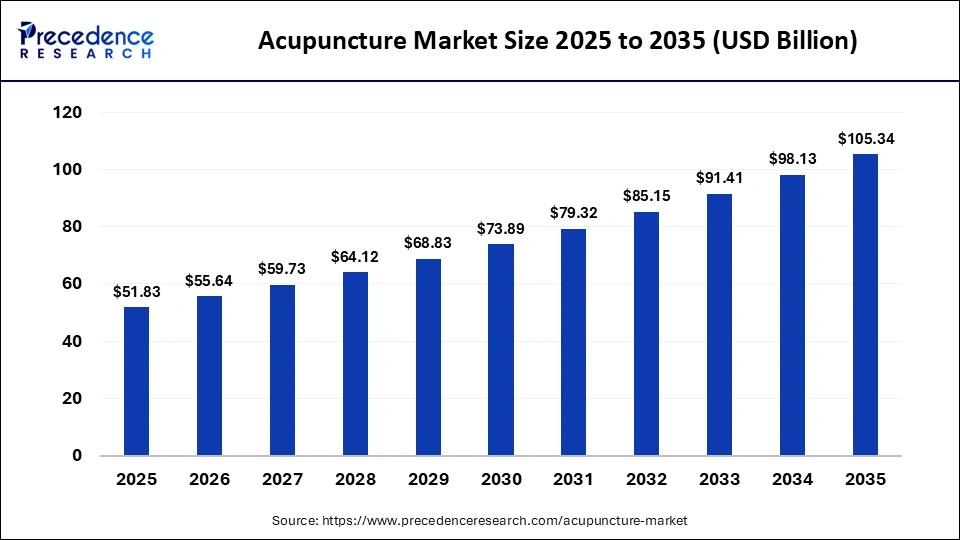
The global acupuncture sector was valued at USD 51.83 billion in 2025 and is projected to reach USD 55.64 billion in 2026 and approximately USD 105.34 billion by 2035, expanding at a CAGR of 7.35% from 2026 to 2035.
Strong growth is being supported by increasing acceptance of complementary medicine, rising demand for drug-free pain management, expanding healthcare coverage, and the growing elderly population. Greater awareness of stress-related disorders and the integration of acupuncture into modern healthcare programs are also strengthening demand.
Download a Sample Report: https://www.precedenceresearch.com/sample/8123
Acupuncture Overview
Acupuncture is a traditional therapeutic practice that involves stimulating specific points of the body using fine, sterile needles. It is commonly used as a complementary approach for pain management, stress relief, rehabilitation, and selected chronic health conditions.
Modern acupuncture has evolved beyond conventional needle-based techniques. Contemporary practices can include electroacupuncture, laser stimulation, moxibustion, cupping, and technology-assisted acupoint mapping. These developments are helping practitioners deliver more structured and personalized treatment while maintaining the core principles of acupuncture.
The growing interest in holistic and patient-centered healthcare is creating new opportunities for acupuncture services and related equipment across hospitals, clinics, rehabilitation centers, wellness facilities, and home-based care environments.
Why Is Acupuncture Gaining Powerful Momentum?
One of the strongest factors supporting acupuncture adoption is the growing preference for non-pharmaceutical approaches to managing pain and stress. Patients with chronic musculoskeletal discomfort, headaches, and other long-term symptoms are increasingly exploring complementary therapies alongside conventional medical treatment.
The aging population is another important contributor. Older adults frequently experience chronic pain, mobility challenges, and age-related health conditions that can require long-term management. Acupuncture is therefore becoming increasingly relevant as part of broader rehabilitation and wellness programs.
Healthcare systems are also becoming more open to integrative care. In several regions, acupuncture is being incorporated into multidisciplinary treatment plans alongside physical therapy, conventional medicine, rehabilitation, and wellness services.
AI Is Transforming Acupuncture Care
Artificial intelligence is introducing new possibilities for acupuncture diagnosis, treatment planning, and patient monitoring. AI-supported systems can analyze large amounts of health information and identify patterns that may help practitioners develop more individualized treatment approaches.
Machine learning can support acupoint selection by combining patient symptoms, medical history, physiological signals, and treatment-response data. Digital systems can also assist practitioners in tracking treatment progress and identifying patterns across multiple sessions.
AI can further contribute to research by organizing traditional medical knowledge and evaluating large clinical datasets. As digital health platforms become more sophisticated, AI has the potential to support more consistent documentation, personalized therapy planning, and improved patient engagement.
Powerful Trends Shaping Acupuncture
Drug-Free Pain Management Is Expanding
The growing focus on alternatives to long-term medication is increasing interest in acupuncture for pain management. Patients are increasingly seeking treatment approaches that can complement conventional care while supporting broader wellness goals.
Technology Is Modernizing Treatment
Laser-based acupuncture, electroacupuncture, digital acupoint mapping, and wearable stimulation technologies are making treatment more precise and convenient. These innovations can improve practitioner control while creating new opportunities for outpatient and home-based care.
Acupuncture Is Moving Into Mainstream Healthcare
Acupuncture is increasingly being integrated into hospitals, rehabilitation programs, pain clinics, and wellness centers. This broader acceptance is helping improve accessibility and encouraging more healthcare professionals to consider acupuncture as part of multidisciplinary care.
Geriatric Care Is Becoming More Important
Older adults are an increasingly important patient group because of the growing burden of chronic pain, mobility problems, and long-term health conditions. Acupuncture is being explored as a complementary component of long-term care and rehabilitation programs.
Holistic Wellness Is Gaining Attention
Acupuncture is increasingly being used for stress management, sleep support, relaxation, and general wellness. This expansion beyond pain management is widening its relevance among consumers seeking preventive and lifestyle-oriented healthcare approaches.
Pain Management Remains the Leading Application
The pain management segment dominated in 2025. Acupuncture is widely used as a complementary approach for musculoskeletal discomfort and certain chronic pain conditions.
Healthcare providers increasingly incorporate acupuncture into rehabilitation and multidisciplinary care plans. Its application alongside other therapies can support long-term management strategies and provide patients with additional options as they work toward improved mobility and quality of life.
The stress relief segment is expected to grow rapidly during the forecast period. Rising work-related stress, anxiety symptoms, sleep difficulties, and lifestyle pressures are increasing demand for non-invasive wellness-oriented treatments.
Practitioners are developing personalized acupuncture programs focused on relaxation, stress reduction, sleep support, and overall emotional well-being. This broader use is helping acupuncture move beyond traditional pain-focused applications.
Traditional Chinese Acupuncture Retains Strong Leadership
The traditional Chinese acupuncture segment maintained its leading position in 2025. Its long-established therapeutic framework, cultural importance, and holistic approach continue to support widespread adoption.
Traditional acupuncture considers the broader relationship between physical symptoms and overall well-being. Its established methodologies and extensive practitioner knowledge base make it an important part of complementary healthcare services.
The dry needling segment is expected to expand rapidly as it becomes more integrated into physiotherapy, sports medicine, and rehabilitation programs. Dry needling focuses on muscular trigger points and is increasingly used by rehabilitation professionals working with sports injuries and mobility-related conditions.
Healthcare Facilities Remain the Leading End Use
The healthcare facilities segment dominated in 2025. Hospitals and clinics provide structured treatment environments supported by licensed practitioners, diagnostic capabilities, and broader multidisciplinary care services.
Acupuncture can be incorporated into rehabilitation and chronic-condition management programs, allowing providers to offer complementary approaches within established clinical settings. Growing acceptance among healthcare professionals is expected to support continued adoption.
The home care segment is expected to grow rapidly. Patients are increasingly interested in convenient treatment experiences that reduce travel and allow greater flexibility. Portable and technology-enabled acupuncture solutions may contribute to this shift as digital healthcare becomes more accessible.
Age Group Demand Remains Strong
The age group segment led in 2025, with adults between 30 and 50 years representing an important user base. This group is increasingly interested in managing stress, lifestyle-related discomfort, fatigue, and long-term wellness.
The gender segment is expected to experience strong growth as interest increases in women’s wellness, reproductive health support, hormonal health, and stress management. Acupuncture is being considered as a complementary option within broader wellness and healthcare programs.
North America Holds a Powerful Position
North America accounted for 36% of the global share in 2025. The region benefits from growing acceptance of complementary healthcare, widespread awareness of integrative medicine, established healthcare infrastructure, and increasing interest in non-drug-based pain management.
The United States remains a major contributor because patients increasingly seek complementary therapies for pain and wellness. Acupuncture is being offered through clinics, rehabilitation facilities, wellness centers, and integrative healthcare practices.
Greater professional recognition and the availability of modern treatment technologies are also supporting adoption. The growing demand for personalized healthcare is encouraging practitioners to combine traditional techniques with digital tools and modern clinical workflows.
Asia Pacific Emerges as the Fastest-Growing Region
Asia Pacific is expected to witness the fastest growth during the forecast period. Acupuncture has deep cultural roots across several countries in the region, while modern healthcare systems are increasingly integrating traditional therapies with contemporary medical services.
China remains a major contributor because acupuncture is closely connected to the country’s traditional medical system. The modernization of acupuncture practices, increasing practitioner networks, and improved clinical infrastructure are creating new opportunities for growth.
Japan, South Korea, and other Asian economies are also supporting innovation through advanced rehabilitation services, wellness programs, and technology-assisted treatment. Growing awareness of preventive health and holistic care is strengthening long-term demand.
Europe Shows Strong Potential Through Integrative Healthcare
Europe is expected to experience significant growth as consumer interest in complementary medicine and preventive healthcare increases. Healthcare systems in countries such as Germany, France, and the UK are showing greater interest in integrating acupuncture into selected rehabilitation and wellness settings.
Germany is an important contributor due to its established healthcare infrastructure and growing practitioner base. Increasing education, professional standards, and healthcare investment are helping improve the accessibility of acupuncture services.
Latin America is also expanding as healthcare awareness increases and consumers show greater interest in traditional and complementary therapies. Brazil and Argentina are emerging as important contributors through expanding practitioner networks and wellness facilities.
The Middle East and Africa region is expected to grow as awareness of complementary medicine increases and healthcare systems continue to develop. The UAE and Saudi Arabia are strengthening healthcare infrastructure and exploring broader integrative care opportunities.
Innovation Is Reshaping Acupuncture Delivery
Technology is playing an increasingly important role in the evolution of acupuncture. Laser stimulation can provide needle-free alternatives for selected applications, while electroacupuncture can introduce controlled electrical stimulation.
Digital acupoint mapping may assist practitioners in identifying treatment locations more systematically. Wearable stimulation devices and portable systems can also support treatment outside traditional clinic environments.
These innovations can increase convenience, improve treatment personalization, and potentially expand access to acupuncture services across different patient groups.
Recent Developments
In January 2026, acupuncture expert Santosh Pandey inaugurated the Rejua Energy Centre in Malad West, Mumbai, expanding wellness-focused services and highlighting the growing visibility of acupuncture and related holistic approaches.
In September 2025, Architecture Sans Frontières Québec announced projects involving an initiative called Urban Acupuncture, demonstrating the broader use of the term in community and urban development contexts as well as its established presence in contemporary wellness discussions.
Future Outlook for Acupuncture
The future of acupuncture is being shaped by the convergence of traditional therapeutic knowledge, modern healthcare integration, digital technology, and growing consumer demand for holistic wellness.
Pain management is expected to remain a major application, while stress relief, rehabilitation, home-based care, and preventive wellness create additional opportunities. AI-assisted treatment planning, laser stimulation, wearable technologies, and digital patient monitoring could further modernize the delivery of acupuncture services.
With the global sector projected to reach approximately USD 105.34 billion by 2035, expanding healthcare acceptance, rising demand for complementary therapies, and increasing focus on personalized and patient-centered care are expected to create strong opportunities for practitioners, healthcare providers, equipment manufacturers, and wellness organizations.
Buy this report: https://www.precedenceresearch.com/checkout/8123
About Us
Healthcare Prism is a dedicated healthcare insights and outreach platform, operating as an extension of Precedence Research. We share relevant perspectives, industry developments, emerging trends, and research-driven insights across the global healthcare sector. Our content is built on the knowledge, research standards, and expertise of Precedence Research, with a focus on making healthcare information clear, accessible, and useful for industry professionals, businesses, researchers, and healthcare stakeholders. Healthcare Prism serves as a focused platform to extend the reach of Precedence Research’s healthcare insights and connect them with a broader professional audience.
You can place an order or ask any questions, please feel free to contact us at [email protected]
Quick Contact:
Europe Region: +44 778 256 0738
North America Region: +1 8044 4193 44
APAC Region: +91 9356 9282 04 and +65 31065601
Visit Our Website: Precedence Research – Advisory, Research & Reports