
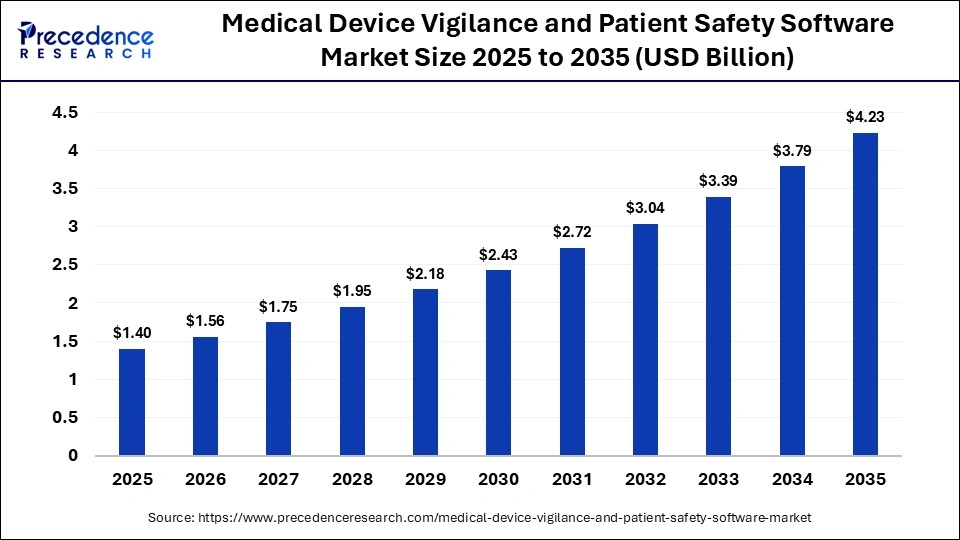
The global Medical Device Vigilance and Patient Safety Software sector was valued at USD 1.40 billion in 2025 and is projected to increase from USD 1.56 billion in 2026 to approximately USD 4.23 billion by 2035, registering a CAGR of 11.70% from 2026 to 2035.
Rising regulatory compliance requirements, growing attention to patient safety, and the increasing need for real-time adverse event monitoring are accelerating the adoption of Medical Device Vigilance and Patient Safety Software across healthcare organizations and medical device manufacturers.
Download a Sample Report: https://www.precedenceresearch.com/sample/8345
Why Medical Device Vigilance and Patient Safety Software Is Gaining Momentum
Medical Device Vigilance and Patient Safety Software enables organizations to capture, monitor, analyze, investigate, and report safety events associated with medical devices and patient care. These platforms help medical device manufacturers, hospitals, healthcare providers, contract research organizations, and regulatory authorities manage safety information more efficiently.
The growing complexity of medical devices and increasing regulatory scrutiny are encouraging organizations to move away from fragmented manual processes toward centralized digital systems. Medical Device Vigilance and Patient Safety Software can improve reporting accuracy, strengthen risk management, support post-market surveillance, and provide faster access to critical safety information.
North America led the sector with a 40% share in 2025, while Asia Pacific is expected to achieve the fastest CAGR of 16% between 2026 and 2035.
Powerful AI Integration Is Transforming Patient Safety
Artificial intelligence is becoming an important technology within Medical Device Vigilance and Patient Safety Software. AI-powered solutions can analyze large volumes of safety data, identify patterns, detect potential risks, and support faster decision-making.
Machine learning can assist with adverse event classification, signal detection, incident analysis, and risk prediction. AI can also help identify patterns associated with medication errors, falls, pressure injuries, and medical device failures.
As healthcare organizations generate increasing volumes of structured and unstructured data, AI-enabled Medical Device Vigilance and Patient Safety Software can reduce manual workloads and support more proactive safety management.
Major Trends Strengthening Medical Device Vigilance and Patient Safety Software
Smarter Regulatory Reporting
Regulatory requirements are becoming more comprehensive across major healthcare systems. Organizations are therefore adopting Medical Device Vigilance and Patient Safety Software to standardize reporting, automate documentation, and improve compliance.
Rapid Growth of Cloud-Based Solutions
Cloud-based Medical Device Vigilance and Patient Safety Software accounted for 55% of the sector in 2025 and is projected to expand at a CAGR of 14.5%. Cloud deployment provides scalability, centralized data access, easier updates, and improved collaboration across geographically distributed teams.
Stronger Focus on Risk Management
Risk management software is becoming increasingly important as manufacturers seek to identify potential device-related risks earlier. This segment is expected to grow at a CAGR of 13.5% from 2026 to 2035.
Proactive Patient Safety Analytics
Healthcare organizations are increasingly using advanced analytics to move from reactive incident reporting toward predictive safety management. This transition is creating demand for Medical Device Vigilance and Patient Safety Software with real-time dashboards, automated alerts, and intelligent risk scoring.
Key Growth Drivers
One of the strongest growth drivers for Medical Device Vigilance and Patient Safety Software is the increasing focus on patient safety and regulatory compliance. Medical device manufacturers are expected to maintain comprehensive records of adverse events, incidents, corrective actions, and post-market safety information.
The growing use of connected medical devices is also generating larger amounts of safety-related data. Digital vigilance platforms help organizations collect and process this information while improving transparency and traceability.
Healthcare digitalization is another important factor. As hospitals and healthcare providers adopt connected systems, electronic health records, cloud infrastructure, and AI-based technologies, the demand for integrated Medical Device Vigilance and Patient Safety Software is increasing.
Challenges Facing Medical Device Vigilance and Patient Safety Software
Despite strong growth prospects, high implementation costs remain a challenge, particularly for smaller healthcare providers and organizations with limited technology budgets. Integrating vigilance software with existing healthcare IT infrastructure can also be complex.
Data privacy and cybersecurity represent additional concerns because these platforms handle sensitive healthcare and patient information. Organizations must maintain strong security controls while ensuring compliance with applicable data protection regulations.
Strong Opportunities Ahead With Advanced Digital Technologies
The integration of AI, machine learning, cloud computing, automation, and cybersecurity is creating significant opportunities for Medical Device Vigilance and Patient Safety Software providers.
Modern platforms can support automated adverse event processing, predictive risk detection, real-time dashboards, centralized regulatory reporting, and cross-functional collaboration. These capabilities can help organizations identify safety concerns earlier and respond more effectively.
The growing shift toward connected healthcare and remote care is also expanding the role of Medical Device Vigilance and Patient Safety Software beyond conventional hospital environments.
Segment Performance Highlights
The adverse event reporting software segment led with a 35% share in 2025, supported by the growing need for efficient event capture, investigation, and regulatory reporting.
The risk management software segment is projected to grow at the fastest CAGR of 13.5%, driven by increasing efforts to identify and mitigate medical device risks proactively.
By deployment mode, cloud-based software held the leading 55% share in 2025, reflecting strong demand for scalable and accessible digital platforms.
By end use, medical device manufacturers accounted for the largest share of 45% in 2025. Meanwhile, contract research organizations are expected to grow at the fastest CAGR of 14% as clinical research and post-market surveillance activities expand.
North America Maintains a Strong Leadership Position
North America accounted for approximately 40% of the Medical Device Vigilance and Patient Safety Software sector in 2025. Strong regulatory requirements, advanced healthcare infrastructure, high medical device adoption, and the presence of major technology and healthcare companies support regional leadership.
The U.S. remains the leading contributor, supported by the influence of the U.S. FDA, advanced healthcare IT infrastructure, extensive clinical research, and strong demand for software-driven safety management.
Asia Pacific Emerges as the Fastest-Growing Region
Asia Pacific is expected to record the fastest CAGR of 16% from 2026 to 2035. Rising healthcare spending, increasing adoption of medical devices, improving digital infrastructure, and strengthening regulatory frameworks are supporting the expansion of Medical Device Vigilance and Patient Safety Software.
China is a major contributor to the region, supported by expanding clinical research, healthcare digitalization, and increasing adoption of advanced medical technologies.
Future Outlook
The future of Medical Device Vigilance and Patient Safety Software is expected to be shaped by intelligent automation, cloud connectivity, predictive analytics, and stronger cybersecurity. As healthcare organizations prioritize proactive risk detection and regulatory transparency, demand for advanced vigilance platforms is likely to increase.
With the global sector projected to reach USD 4.23 billion by 2035, Medical Device Vigilance and Patient Safety Software is becoming an increasingly important foundation for safer medical device management, stronger compliance, and improved patient outcomes.
Buy this report: https://www.precedenceresearch.com/checkout/8345
About Us
Healthcare Prism is a dedicated healthcare insights and outreach platform, operating as an extension of Precedence Research. We share relevant perspectives, industry developments, emerging trends, and research-driven insights across the global healthcare sector. Our content is built on the knowledge, research standards, and expertise of Precedence Research, with a focus on making healthcare information clear, accessible, and useful for industry professionals, businesses, researchers, and healthcare stakeholders. Healthcare Prism serves as a focused platform to extend the reach of Precedence Research’s healthcare insights and connect them with a broader professional audience.
You can place an order or ask any questions, please feel free to contact us at [email protected]
Quick Contact:
Europe Region: +44 778 256 0738
North America Region: +1 8044 4193 44
APAC Region: +91 9356 9282 04 and +65 31065601
Visit Our Website: Precedence Research – Advisory, Research & Reports