
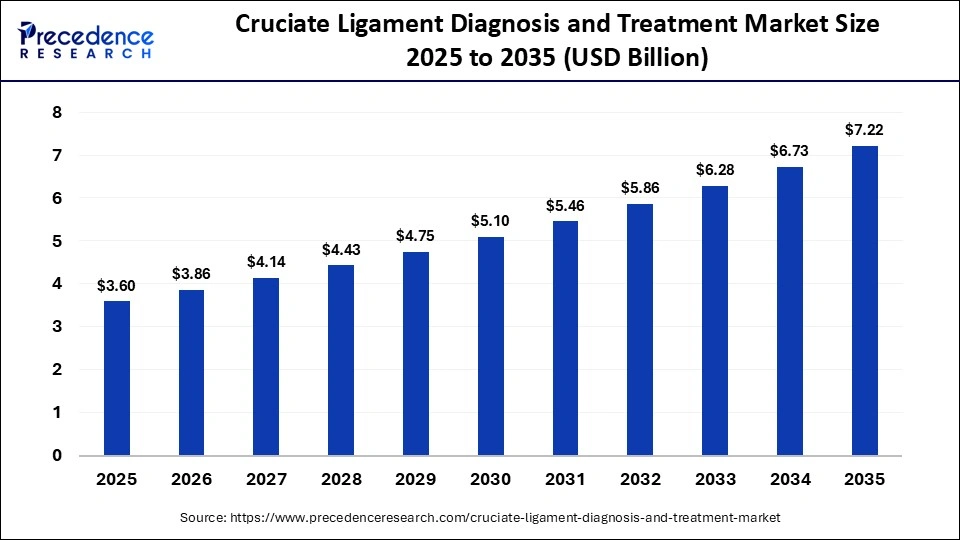
The cruciate ligament diagnosis and treatment sector is entering a strong growth phase as sports-related injuries, orthopedic conditions, advanced imaging, and minimally invasive procedures continue to reshape ligament care. Valued at USD 3.60 billion in 2025, the global sector is projected to reach approximately USD 7.22 billion by 2035, expanding at a CAGR of 7.20% from 2026 to 2035.
Increasing sports participation, rising awareness of ligament injuries, improved diagnostic technologies, and advancements in surgical and rehabilitation techniques are creating significant growth opportunities.
Download a Sample Report: https://www.precedenceresearch.com/sample/8333
Advanced Diagnosis Is Improving Cruciate Ligament Care
Cruciate ligament injuries, particularly anterior cruciate ligament injuries, are common among athletes and physically active individuals. These injuries can affect knee stability, movement, and long-term mobility, making timely diagnosis and effective treatment essential.
Modern diagnostic technologies are improving the ability of healthcare professionals to detect ligament damage accurately. MRI scans provide detailed visualization of soft tissues and are widely used to evaluate ligament tears and associated knee damage. X-ray imaging continues to play an important role in ruling out fractures and assessing bone structures, while arthroscopy can provide direct visualization of the joint.
The growing use of advanced imaging is also supporting more personalized treatment planning and improving clinical decision-making.
AI Is Revolutionizing Ligament Diagnosis and Recovery
Artificial intelligence is becoming an increasingly valuable technology in orthopedic care. AI-powered imaging systems can analyze medical images and help identify ligament abnormalities with greater speed and consistency.
AI is supporting several areas of cruciate ligament management, including:
- Faster interpretation of MRI and imaging data
- Earlier identification of ligament injuries
- Personalized surgical planning
- Recovery and rehabilitation monitoring
- Prediction of reinjury risk
- Data-driven treatment recommendations
Wearable technologies and digital monitoring platforms are also creating new opportunities for tracking mobility, strength, gait, and rehabilitation progress. These solutions can provide clinicians with continuous information beyond traditional clinic visits.
Surgical Treatment Continues to Dominate
The surgical treatment segment accounted for 70% of the sector in 2025, making it the leading treatment category. Surgical approaches remain essential for severe ligament injuries, particularly among athletes and active patients who require restoration of knee stability and function.
ACL reconstruction, ligament repair, and graft-based techniques are widely utilized for restoring structural stability. Continuous improvements in surgical instruments, imaging guidance, graft techniques, and postoperative protocols are helping improve treatment precision and recovery outcomes.
At the same time, the non-surgical treatment segment is expected to grow at a CAGR of 7.5% through 2035. Physiotherapy, bracing, pain management, and structured rehabilitation are increasingly important for suitable patients who can recover without surgery.
This growing balance between surgical intervention and conservative treatment is supporting a more individualized approach to ligament care.
Minimally Invasive Procedures Are Transforming Orthopedic Surgery
The minimally invasive surgery segment held 40% in 2025 and continues to benefit from growing clinical preference for procedures that reduce tissue damage and support faster recovery.
Arthroscopic techniques have become particularly important in cruciate ligament procedures because they allow surgeons to access the joint through small incisions while maintaining high levels of visibility and precision.
Advantages associated with minimally invasive procedures include reduced postoperative discomfort, shorter hospital stays, quicker mobility, and lower tissue disruption. These benefits are increasing interest among both healthcare providers and patients.
The arthroscopic surgery segment is expected to grow at a CAGR of 6.5% between 2026 and 2035 as orthopedic centers continue adopting advanced surgical technologies.
MRI Remains the Leading Diagnostic Tool
The MRI scans segment accounted for 40% of the sector in 2025, reflecting its importance in diagnosing soft-tissue injuries and assessing the severity of cruciate ligament damage.
MRI enables detailed visualization of ligaments, cartilage, tendons, and surrounding tissues without ionizing radiation. This makes it a highly valuable diagnostic tool for developing individualized treatment plans.
Arthroscopy accounted for 25%, while X-ray imaging represented 15%. Although X-rays cannot directly visualize ligament tears, they remain useful for detecting fractures and other bone-related abnormalities following a knee injury.
As imaging technologies become more advanced, clinicians can combine multiple diagnostic methods to achieve more comprehensive assessments.
Rehabilitation Is Becoming a Critical Part of Recovery
Rehabilitation is increasingly recognized as a central component of successful cruciate ligament treatment. Following surgery or non-surgical management, patients typically require structured programs designed to restore strength, flexibility, balance, mobility, and functional performance.
Digital rehabilitation platforms, remote monitoring, wearable sensors, and personalized exercise programs are improving patient engagement. These technologies allow healthcare professionals to track progress and identify recovery challenges earlier.
The growing importance of rehabilitation is also contributing to the expansion of specialized centers that focus on long-term recovery and injury prevention.
Hospitals Continue to Lead Care Delivery
Hospitals accounted for 55% of the sector in 2025, making them the leading end-use setting. Their dominance is supported by access to advanced imaging systems, orthopedic specialists, operating rooms, rehabilitation services, and multidisciplinary care teams.
Hospitals are particularly important for patients with severe injuries that require surgery or comprehensive treatment planning.
Specialty clinics accounted for 25% and are expected to grow at a CAGR of 8% during the forecast period. These facilities are gaining attention because they provide focused orthopedic expertise, faster consultations, and access to modern minimally invasive treatment options.
The rehabilitation centers segment is expected to grow at the fastest CAGR of 9%, highlighting the rising importance of recovery-oriented care.
North America Maintains a Strong Leadership Position
North America accounted for approximately 40% of the sector in 2025, supported by advanced orthopedic healthcare infrastructure, high healthcare expenditure, strong sports participation, and rapid adoption of medical technologies.
The region has extensive access to MRI systems, arthroscopic surgery, orthopedic specialists, and advanced rehabilitation programs. Strong research activity and the presence of leading medical device companies are also supporting innovation.
The U.S. cruciate ligament diagnosis and treatment sector was valued at USD 1.08 billion in 2025 and is projected to reach approximately USD 2.21 billion by 2035, expanding at a CAGR of 7.42%.
High participation in sports and fitness activities, advanced orthopedic facilities, and strong reimbursement systems are helping the United States maintain a leading position.
Asia Pacific Is Emerging as a Powerful Growth Region
Asia Pacific is expected to experience the fastest growth, with a projected CAGR of 9% from 2026 to 2035. Rising healthcare expenditure, expanding orthopedic infrastructure, increasing sports participation, and greater awareness of ligament injuries are supporting regional expansion.
China is a major contributor, benefiting from large patient populations, expanding hospitals, improved access to advanced diagnostic equipment, and increasing adoption of modern orthopedic procedures.
India is also emerging as an important growth country. Investments in specialty hospitals, sports medicine centers, rehabilitation facilities, and minimally invasive surgical technologies are improving access to ligament care.
Europe Continues to Strengthen Orthopedic Care
Europe held approximately 30% of the global sector in 2025 and is expected to grow at a CAGR of 5.8% through 2035.
Strong healthcare systems, high adoption of minimally invasive orthopedic procedures, and well-developed sports medicine infrastructure are contributing to continued growth. Germany, France, and the United Kingdom remain important contributors because of their advanced treatment capabilities and established clinical networks.
Growing awareness of injury prevention and improved rehabilitation programs are also supporting demand across the region.
Innovation Is Intensifying Competition
The competitive landscape includes major medical device and orthopedic companies focused on implants, surgical instruments, arthroscopic technologies, robotics, and regenerative treatment solutions.
Key companies include Zimmer Biomet, Stryker, DePuy Synthes, Smith & Nephew, Arthrex, Medtronic, CONMED, B. Braun, NuVasive, and Corin Group.
Companies are increasingly investing in minimally invasive technologies, advanced implants, robotic-assisted procedures, imaging integration, and regenerative approaches.
Recent developments demonstrate the rapid pace of innovation. In February 2026, Arthrex introduced the TightRope SB implant, an all-suture implant designed for ACL reconstruction. Its metal-free design is intended to improve fixation options and surgical flexibility.
In May 2025, Miach Orthopaedics received updated FDA labeling for its BEAR implant, supporting its regenerative approach to ACL restoration.
In July 2025, Zimmer Biomet completed the acquisition of Monogram Technologies to expand its robotic-assisted orthopedic capabilities.
The Future of Cruciate Ligament Care Looks Promising
The future of cruciate ligament diagnosis and treatment is moving toward greater precision, faster recovery, personalized rehabilitation, and minimally invasive intervention.
MRI and AI-assisted diagnostics are expected to improve early and accurate injury identification, while arthroscopic and minimally invasive procedures can continue to enhance surgical outcomes. Wearable technologies and digital rehabilitation platforms will also play a larger role in tracking recovery and supporting long-term patient engagement.
With the global cruciate ligament diagnosis and treatment sector projected to reach USD 7.22 billion by 2035, continued innovation in imaging, orthopedic surgery, regenerative medicine, rehabilitation, and digital healthcare is expected to create a stronger and more patient-focused future for ligament care.
Cruciate Ligament Diagnosis and Treatment Snapshot
2025 Value: USD 3.60 Billion
2026 Value: USD 3.86 Billion
2035 Forecast: USD 7.22 Billion
CAGR: 7.20%
Leading Region: North America
Fastest-Growing Region: Asia Pacific
Buy this report: https://www.precedenceresearch.com/checkout/8333
About Us
Healthcare Prism is a dedicated healthcare insights and outreach platform, operating as an extension of Precedence Research. We share relevant perspectives, industry developments, emerging trends, and research-driven insights across the global healthcare sector. Our content is built on the knowledge, research standards, and expertise of Precedence Research, with a focus on making healthcare information clear, accessible, and useful for industry professionals, businesses, researchers, and healthcare stakeholders. Healthcare Prism serves as a focused platform to extend the reach of Precedence Research’s healthcare insights and connect them with a broader professional audience.
You can place an order or ask any questions, please feel free to contact us at [email protected]
Quick Contact:
Europe Region: +44 778 256 0738
North America Region: +1 8044 4193 44
APAC Region: +91 9356 9282 04 and +65 31065601
Visit Our Website: Precedence Research – Advisory, Research & Reports