
Elastography imaging is becoming an increasingly important diagnostic technology as healthcare providers look for accurate, non-invasive ways to evaluate tissue stiffness and detect disease. The technology is widely used for assessing liver fibrosis, breast lesions, prostate conditions, musculoskeletal disorders, and other abnormalities.
The global elastography imaging sector was valued at USD 2.54 billion in 2025 and is projected to increase from USD 2.73 billion in 2026 to approximately USD 5.19 billion by 2035, expanding at a CAGR of 7.41% from 2026 to 2035.
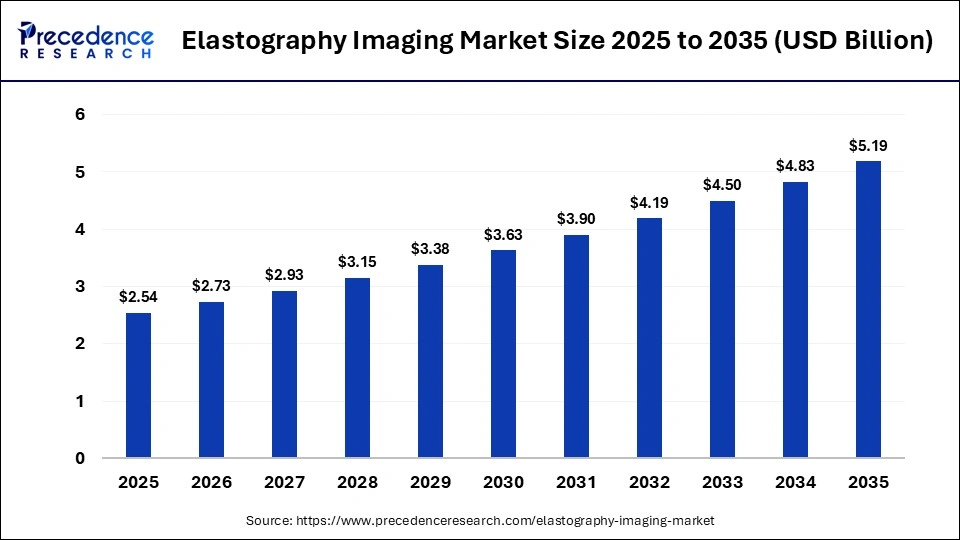
The growing prevalence of chronic liver disease and cancer is supporting demand, while advances in ultrasound, magnetic resonance imaging, artificial intelligence, and machine learning are improving diagnostic capabilities.
Download a Sample Report: https://www.precedenceresearch.com/sample/7417
Compact Scope Table of Elastography Imaging
| Report Coverage | Details |
|---|---|
| Sector Size in 2025 | USD 2.54 Billion |
| Sector Size in 2026 | USD 2.73 Billion |
| Sector Size by 2035 | USD 5.19 Billion |
| Growth Rate from 2026 to 2035 | CAGR of 7.41% |
| Leading Region | North America |
| Fastest-Growing Region | Asia Pacific |
| Leading Modality | Ultrasound Elastography |
| Leading Technology | Shear Wave Elastography |
| Leading Application | Liver Disease Assessment |
| Leading End User | Hospitals |
| Leading Product Type | Elastography-Enabled Ultrasound Systems |
| Leading Portability | Cart-Based/Fixed Systems |
| Leading Clinical Workflow | Radiology/Imaging Department-Based Use |
| Base Year | 2025 |
| Forecast Period | 2026–2035 |
What Is Elastography Imaging
Elastography imaging is a diagnostic technique that evaluates the stiffness or elasticity of tissues.
Unlike conventional imaging, which primarily provides anatomical information, elastography adds information about mechanical tissue properties. Changes in tissue stiffness can be associated with conditions such as fibrosis, tumors, inflammation, and other pathological abnormalities.
The technology is primarily integrated with ultrasound and MRI systems.
Its non-invasive nature makes it especially valuable in situations where repeated tissue assessment would otherwise require invasive biopsy procedures.
Elastography has become particularly important in hepatology, radiology, oncology, women’s health, urology, and musculoskeletal imaging.
Why Elastography Imaging Is Growing
The increasing prevalence of chronic liver disease is one of the strongest factors supporting adoption.
Conditions such as fatty liver disease, fibrosis, and cirrhosis often require ongoing assessment. Elastography can provide quantitative information about liver stiffness without requiring a conventional biopsy in many clinical pathways.
Cancer diagnosis is another important area of growth. Changes in tissue stiffness can provide additional information when evaluating suspicious lesions in the breast, prostate, thyroid, and other organs.
The growing emphasis on early diagnosis is also supporting demand. Healthcare providers increasingly want technologies that can identify abnormalities earlier and provide objective measurements that can be followed over time.
At the same time, improvements in imaging hardware, software, and artificial intelligence are making elastography more accurate and easier to integrate into routine workflows.
AI Is Making Elastography More Intelligent
Artificial intelligence and machine learning are adding a new layer of intelligence to elastography imaging.
Traditional elastography requires image acquisition followed by expert interpretation. AI can assist by analyzing large quantities of imaging data, identifying patterns, quantifying tissue stiffness, and supporting classification.
AI-enabled systems can potentially reduce variability between assessments and help clinicians interpret complex imaging findings more efficiently.
Machine learning can also support predictive analytics. By combining tissue measurements with patient history and other clinical information, algorithms can assist in identifying patterns associated with fibrosis, malignancy, or disease progression.
Another opportunity is automated workflow support. AI can help with image optimization, region-of-interest selection, measurement consistency, and report generation.
This can improve efficiency while allowing radiologists and other healthcare professionals to focus on clinical interpretation.
Key Trends Shaping Elastography Imaging
Ultrasound Elastography Continues to Lead
Ultrasound elastography accounted for approximately 79% of the modality segment in 2025.
Its leading position is supported by relatively accessible equipment costs, real-time imaging, portability, and broad clinical applicability.
Ultrasound elastography can be used for liver assessment, breast imaging, prostate evaluation, and musculoskeletal applications.
Its ability to provide imaging and tissue-stiffness information within the same examination also makes it attractive for routine clinical workflows.
Magnetic Resonance Elastography Is Expanding
Magnetic resonance elastography is expected to grow rapidly during the forecast period.
MRE can provide quantitative stiffness mapping of deeper organs and can generate detailed information that may be difficult to obtain with ultrasound in certain patients or anatomical locations.
Its ability to create three-dimensional stiffness maps makes it particularly valuable for complex liver and other organ assessments.
As MRI systems and specialized software become more advanced, MRE is positioned to gain greater clinical adoption.
Shear Wave Elastography Has a Strong Position
Shear wave elastography represented approximately 42% in 2025 and is expected to remain a major technology segment.
The technique provides quantitative information about tissue mechanical properties by generating and measuring shear waves.
Its ability to deliver objective stiffness measurements has increased its usefulness in liver disease, breast imaging, prostate assessment, and musculoskeletal applications.
Point-of-Care Imaging Is Becoming More Important
Portable and handheld systems are expanding access to elastography.
Compact ultrasound devices can be used in clinics, emergency settings, rural healthcare facilities, and bedside environments.
These systems are particularly useful in regions where access to large imaging centers is limited.
Point-of-care use can reduce the need for patients to travel between departments and can provide faster diagnostic information during clinical consultations.
Liver Disease Assessment Remains the Leading Application
Liver disease assessment accounted for approximately 46% of applications in 2025.
The segment benefits from the growing prevalence of chronic liver conditions and the need for repeated evaluation of fibrosis and disease progression.
Elastography can measure liver stiffness and provide physicians with quantitative information that can support clinical assessment.
The shift toward non-invasive diagnostic approaches is particularly important because liver biopsies can be invasive, require specialized procedures, and are not always practical for repeated monitoring.
Technology improvements are further supporting adoption through better image quality, real-time measurements, quantitative analysis, and AI-assisted interpretation.
Prostate Imaging Offers Strong Growth Potential
The prostate imaging segment is expected to record the highest growth during the forecast period.
Elastography can help identify differences in tissue stiffness and provide additional information when evaluating prostate abnormalities.
As prostate cancer screening and early diagnosis receive greater attention, imaging techniques that can complement conventional diagnostic methods may gain importance.
The non-invasive nature of elastography and its ability to provide quantitative information are supporting research and clinical interest in prostate applications.
Hospitals Remain the Primary End User
Hospitals accounted for approximately 47% of end use in 2025.
Large hospitals typically have the infrastructure, imaging departments, trained specialists, and financial resources needed to adopt advanced elastography systems.
High patient volumes for liver disease, cancer, and other chronic conditions also support equipment utilization.
Hospitals can integrate elastography into broader diagnostic pathways, combining it with ultrasound, MRI, laboratory tests, and specialist consultation.
Diagnostic Imaging Centers Are Expanding
Diagnostic imaging centers are expected to grow rapidly as providers seek specialized, non-invasive diagnostic services.
These facilities can invest in dedicated imaging technologies while focusing on high patient throughput and specialized interpretation.
The expansion of outpatient diagnosis is creating additional opportunities for elastography outside large hospitals.
Elastography-Enabled Ultrasound Systems Lead Product Demand
Elastography-enabled ultrasound systems represented approximately 58% of product types in 2025.
These systems benefit from several advantages, including real-time imaging, comparatively lower costs, portability, and broad clinical applicability.
Healthcare providers can use integrated ultrasound systems to perform conventional imaging and elastography during the same examination.
Software and Platforms Are Becoming More Important
Elastography software and platforms are expected to expand at a strong pace.
Software can enhance image processing, automate measurements, support AI-assisted interpretation, and improve report generation.
Advanced platforms can also enable two-dimensional and three-dimensional visualization, helping clinicians assess subtle changes in tissue properties.
The growing importance of software means competitive differentiation is increasingly shifting beyond hardware toward algorithms, analytics, workflow integration, and clinical usability.
Cart-Based Systems Continue to Lead
Cart-based and fixed imaging systems held approximately 71% of the portability segment in 2025.
These systems are widely used in hospitals and major diagnostic facilities because they provide high performance, larger displays, advanced imaging functionality, and integration with established clinical infrastructure.
However, portable and handheld elastography systems are expected to grow rapidly.
Portable systems can make diagnostic imaging more accessible in outpatient clinics, emergency departments, rural facilities, and point-of-care environments.
Lower infrastructure requirements and faster examination workflows are strengthening demand for compact solutions.
Radiology Departments Remain the Main Clinical Workflow
Radiology and imaging department-based use accounted for approximately 62% in 2025.
These departments benefit from established infrastructure, trained imaging specialists, high examination volumes, and integration with hospital diagnostic workflows.
Patients and physicians also have long-standing familiarity with radiology-based imaging pathways.
Point-of-Care Use Is Expanding
Point-of-care ultrasound and bedside elastography are expected to represent one of the fastest-growing workflow segments.
Handheld devices can be used directly where the patient is being treated rather than requiring transfer to a centralized imaging department.
This can be particularly valuable in emergency care, outpatient clinics, intensive care, rural healthcare, and resource-limited environments.
North America Leads the Global Landscape
North America accounted for approximately 36% of the global sector in 2025, making it the leading regional contributor.
The region benefits from advanced healthcare infrastructure, high adoption of medical imaging technologies, strong research capabilities, and substantial awareness of early diagnosis.
The United States remains the largest contributor within the region, supported by its extensive hospital network, advanced radiology infrastructure, and strong investment in medical technology.
The regional environment is also favorable for AI-enabled imaging, digital diagnostics, and advanced ultrasound technologies.
The U.S. Is a Major Contributor
The United States represents an important center for elastography innovation and adoption.
Demand is supported by a strong healthcare technology ecosystem, research investment, and the growing burden of conditions such as liver disease, cancer, and obesity-related metabolic disorders.
The expansion of non-invasive diagnostic techniques is also increasing interest in elastography-based assessment.
Research and product development are increasingly focused on combining imaging technologies with automation, AI, and quantitative measurements.
Asia Pacific Is Growing Fastest
Asia Pacific is expected to record the fastest growth from 2026 to 2035.
The region benefits from a large and growing population, increasing healthcare investment, expanding diagnostic infrastructure, and rising prevalence of chronic diseases.
The development of domestic medical device manufacturing is also improving access to more affordable imaging equipment.
Countries such as China, India, Japan, and South Korea are becoming increasingly important to regional growth.
Government investment in healthcare infrastructure and greater awareness of early diagnosis are creating additional opportunities.
China Is Strengthening Its Imaging Capabilities
China is expanding investment in healthcare technology and diagnostic infrastructure.
Government-supported financing initiatives can make it easier for hospitals and clinics to upgrade imaging equipment.
Growing awareness of advanced diagnostic methods and increasing demand for non-invasive evaluation are further supporting adoption.
Europe Continues to Expand Non-Invasive Imaging
Europe is expected to experience steady growth during the forecast period.
Healthcare systems across the region increasingly emphasize early diagnosis, cost-effective testing, and non-invasive approaches.
Germany and France are important contributors, particularly in liver disease assessment, advanced ultrasound, and medical imaging research.
Germany Is Advancing Elastography Adoption
Germany has a strong healthcare and medical technology ecosystem.
Hospitals increasingly use advanced ultrasound and MRI-based imaging technologies for the assessment of chronic diseases.
Research and development activities are also supporting improvements in liver disease evaluation, cancer diagnosis, and imaging precision.
Latin America Is Building Diagnostic Capacity
Latin America is expected to record notable growth as healthcare infrastructure develops and demand for advanced diagnostic technologies increases.
Brazil and Argentina are important contributors.
Greater awareness of early cancer diagnosis and the advantages of non-invasive tissue assessment is encouraging adoption of elastography technologies.
Brazil Is Expanding Non-Invasive Diagnosis
Brazil is seeing increased interest in elastography as an alternative or complement to invasive tissue sampling.
Private healthcare providers are investing in more advanced imaging systems, while healthcare professionals are becoming more familiar with the technology.
Middle East and Africa Offer Additional Opportunities
The Middle East and Africa region is expected to experience attractive growth.
Investment in private hospitals, diagnostic facilities, and modern healthcare infrastructure is supporting demand for advanced imaging.
The shift from invasive biopsy toward less invasive tissue assessment is another important contributor.
South Africa Is Advancing Modern Imaging
South Africa’s healthcare infrastructure is gradually incorporating more advanced imaging systems.
Rising chronic disease prevalence and investment in modern diagnostic facilities are encouraging greater use of technologies such as elastography.
The Elastography Imaging Value Chain
The elastography imaging value chain includes technology development, device manufacturing, distribution, clinical implementation, software, and patient support.
Research and Development
R&D focuses on improving diagnostic precision, developing advanced imaging algorithms, expanding AI capabilities, and increasing the range of clinical applications.
Leading technology participants include GE HealthCare, Philips, and Siemens Healthineers.
Device Manufacturing and Integration
Manufacturers integrate elastography capabilities into ultrasound systems, MRI platforms, and dedicated imaging solutions.
Companies such as Canon Medical Systems, Fujifilm, Mindray, Samsung Medison, and Esaote contribute to this stage.
Distribution to Hospitals and Clinics
Devices are distributed through direct manufacturer channels, distributors, and healthcare procurement networks.
Strong distribution capabilities are particularly important in emerging regions where hospitals are expanding diagnostic infrastructure.
Software and Clinical Services
Software providers and medical technology companies support image analysis, AI-assisted interpretation, reporting, maintenance, and system upgrades.
These services are becoming increasingly important as elastography platforms become more digitally connected.
Major Companies in Elastography Imaging
The competitive landscape includes major medical imaging manufacturers and specialized diagnostic technology companies.
Key participants include:
- Canon Medical Systems Corporation
- Esaote S.p.A.
- FUJIFILM Corporation
- GE HealthCare
- Hitachi, Ltd.
- Koninklijke Philips N.V.
- Mindray Bio-Medical Electronics Co., Ltd.
- Samsung Medison Co., Ltd.
- Siemens Healthineers
- Toshiba America Medical Systems, Inc.
Competition is increasingly focused on image quality, quantitative measurement, AI integration, software capabilities, portability, workflow efficiency, and interoperability.
Recent Industry Developments
In March 2026, Esaote Group showcased new imaging innovations at the European Congress of Radiology in Vienna, including the MyLab E85 and MyLab C30 GTS Edition ultrasound systems. The company’s focus included ultrasound applications for interventional radiology and advanced imaging workflows.
In November 2025, Canon Medical Systems received U.S. FDA clearance for advanced ultrasound processing algorithms designed to improve image quality, microvascular flow assessment, and elastography performance.
In April 2025, Royal Philips introduced an upgrade for the EPIQ Elite ultrasound system that included Auto ElastQ for liver elastography, supporting automated and non-invasive liver stiffness assessment.
These developments demonstrate the industry’s broader movement toward higher-quality imaging, automation, advanced processing, and AI-supported diagnostics.
Challenges Facing Elastography Imaging
Despite strong growth potential, several challenges remain.
The cost of advanced imaging equipment can limit adoption, particularly among smaller healthcare facilities and providers in lower-income regions.
MRI-dependent elastography can require significant infrastructure and capital investment.
Another challenge is operator expertise. Although automation and AI are improving usability, imaging quality and interpretation can still depend on appropriate clinical technique.
Healthcare providers also need to integrate elastography results with other diagnostic information rather than using tissue stiffness measurements in isolation.
Interoperability, cybersecurity, data management, and ongoing software maintenance are becoming increasingly important as imaging systems become more connected.
What Healthcare Companies Should Watch
Healthcare providers, medical device manufacturers, diagnostic imaging companies, investors, and technology developers should closely monitor:
- AI-enabled elastography
- Ultrasound elastography
- Magnetic resonance elastography
- Shear wave imaging
- Portable and handheld systems
- Point-of-care elastography
- Liver fibrosis assessment
- Breast and prostate imaging
- Elastography software platforms
- Automated image analysis
- Connected imaging systems
- Non-invasive diagnostic technologies
The Road Ahead
Elastography imaging is moving toward a more quantitative, automated, portable, and AI-enabled future.
Ultrasound elastography will remain an important technology because of its accessibility, real-time capabilities, and broad clinical applications. At the same time, magnetic resonance elastography is likely to gain importance in complex cases where detailed tissue mapping is required.
AI will play an increasingly important role by improving image processing, measurement consistency, automated analysis, and clinical workflow.
Portable and handheld technologies will also expand access by bringing elastography closer to patients in outpatient, bedside, and resource-limited settings.
The largest opportunity lies in combining advanced imaging hardware, AI-powered software, quantitative measurements, and point-of-care capabilities.
As healthcare systems continue emphasizing earlier diagnosis and less invasive approaches, elastography imaging can become an increasingly valuable tool for assessing tissue health, monitoring disease progression, and supporting more informed clinical decisions.
Also Read About: https://healthcareprism.com/u-s-ai-in-medical-imaging-how-competition-is-shaping-the-healthcare-field/
Buy this report: https://www.precedenceresearch.com/checkout/7417
About Us
Healthcare Prism is a dedicated healthcare insights and outreach platform, operating as an extension of Precedence Research. We share relevant perspectives, industry developments, emerging trends, and research-driven insights across the global healthcare sector. Our content is built on the knowledge, research standards, and expertise of Precedence Research, with a focus on making healthcare information clear, accessible, and useful for industry professionals, businesses, researchers, and healthcare stakeholders. Healthcare Prism serves as a focused platform to extend the reach of Precedence Research’s healthcare insights and connect them with a broader professional audience.
You can place an order or ask any questions, please feel free to contact us at [email protected]
Quick Contact:
Europe Region: +44 778 256 0738
North America Region: +1 8044 4193 44
APAC Region: +91 9356 9282 04 and +65 31065601
Visit Our Website: Precedence Research – Advisory, Research & Reports