
The pharmaceutical manufacturing landscape is entering a major period of investment as biologics, injectable medicines, vaccines, cell and gene therapies, and self-administered treatments continue to expand.
Fill-finish manufacturing has become especially important because even when a drug substance is successfully developed, it still requires reliable sterile filling, packaging, inspection, and delivery before reaching patients.
The global fill-finish manufacturing sector was valued at approximately USD 20.00 billion in 2025 and is projected to reach around USD 47.8 billion by 2035, expanding at a CAGR of 9.10% from 2026 to 2035.
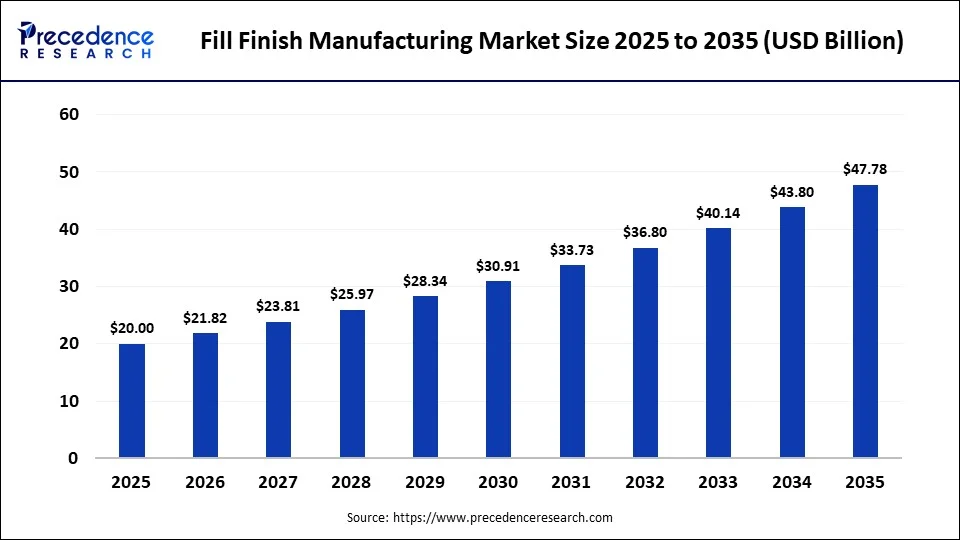
The expansion is being supported by the growing biologics pipeline, increasing demand for injectable therapies, greater adoption of prefilled syringes, commercialisation of advanced therapies, and continued investment in high-capacity sterile manufacturing infrastructure.
Download a Sample Report: https://www.precedenceresearch.com/sample/8652
Why Fill-Finish Manufacturing Is Becoming More Important
Fill-finish manufacturing is the final stage of pharmaceutical production in which a drug product is filled into its primary container, sealed, inspected, and prepared for distribution.
This stage is particularly critical for sterile injectable medicines because the product must be protected against contamination while maintaining quality, stability, and potency.
Common primary packaging formats include:
- Vials
- Prefilled syringes
- Cartridges
- Ampoules
- IV bags
- Bottles
For many years, vials have been the standard format for biologics and injectable medicines. However, the industry is gradually moving toward ready-to-use and self-administered formats.
The growing use of prefilled syringes and autoinjector-compatible cartridges reflects this transition. GLP-1 therapies are one of the strongest examples of how patient convenience can influence pharmaceutical packaging and manufacturing requirements.
Aseptic Processing Continues to Dominate
Aseptic fill-finish accounted for approximately 78% of the filling technology segment in 2025.
This dominance is understandable because many biologics, vaccines, peptides, and other sensitive injectable medicines cannot tolerate the temperatures associated with terminal sterilization.
Aseptic processing requires tightly controlled environments, contamination-control strategies, sterile equipment, highly trained personnel, and advanced quality systems.
The revised EU GMP Annex 1 has further increased attention on contamination control and sterile manufacturing practices. Its general application began in August 2023, with additional requirements becoming applicable in August 2024.
These requirements affect manufacturers serving European pharmaceutical supply chains regardless of where the products are physically manufactured.
As sterile manufacturing standards become more demanding, pharmaceutical companies and contract manufacturers are investing in automation, environmental monitoring, closed systems, advanced inspection, and flexible filling technologies.
Prefilled Syringes Are Changing the Packaging Landscape
Vials remained the leading product format in 2025, accounting for 39%, while prefilled syringes represented approximately 27%.
However, prefilled syringes are gaining momentum rapidly.
The main driver is convenience. A prefilled syringe can reduce preparation steps, support accurate dosing, and make self-administration easier for appropriate therapies.
The growth of chronic treatments administered outside traditional clinical settings is strengthening this trend.
GLP-1 therapies have provided a major example of how drug delivery can shift toward patient-friendly formats. Similar preferences are emerging across biologics, autoimmune therapies, vaccines, and other injectable treatments.
For manufacturers, this means fill-finish facilities must increasingly support multiple container formats rather than relying on traditional vial-based lines alone.
Biologics Continue to Drive Capacity Requirements
Biologics accounted for approximately 38% of fill-finish manufacturing in 2025 and are expected to remain the leading drug type.
Monoclonal antibodies, recombinant proteins, vaccines, and other biological medicines require highly controlled manufacturing environments.
The growing biologics pipeline is therefore creating demand for:
- High-speed sterile filling
- Automated inspection
- Flexible production lines
- Cold-chain infrastructure
- Advanced containment
- Specialized lyophilization
- Strong quality-control systems
At the same time, cell and gene therapies are emerging as one of the fastest-growing areas, with a projected 16.8% CAGR through 2035.
These therapies often require smaller batch sizes, specialized handling, high containment, and highly controlled processes, creating demand for flexible manufacturing capabilities.
How Cell and Gene Therapies Are Changing Fill-Finish
Cell and gene therapies are fundamentally different from many traditional medicines.
Production often involves highly specialized materials, lower-volume batches, personalized manufacturing, and sensitive biological products.
This creates new requirements for fill-finish providers.
Manufacturers must be able to handle smaller batch sizes while maintaining strict sterility and traceability requirements.
The growing commercialization of advanced therapies is encouraging contract development and manufacturing organizations to build capabilities specifically designed for complex sterile products.
As more cell and gene therapy candidates progress through clinical development, the need for specialized fill-finish capacity is expected to rise.
How Leading Companies Are Positioning
The competitive landscape includes large pharmaceutical manufacturers, specialized CDMOs, and integrated biologics manufacturing companies.
Novo Nordisk is investing heavily in manufacturing infrastructure to support demand for GLP-1 medicines such as Ozempic and Wegovy. Its acquisition of selected Catalent facilities further strengthened its internal fill-finish capabilities and demonstrates how strategically important sterile capacity has become.
Samsung Biologics is rapidly expanding its biologics manufacturing footprint. The company has increased overall biomanufacturing capacity while also investing in automated prefilled syringe capabilities. Its planned expansion toward approximately 964,000 liters of total capacity highlights the scale of investment taking place in biologics manufacturing.
Lonza continues to expand its drug product and biologics capabilities across major manufacturing locations. Its investment in the Vacaville, California facility further strengthens its large-scale biologics production capabilities.
Fujifilm Diosynth Biotechnologies is expanding its biologics and advanced manufacturing network to support increasing demand for complex therapies. Its broader strategy combines drug substance, drug product, and specialized manufacturing services.
Catalent, now part of the Novo Holdings ecosystem, remains an important name in sterile fill-finish and CDMO services. Its facilities have historically supported a wide range of injectable pharmaceutical products and biologics.
Competition is increasingly centered on capacity, flexibility, regulatory compliance, automation, container formats, speed to commercialisation, quality systems, and the ability to handle complex biologics.
Commercial Scale Manufacturing Leads
Commercial-scale manufacturing accounted for approximately 73% in 2025.
Once a drug receives regulatory approval and demand begins expanding, manufacturers must transition from relatively small clinical batches to large commercial production volumes.
This requires:
- High-throughput filling lines
- Reliable equipment
- Automated inspection
- Large-scale quality control
- Robust cold-chain systems
- Consistent supply-chain operations
Clinical-scale production remains important for new therapies, but commercial manufacturing is increasingly driving capital investment as more biologics and injectable products reach patients.
Liquid Fill-Finish Remains the Leading Format
Liquid fill-finish accounted for approximately 61% in 2025.
Liquid formulations remain widely used because they are straightforward to process and are suitable for many injectable therapies.
However, lyophilized or freeze-dried products are gaining importance, particularly for temperature-sensitive biologics.
Lyophilization can improve the stability and shelf life of certain products and can make transportation and storage easier.
As more complex biological therapies enter development, demand for specialized freeze-drying and fill-finish capabilities is expected to increase.
CDMOs Are Becoming More Important
Pharmaceutical companies accounted for the largest end-user share in 2025, but contract development and manufacturing organizations are among the fastest-growing participants.
The reason is straightforward: pharmaceutical and biotechnology companies increasingly prefer outsourcing specialized sterile manufacturing rather than building every capability internally.
A CDMO can provide:
- Flexible production capacity
- Regulatory expertise
- Existing sterile manufacturing infrastructure
- Specialized equipment
- Commercial-scale manufacturing
- Analytical and quality services
This model can reduce the time required to bring a product into commercial production while allowing pharmaceutical companies to allocate capital toward research and development.
North America Remains a Major Manufacturing Hub
North America accounted for approximately 39% in 2025.
The region benefits from an extensive biologics manufacturing base, strong pharmaceutical research, established CDMOs, and significant investment in advanced therapies.
The United States remains the largest contributor.
Major expansion projects in biologics and sterile manufacturing demonstrate the strategic importance of local capacity, particularly as pharmaceutical companies seek greater supply-chain resilience.
Although North America’s share is projected to decline gradually as Asia Pacific expands faster, the region is expected to remain a major manufacturing center through 2035.
Asia Pacific Is Becoming a Major Capacity Destination
Asia Pacific accounted for approximately 24% in 2025 and is projected to reach around 31% by 2035.
The region is growing faster than North America and Europe, supported by expanding pharmaceutical manufacturing and CDMO capabilities in countries such as South Korea, China, and India.
South Korea has become particularly important for large-scale biologics production, while China is increasing its domestic pharmaceutical and biopharmaceutical capabilities.
India is also strengthening its role in pharmaceutical manufacturing through expanding sterile production, biologics capabilities, and global outsourcing partnerships.
This shift means that Asia Pacific could capture an increasing share of new fill-finish capacity investment during the next decade.
Why GLP-1 Therapies Matter to Fill-Finish Manufacturing
The rapid growth of GLP-1 therapies is having an important structural impact on pharmaceutical manufacturing.
Products such as semaglutide and tirzepatide are creating enormous demand for injectable production capacity.
Beyond drug substance manufacturing, this growth affects:
- Prefilled syringes
- Autoinjector cartridges
- Filling lines
- Inspection systems
- Packaging systems
- Cold-chain logistics
The demand for convenient self-administered treatments is also encouraging manufacturers to invest in flexible drug product facilities.
This makes GLP-1 therapies more than a pharmaceutical development story. They are becoming a manufacturing capacity story as well.
Regulation Is Reshaping Sterile Manufacturing
Regulatory requirements are becoming increasingly important in fill-finish manufacturing.
EU GMP Annex 1 has raised expectations around contamination-control strategy, cleanroom management, aseptic processing, equipment sterilization, and environmental monitoring.
These requirements are encouraging manufacturers to invest in more automated and controlled production environments.
For pharmaceutical companies and CDMOs, regulatory readiness is becoming a competitive advantage because facilities that can meet complex sterile manufacturing requirements are better positioned to support global product launches.
Key Challenges
Fill-finish manufacturing faces several challenges despite strong demand.
High capital costs remain a significant barrier because sterile facilities require highly specialized infrastructure, environmental control, validation, and quality systems.
Manufacturers also face shortages of skilled professionals with expertise in aseptic processing, validation, sterile operations, and regulatory compliance.
Another challenge is maintaining flexibility. Companies need facilities capable of handling different drug products and packaging formats without creating excessive downtime or cross-contamination risks.
Supply-chain disruption, equipment lead times, and increasingly complex biologics are adding further pressure.
What Should Pharmaceutical Companies Watch?
Companies operating across pharmaceutical manufacturing, biotechnology, CDMOs, and injectable drug development should closely monitor:
- Aseptic fill-finish capacity
- Prefilled syringe production
- Autoinjector-compatible cartridges
- Biologics manufacturing
- Cell and gene therapy production
- Lyophilization capacity
- Automated visual inspection
- Closed and isolator-based processing
- Regulatory compliance
- CDMO outsourcing
- GLP-1 manufacturing demand
- Asia Pacific capacity expansion
What Comes Next?
Fill-finish manufacturing is becoming much more than the final step of pharmaceutical production.
It is increasingly a strategic capability that determines how quickly, safely, and consistently complex therapies can reach patients.
The next decade is likely to be shaped by expanding biologics pipelines, growing injectable demand, increasing use of prefilled and self-administered formats, stricter sterile manufacturing standards, and continued CDMO expansion.
The companies best positioned for the future will be those that can combine high-capacity manufacturing with flexibility, automation, advanced quality systems, and strong regulatory expertise.
As pharmaceutical innovation moves toward more complex and patient-specific therapies, fill-finish manufacturing will remain a critical part of the healthcare supply chain.
Buy this report: https://www.precedenceresearch.com/checkout/8652
About Us
Healthcare Prism is a dedicated healthcare insights and outreach platform, operating as an extension of Precedence Research. We share relevant perspectives, industry developments, emerging trends, and research-driven insights across the global healthcare sector. Our content is built on the knowledge, research standards, and expertise of Precedence Research, with a focus on making healthcare information clear, accessible, and useful for industry professionals, businesses, researchers, and healthcare stakeholders. Healthcare Prism serves as a focused platform to extend the reach of Precedence Research’s healthcare insights and connect them with a broader professional audience.
You can place an order or ask any questions, please feel free to contact us at [email protected]
Quick Contact:
Europe Region: +44 778 256 0738
North America Region: +1 8044 4193 44
APAC Region: +91 9356 9282 04 and +65 31065601
Visit Our Website: Precedence Research – Advisory, Research & Reports