
What is the Smart Drugs Size in 2026?
The global smart drugs sector was valued at USD 2.30 billion in 2025 and is projected to reach USD 2.54 billion in 2026 and approximately USD 6.24 billion by 2035, expanding at a CAGR of 10.50% from 2026 to 2035.
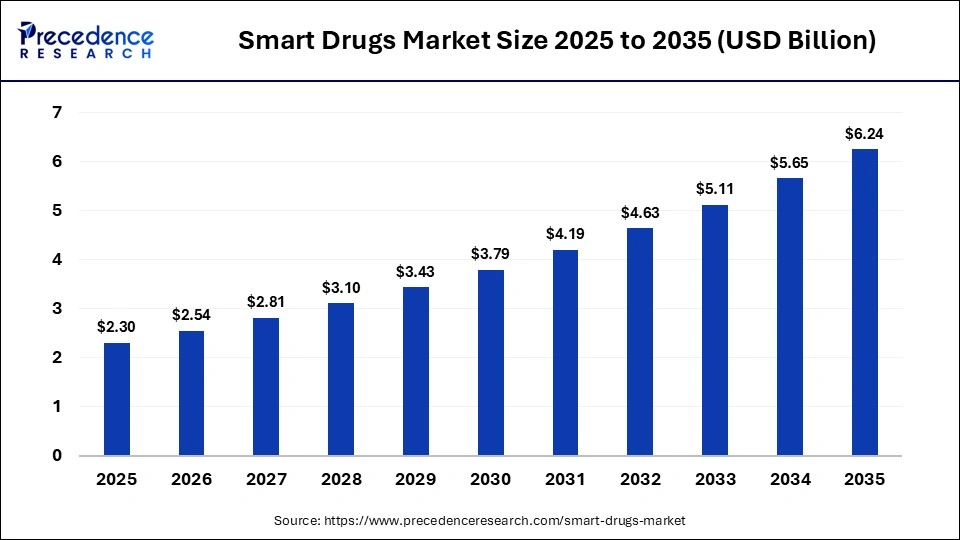
Growth is being driven by increasing demand for therapies that support attention, wakefulness, memory, and cognitive performance, along with rising diagnosis of attention deficit hyperactivity disorder, sleep disorders, and neurodegenerative conditions.
Download a Sample Report: https://www.precedenceresearch.com/sample/8114
Smart Drugs Overview
Smart drugs include prescription and regulated pharmacological therapies used to improve attention, alertness, memory, and cognitive function in specific clinical conditions. Major categories include stimulants, wakefulness-promoting agents, cholinesterase inhibitors, NMDA receptor antagonists, and other cognitive-related therapies.
Their use is expanding alongside greater awareness of neurological and cognitive disorders, better diagnosis, and advances in personalized medicine. Healthcare providers are also increasingly using digital tools and advanced diagnostics to support treatment selection and long-term patient monitoring.
AI Is Revolutionizing Smart Drugs Development
Artificial intelligence is transforming smart drugs development by helping researchers analyze large biological datasets, identify potential molecular interactions, and accelerate drug discovery. AI can support the prediction of drug efficacy, safety, and patient response, helping researchers prioritize promising candidates.
Machine learning is also being integrated into personalized treatment models. By analyzing patient history, genetic characteristics, clinical data, and treatment responses, AI systems can help healthcare professionals develop more individualized therapeutic strategies.
Powerful Trends Shaping Smart Drugs
Personalized Cognitive Care
Personalized medicine is becoming increasingly important as healthcare providers seek therapies that address individual patient needs. AI, biomarker analysis, and digital monitoring can support more precise treatment approaches.
Digital and Smart Drug Technologies
Connected technologies are introducing new possibilities for medication tracking, adherence monitoring, and patient engagement. Smart pills and sensor-based systems can provide information about medication use and physiological responses in selected applications.
Growth of Non-Invasive Solutions
Patients increasingly prefer convenient treatment options that reduce clinical burden. Tablets, capsules, and emerging transdermal systems offer practical administration and may improve adherence for long-term therapies.
Expanding Neurological Care
Growing diagnosis of ADHD, dementia, narcolepsy, and other neurological conditions is increasing the need for effective pharmacological management. Rising awareness is also encouraging earlier consultation and treatment.
Stimulants Maintain Strong Leadership
The stimulants segment accounted for 36.70% of the global share in 2025. Stimulant medicines are widely prescribed for conditions such as ADHD and narcolepsy because they can improve attention, alertness, and wakefulness.
The segment benefits from increasing ADHD diagnosis, greater awareness among adults, and continued development of longer-acting formulations. However, appropriate prescribing, safety monitoring, and regulatory compliance remain essential because these medicines are prescription therapies.
The other drug class segment is expected to grow at the fastest CAGR of 11.70% during the forecast period. Expansion is supported by emerging therapeutic applications, specialized neurological conditions, and continued pharmaceutical innovation.
ADHD Remains the Leading Indication
The attention deficit hyperactivity disorder segment held a 33.60% share in 2025. Increasing diagnosis among children and adults and growing awareness of attention-related symptoms are supporting demand for established pharmacological treatments.
The cognitive enhancement in healthy adults segment is expected to grow at a CAGR of 10.40%. Demand is associated with interest among students and professionals in focus, alertness, and productivity. However, the use of prescription medicines for cognitive enhancement outside approved indications requires careful medical consideration and appropriate supervision.
Retail Pharmacies Lead Distribution
The retail pharmacy segment accounted for 55.70% of the share in 2025. Retail pharmacies provide broad physical accessibility and remain an important channel for prescription and non-prescription products.
The online pharmacy segment is expected to expand rapidly as digital healthcare adoption increases. Online ordering, prescription management, home delivery, and integrated health platforms are making medication access more convenient in many regions.
Tablets Continue to Dominate Dosage Forms
The tablets segment represented 56.60% of the share in 2025. Tablets offer convenience, stability, long shelf life, and relatively efficient manufacturing, making them a preferred dosage form for several cognitive and neurological therapies.
The transdermal patches segment is expected to register the fastest growth. These systems can provide controlled drug release and may reduce dosing frequency for suitable therapies. Innovations in smart patches and microneedle technologies are further expanding interest in advanced delivery systems.
Specialty Neurology and Psychiatry Clinics Gain Momentum
The specialty neurology and psychiatry clinics segment accounted for 34.80% of the share in 2025 and is also expected to grow at a CAGR of 7.70%. These specialized facilities provide focused neurological and psychiatric assessment, treatment planning, and ongoing monitoring.
The segment benefits from growing demand for personalized care and advanced diagnostic technologies. Homecare is also becoming increasingly important for patients who require long-term medication management and regular monitoring outside traditional clinical environments.
North America Maintains a Strong Position
North America accounted for 39.60% of the global share in 2025. The region benefits from established healthcare infrastructure, high awareness of neurological disorders, extensive pharmaceutical capabilities, and broad access to specialized healthcare services.
The United States remains a major contributor because of its advanced pharmaceutical ecosystem, growing diagnosis of ADHD and neurological conditions, and continued investment in digital healthcare and drug development. The country’s regulatory framework also plays a major role in determining the approval and appropriate use of cognitive therapies.
Asia Pacific Emerges as a Powerful Growth Engine
Asia Pacific is projected to experience the fastest growth during the forecast period. Increasing healthcare expenditure, an aging population, rising awareness of neurological conditions, and expanding retail and online pharmacy networks are supporting adoption.
China is a major contributor because of its large population, expanding healthcare infrastructure, and growing demand for neurological and cognitive care. India, Japan, South Korea, and other countries are also increasing investments in digital health, pharmaceutical innovation, and specialized healthcare services.
Europe continues to progress through improvements in neurological care, pharmaceutical research, and digital healthcare adoption. Growing awareness of cognitive disorders and expanding access to advanced treatment options are supporting regional development.
Technology Is Strengthening the Smart Drugs Ecosystem
The convergence of AI, digital healthcare, wearable technology, and advanced drug delivery is opening new possibilities for smart drugs. AI-supported research can accelerate molecular discovery, while connected systems can help monitor medication adherence and patient responses.
Research collaborations are also supporting innovation. In July 2025, 10x Genomics announced a research collaboration focused on using multimodal AI and spatial biology approaches for target inference, demonstrating the growing role of advanced computational technologies in pharmaceutical research.
Recent Developments
In October 2025, researchers at Scripps Research Translational Institute invited participants with long COVID to join a remote clinical trial evaluating tirzepatide, an existing FDA-approved therapy, for potential symptom relief.
In July 2025, 10x Genomics announced a collaboration for the TISHUMAP project, which focuses on multimodal AI, spatial omics, histology, and phenotype-based target inference.
Future Outlook for Smart Drugs
The future of smart drugs is being shaped by personalized medicine, AI-enabled research, advanced diagnostics, connected technologies, and innovative drug delivery. As healthcare providers increasingly focus on individualized treatment and long-term cognitive health, demand for effective and precisely managed therapies is expected to strengthen.
With the global sector projected to reach approximately USD 6.24 billion by 2035, continued innovation across pharmaceutical research, digital healthcare, neurological care, and patient-centric treatment is expected to create powerful opportunities for smart drugs worldwide.
Buy this report: https://www.precedenceresearch.com/checkout/8114
About Us
Healthcare Prism is a dedicated healthcare insights and outreach platform, operating as an extension of Precedence Research. We share relevant perspectives, industry developments, emerging trends, and research-driven insights across the global healthcare sector. Our content is built on the knowledge, research standards, and expertise of Precedence Research, with a focus on making healthcare information clear, accessible, and useful for industry professionals, businesses, researchers, and healthcare stakeholders. Healthcare Prism serves as a focused platform to extend the reach of Precedence Research’s healthcare insights and connect them with a broader professional audience.
You can place an order or ask any questions, please feel free to contact us at [email protected]
Quick Contact:
Europe Region: +44 778 256 0738
North America Region: +1 8044 4193 44
APAC Region: +91 9356 9282 04 and +65 31065601
Visit Our Website: Precedence Research – Advisory, Research & Reports