
The global pulmonary embolism treatment sector was valued at USD 2.70 billion in 2025 and is projected to reach USD 2.93 billion in 2026 and approximately USD 6.04 billion by 2035, expanding at a CAGR of 8.38% from 2026 to 2035.
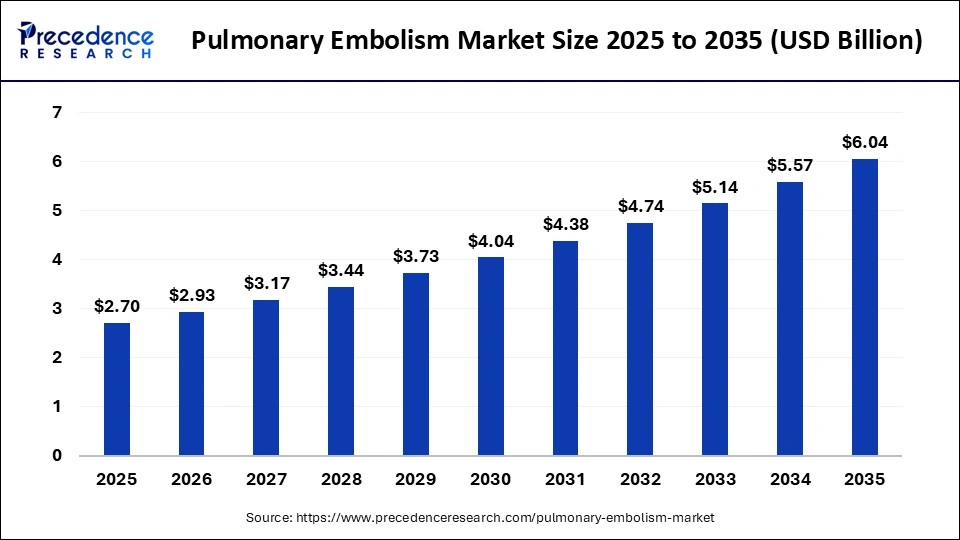
Growth is being supported by the increasing burden of venous thromboembolism, an aging population, rising cardiovascular risk factors, improved diagnostic technologies, and advances in anticoagulant and minimally invasive therapies.
Download a Sample Report: https://www.precedenceresearch.com/sample/7882
Pulmonary Embolism Treatment Overview
Pulmonary embolism occurs when a blood clot blocks an artery in the lungs and restricts normal blood flow. It is a potentially life-threatening condition that requires rapid diagnosis and appropriate treatment. Modern care includes anticoagulants, thrombolytic therapies, mechanical thrombectomy, and supportive clinical management depending on disease severity and patient risk.
The growing prevalence of obesity, cancer, cardiovascular disorders, and sedentary lifestyles is contributing to the increasing burden of venous thromboembolism. At the same time, better awareness of warning signs and greater availability of advanced imaging are helping healthcare professionals identify pulmonary embolism earlier and initiate treatment more quickly.
AI Is Revolutionizing Pulmonary Embolism Diagnosis
Artificial intelligence is becoming an important part of modern pulmonary embolism care. AI-powered software can analyze CT pulmonary angiography images and identify signs of embolism, helping radiologists prioritize urgent cases.
AI can also combine imaging results with clinical information to assist with risk assessment and treatment decisions. Faster image interpretation and automated alerts can improve communication between emergency departments, radiology teams, cardiologists, pulmonologists, and critical care specialists.
In May 2026, Viz.ai developed the Viz Pulmonary Suite, an AI-enabled solution designed to help clinicians identify pulmonary embolism along with other pulmonary conditions. This reflects the growing role of AI in accelerating diagnosis and supporting clinical workflows.
Powerful Trends Transforming Pulmonary Embolism Care
The increasing use of direct oral anticoagulants is one of the strongest trends shaping pulmonary embolism treatment. These therapies offer convenient dosing and generally reduce the need for frequent laboratory monitoring compared with traditional vitamin K antagonists.
Another major trend is the expansion of minimally invasive interventions. Catheter-directed thrombolysis and mechanical thrombectomy are gaining attention, particularly for selected high-risk and intermediate-risk patients. These procedures can provide rapid clot removal while offering an alternative to systemic thrombolytic approaches in appropriate cases.
Advanced diagnostic imaging is also improving treatment pathways. Faster access to CT pulmonary angiography, AI-assisted image analysis, telemedicine, and coordinated pulmonary embolism response teams are helping healthcare providers improve treatment speed and patient management.
Anticoagulants Continue to Lead Treatment
The anticoagulants segment held the leading position in 2025. Anticoagulants remain the foundation of pulmonary embolism treatment because they help prevent clot extension and reduce the risk of recurrent thromboembolic events.
Their established clinical effectiveness, broad availability, and use across both acute and long-term management continue to support strong adoption. Increasing availability of newer oral anticoagulants is also improving convenience for many patients.
The thrombolytics segment is expected to expand at the fastest rate during the forecast period. Thrombolytic therapies can rapidly dissolve blood clots and remain important for severe or life-threatening pulmonary embolism requiring urgent intervention.
DOACs Strengthen Long-Term Treatment
The Direct Oral Anticoagulants segment dominated the drug category in 2025. Medicines such as apixaban, rivaroxaban, and edoxaban are increasingly used because they provide predictable dosing, convenient administration, and fewer monitoring requirements than warfarin.
The heparins segment is expected to witness strong growth because of its essential role in acute hospital management. Their rapid onset of action and controllability make them particularly useful when immediate anticoagulation is required.
Hospitals Remain the Primary Treatment Setting
The hospitals segment led in 2025 because hospitals provide access to emergency diagnosis, advanced imaging, intensive monitoring, anticoagulant therapy, thrombolysis, and mechanical interventions.
Hospitals also provide multidisciplinary expertise through emergency physicians, radiologists, cardiologists, pulmonologists, and critical care specialists. This coordinated structure is particularly valuable for patients with high-risk pulmonary embolism.
The clinics segment is expected to expand rapidly as healthcare systems increasingly move appropriate patients toward outpatient follow-up and community-based care. Stable patients receiving long-term anticoagulation can benefit from convenient monitoring and specialist consultations outside acute hospital settings.
North America Maintains a Strong Position
North America held the leading position in 2025 because of its advanced healthcare infrastructure, high awareness of venous thromboembolism, strong diagnostic capabilities, and broad access to modern therapies. The United States remains a major contributor due to high healthcare expenditure, specialist expertise, strong clinical research activity, and rapid adoption of innovative technologies.
Asia Pacific is expected to experience the fastest growth through 2035. Expanding healthcare infrastructure, increasing awareness, rising diagnostic capabilities, and a growing burden of cardiovascular and metabolic risk factors are supporting demand across the region. China and India are expected to remain important contributors as hospitals and specialized centers continue adopting advanced diagnostic and treatment solutions.
Europe is also advancing steadily due to established healthcare systems, growing adoption of direct oral anticoagulants, and increasing use of catheter-based interventions. Latin America is benefiting from improving access to diagnostic imaging and essential anticoagulant medicines, while the Middle East and Africa are expanding through healthcare infrastructure development and increased investment in advanced medical technologies.
Future Outlook for Pulmonary Embolism Treatment
The future of pulmonary embolism treatment is being shaped by faster diagnosis, better risk stratification, advanced anticoagulants, and minimally invasive interventions. AI-assisted imaging is expected to improve diagnostic workflows, while mechanical thrombectomy and catheter-directed therapies could expand treatment options for appropriately selected patients.
With the global sector projected to reach approximately USD 6.04 billion by 2035, continued innovation in diagnostics, emergency care, anticoagulation, and interventional treatment is expected to strengthen patient management and improve access to more precise and effective pulmonary embolism care.
Buy this report: https://www.precedenceresearch.com/checkout/7882
About Us
Healthcare Prism is a dedicated healthcare insights and outreach platform, operating as an extension of Precedence Research. We share relevant perspectives, industry developments, emerging trends, and research-driven insights across the global healthcare sector. Our content is built on the knowledge, research standards, and expertise of Precedence Research, with a focus on making healthcare information clear, accessible, and useful for industry professionals, businesses, researchers, and healthcare stakeholders. Healthcare Prism serves as a focused platform to extend the reach of Precedence Research’s healthcare insights and connect them with a broader professional audience.
You can place an order or ask any questions, please feel free to contact us at [email protected]
Quick Contact:
Europe Region: +44 778 256 0738
North America Region: +1 8044 4193 44
APAC Region: +91 9356 9282 04 and +65 31065601
Visit Our Website: Precedence Research – Advisory, Research & Reports