
The global pulmonary embolism sector is entering a significant period of growth as healthcare systems respond to the rising burden of venous thromboembolism, cardiovascular disorders, obesity, and aging populations. Valued at USD 2.70 billion in 2025, the sector is projected to reach USD 2.93 billion in 2026 and approximately USD 6.04 billion by 2035, expanding at a CAGR of 8.38% from 2026 to 2035.
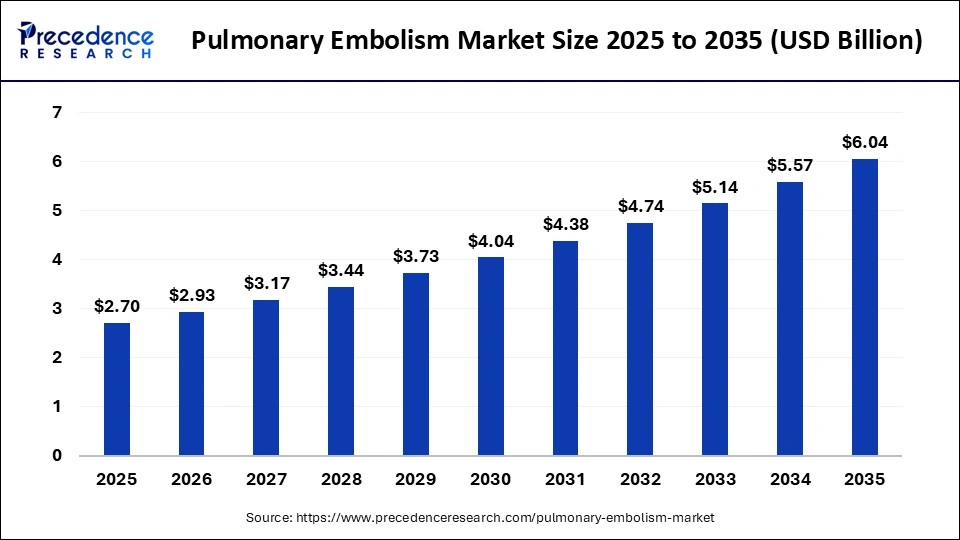
Advances in anticoagulant therapies, AI-assisted diagnostics, minimally invasive thrombectomy, and improved emergency care are creating new opportunities across diagnosis and treatment.
Download a Sample Report: https://www.precedenceresearch.com/sample/7882
Compact Scope Table
| Report Coverage | Details |
|---|---|
| 2025 Value | USD 2.70 Billion |
| 2026 Value | USD 2.93 Billion |
| 2035 Value | USD 6.04 Billion |
| CAGR 2026–2035 | 8.38% |
| Leading Region | North America |
| Fastest-Growing Region | Asia Pacific |
| Leading Treatment | Anticoagulants |
| Fastest-Growing Treatment | Thrombolytics |
| Leading Drug Type | DOACs |
| Leading End User | Hospitals |
| Key Opportunity | AI Diagnostics and Minimally Invasive Therapies |
Rising Disease Burden Is Strengthening Demand
Pulmonary embolism is a potentially life-threatening condition that occurs when a blood clot blocks an artery in the lungs. Its growing prevalence is closely associated with risk factors including deep vein thrombosis, cardiovascular disease, cancer, obesity, smoking, sedentary lifestyles, and advanced age.
Improved awareness and faster diagnosis are also increasing the number of patients receiving timely treatment. As healthcare providers focus on reducing complications and mortality, demand is increasing for reliable diagnostic procedures, anticoagulants, thrombolytics, and advanced interventions.
Anticoagulants Remain the Foundation of Treatment
The anticoagulants segment held the leading position in 2025. These therapies remain central to both acute management and prevention of recurrent blood clots because of their established clinical effectiveness and broad use across patient populations.
Within drug types, direct oral anticoagulants (DOACs) led in 2025. Their predictable dosing, convenience, limited monitoring requirements, and ease of outpatient use have strengthened their adoption.
Meanwhile, the thrombolytics segment is expected to record the fastest growth through 2035. Faster diagnosis and increasing attention to high-risk pulmonary embolism are supporting demand for therapies capable of rapidly dissolving clots.
Minimally Invasive Treatment Is Expanding
Treatment is increasingly moving beyond conventional systemic therapies toward catheter-directed interventions and mechanical thrombectomy.
These approaches can provide targeted clot removal and may be particularly valuable for selected high-risk or intermediate-risk patients. Ongoing clinical trials and improvements in device design are strengthening the role of minimally invasive treatment in specialist care.
The continued development of thrombectomy systems is creating opportunities for medical device companies alongside pharmaceutical manufacturers.
AI Is Transforming Pulmonary Embolism Diagnosis
Artificial intelligence is becoming an important tool for faster and more accurate pulmonary embolism detection.
AI-powered software can analyze CT pulmonary angiography and identify suspicious findings, helping radiologists and emergency teams prioritize potentially critical cases. Automated detection and triage can shorten diagnostic workflows and support faster treatment decisions.
AI is also being explored for patient risk assessment, treatment planning, and clinical research. By analyzing large datasets, machine learning models may help identify patients at higher risk of complications or treatment failure.
The growing combination of imaging, AI, and digital clinical workflows is creating a more responsive approach to pulmonary embolism care.
Hospitals Lead as Clinics Expand
Hospitals remained the leading end-user segment in 2025 because they provide emergency services, advanced imaging, intensive care, anticoagulation, thrombolytic treatment, and multidisciplinary specialist support.
Pulmonary Embolism Response Teams are also helping coordinate care between emergency physicians, cardiologists, pulmonologists, radiologists, and vascular specialists.
At the same time, clinics are expected to experience rapid growth as healthcare delivery increasingly shifts toward outpatient follow-up and community-based care. Clinics can support medication monitoring, recovery assessment, and long-term prevention after hospital treatment.
North America Leads the Global Landscape
North America held the leading position in 2025, supported by advanced healthcare infrastructure, high awareness, strong adoption of innovative therapies, and significant investment in research and development.
The U.S. remains an important center for pharmaceutical and medical device innovation, particularly in anticoagulants, AI-enabled imaging, catheter-based interventions, and mechanical thrombectomy.
Asia Pacific is expected to record the fastest growth as healthcare expenditure rises, diagnostic capabilities improve, and awareness of pulmonary and cardiovascular disorders increases across China, India, Japan, and South Korea.
Companies Are Accelerating Innovation
The competitive landscape includes pharmaceutical companies, diagnostic technology providers, and medical device manufacturers.
Roche and Genentech contribute through diagnostics and thrombolytic therapies, while Bayer, Pfizer, Bristol Myers Squibb, Johnson & Johnson, Sanofi, AstraZeneca, and Teva Pharmaceutical Industries are active across anticoagulation and related cardiovascular therapies.
On the device side, companies are increasingly focusing on advanced thrombectomy and catheter-based technologies. Recent developments from Viz.ai, Endovascular Engineering, and Inquis Medical highlight the growing role of AI-supported diagnosis and minimally invasive intervention.
The Road Ahead
The future of pulmonary embolism care is shifting toward faster diagnosis, personalized risk assessment, advanced anticoagulants, AI-assisted imaging, and minimally invasive treatment.
The sector is projected to reach USD 6.04 billion by 2035, creating opportunities across pharmaceuticals, medical devices, diagnostics, digital health, and specialized clinical services.
As healthcare providers continue improving early detection and treatment pathways, the combination of technology and therapeutic innovation is expected to make pulmonary embolism care faster, more precise, and increasingly patient-centered.
Buy this report: https://www.precedenceresearch.com/checkout/7882
About Us
Healthcare Prism is a dedicated healthcare insights and outreach platform, operating as an extension of Precedence Research. We share relevant perspectives, industry developments, emerging trends, and research-driven insights across the global healthcare sector. Our content is built on the knowledge, research standards, and expertise of Precedence Research, with a focus on making healthcare information clear, accessible, and useful for industry professionals, businesses, researchers, and healthcare stakeholders. Healthcare Prism serves as a focused platform to extend the reach of Precedence Research’s healthcare insights and connect them with a broader professional audience.
You can place an order or ask any questions, please feel free to contact us at [email protected]
Quick Contact:
Europe Region: +44 778 256 0738
North America Region: +1 8044 4193 44
APAC Region: +91 9356 9282 04 and +65 31065601
Visit Our Website: Precedence Research – Advisory, Research & Reports