
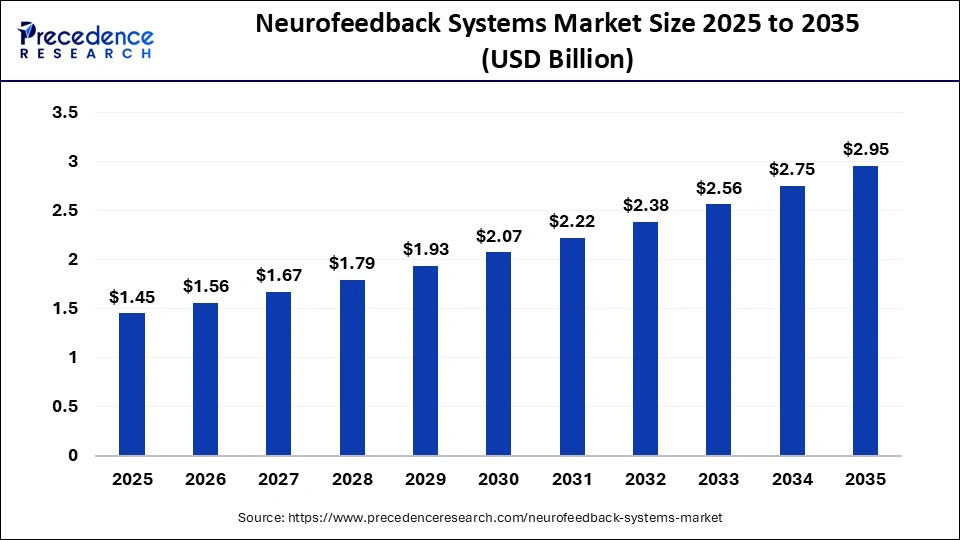
The global neurofeedback systems sector is gaining momentum as healthcare providers, researchers, and consumers increasingly adopt non-invasive technologies for brain monitoring and personalized neurotherapy. Valued at USD 1.45 billion in 2025, the sector is projected to reach USD 1.56 billion in 2026 and approximately USD 2.95 billion by 2035, expanding at a CAGR of 7.35% from 2026 to 2035.
Growing clinical attention toward ADHD, anxiety, epilepsy, sleep disorders, and cognitive performance is supporting adoption. Advancements in real-time EEG analytics, wearable devices, AI-enabled software, and remote therapy are further transforming the field.
Download a Sample Report: https://www.precedenceresearch.com/sample/7877
Compact Scope Table
| Report Coverage | Details |
|---|---|
| 2025 Value | USD 1.45 Billion |
| 2026 Value | USD 1.56 Billion |
| 2035 Value | USD 2.95 Billion |
| CAGR 2026–2035 | 7.35% |
| Leading Region | North America |
| Fastest-Growing Region | Asia Pacific |
| Leading Product Type | Devices |
| Leading Application | ADHD |
| Leading Modality | Portable/Wearable Systems |
| Leading End User | Hospitals and Specialty Clinics |
AI Is Transforming Neurofeedback Systems
Artificial intelligence is creating new opportunities for more personalized and responsive neurofeedback. AI and machine learning can help process EEG signals, filter unwanted noise, identify neural patterns, and adjust training protocols according to individual responses.
AI-enabled analytics can also support remote monitoring, treatment tracking, and personalized therapy plans. These capabilities could make neurofeedback more data-driven while improving convenience for both clinicians and users.
Wearable and Remote Technologies Are Expanding Access
Portable and wearable systems held approximately 48% share in 2025, supported by lightweight EEG headsets, wireless connectivity, and mobile integration. These technologies allow users to complete brain-training sessions outside conventional clinical settings.
Tele-neurofeedback is also gaining momentum as remote healthcare adoption increases. Cloud-based platforms can enable virtual supervision, progress tracking, and protocol adjustments, creating new opportunities for home-based neurotherapy.
Software and Cognitive Performance Create New Opportunities
Devices accounted for around 70% of the sector in 2025, but software and services are expected to record the fastest growth as demand rises for AI-powered analytics, adaptive training, cloud platforms, and subscription-based solutions.
By application, ADHD represented approximately 32% share in 2025, supported by clinical interest in attention regulation and behavioral support. Meanwhile, cognitive performance enhancement is expected to expand rapidly as neurofeedback finds applications in wellness, sports performance, and cognitive training.
North America Leads While Asia Pacific Accelerates
North America held approximately 40% of the global share in 2025, supported by advanced healthcare infrastructure, strong clinical research, widespread adoption of EEG technologies, and growing interest in non-pharmacological therapies. The regional sector is projected to reach around USD 1.19 billion by 2035.
Asia Pacific is expected to experience the fastest growth, driven by expanding mental healthcare infrastructure, increasing awareness of brain-training technologies, healthcare digitalization, and rising demand for affordable wearable EEG solutions.
Innovation Is Strengthening Competitive Positions
Companies including BrainMaster Technologies, NeuroSky, Thought Technology, BEE Medic, Mind Media, Neuroelectrics, Myndlift, NeuroCare Group, OpenBCI, and InteraXon are contributing to the evolution of neurofeedback through hardware, software, remote platforms, and digital brain-health solutions.
Recent product developments are further demonstrating the industry’s shift toward multimodal monitoring, AI-supported analysis, wearable technology, and connected care.
The Road Ahead
The future of neurofeedback systems will increasingly focus on AI-powered personalization, wearable EEG, remote therapy, multimodal brain training, and consumer-focused digital platforms.
As healthcare providers and consumers seek accessible and personalized approaches to brain health, neurofeedback is positioned to expand beyond traditional clinical environments and become an increasingly connected component of modern neurotherapy and cognitive wellness.
Buy this report: https://www.precedenceresearch.com/checkout/7877
About Us
Healthcare Prism is a dedicated healthcare insights and outreach platform, operating as an extension of Precedence Research. We share relevant perspectives, industry developments, emerging trends, and research-driven insights across the global healthcare sector. Our content is built on the knowledge, research standards, and expertise of Precedence Research, with a focus on making healthcare information clear, accessible, and useful for industry professionals, businesses, researchers, and healthcare stakeholders. Healthcare Prism serves as a focused platform to extend the reach of Precedence Research’s healthcare insights and connect them with a broader professional audience.
You can place an order or ask any questions, please feel free to contact us at [email protected]
Quick Contact:
Europe Region: +44 778 256 0738
North America Region: +1 8044 4193 44
APAC Region: +91 9356 9282 04 and +65 31065601
Visit Our Website: Precedence Research – Advisory, Research & Reports