
The global clinical alarm management market is rapidly expanding as healthcare providers prioritize patient safety and adopt advanced monitoring technologies. With the growing burden of alarm fatigue and increasing integration of healthcare IT systems, clinical alarm management solutions are becoming essential in modern healthcare environments.
Market Overview
The global clinical alarm management market was valued at USD 3.20 billion in 2025 and is expected to grow from USD 3.56 billion in 2026 to approximately USD 9.20 billion by 2035, registering a CAGR of 11.20% from 2026 to 2035.
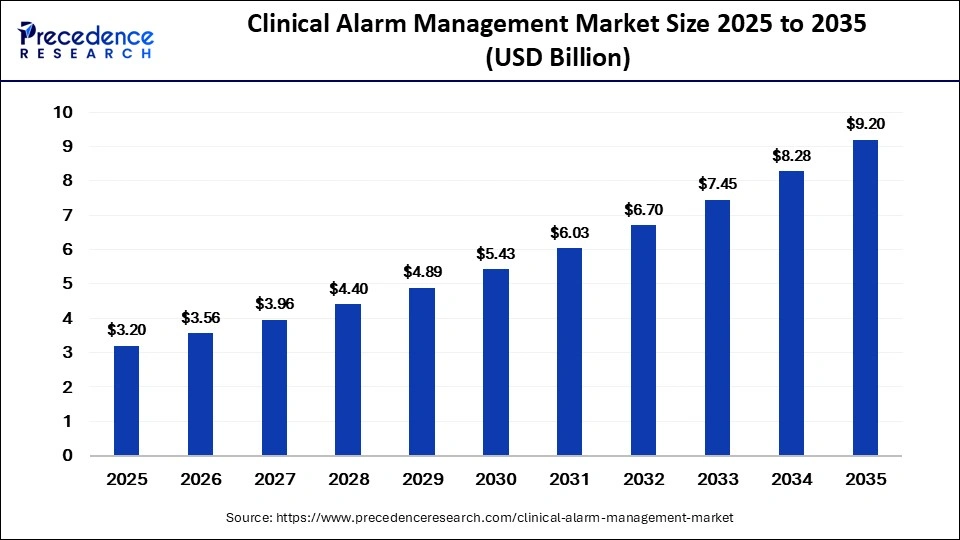
This growth is largely driven by rising adoption of connected medical devices, increasing demand for real-time patient monitoring, and the need to reduce alarm fatigue in healthcare settings.
Read Also: Intracranial Pressure Monitor Market
What is Clinical Alarm Management?
Clinical alarm management refers to systems designed to monitor, prioritize, and manage alerts generated by medical devices, including:
- Physiological monitors
- Ventilators
- Infusion pumps
- Bed alarms
- Nurse call systems
These systems help clinicians respond quickly to critical situations while filtering out non-actionable alarms.
Key Market Highlights
- North America held the largest market share of 41% in 2025
- Asia Pacific is expected to grow at the fastest CAGR
- Solutions segment dominated with 56% share
- Nurse call systems accounted for 28% share
- Hospitals & clinics contributed 70% of total revenue
- Centralized systems led with 64% market share
Market Drivers
1. Rising Alarm Fatigue
Healthcare professionals often face thousands of alarms daily, many of which are false or non-actionable. This leads to alarm fatigue, increasing the risk of missed critical alerts and driving demand for smarter alarm management systems.
2. Growing Adoption of Healthcare IT
Hospitals are increasingly investing in digital health infrastructure, including integrated monitoring systems and centralized alarm platforms.
3. Increasing Chronic Disease Burden
The rising prevalence of chronic diseases and aging populations is increasing the need for continuous patient monitoring and efficient alarm systems.
4. Technological Advancements
AI-powered alarm filtering, cloud-based systems, and real-time data analytics are enhancing system efficiency and reducing false alarms.
Market Challenges
- High implementation and maintenance costs
- Integration issues with legacy systems
- Lack of skilled professionals
- Resistance to workflow changes
These factors may limit adoption, especially in smaller healthcare facilities.
Segment Analysis
By Component
- Solutions (dominant segment)
- Services
Solutions dominate due to their ability to centralize alarm data and improve clinical workflows.
By Product
- Nurse call systems (largest share)
- Physiological monitors
- Bed alarms
- EMR integration systems
- Ventilators
- Infusion pumps
Nurse call systems lead due to their critical role in patient-provider communication.
By Deployment Mode
- On-premise systems (62% share)
- Cloud-based systems
On-premise systems dominate due to better data security, while cloud solutions are growing rapidly due to flexibility and scalability.
By End User
- Hospitals & clinics (dominant segment)
- Long-term care centers
- Ambulatory care centers
- Home care settings
Hospitals lead due to high patient volumes and extensive use of monitoring devices.
By Type
- Centralized alarm management systems (largest share)
- Decentralized systems
Centralized systems are preferred for their ability to integrate multiple devices and improve response time.
Role of AI in Clinical Alarm Management
Artificial intelligence is revolutionizing the market by:
- Filtering non-actionable alarms
- Prioritizing critical alerts
- Enabling predictive analytics
- Improving clinical decision-making
AI-driven solutions are helping reduce clinician workload and enhance patient safety.
Regional Insights
North America
North America dominates due to:
- Advanced healthcare infrastructure
- Strong regulatory frameworks
- High adoption of digital health technologies
Asia Pacific
Asia Pacific is expected to grow fastest due to:
- Rapid healthcare digitization
- Increasing investments in smart hospitals
- Rising awareness of patient safety solutions
Competitive Landscape
Key players in the clinical alarm management market include:
- Philips
- GE Healthcare
- Medtronic
- Siemens Healthineers
- Ascom
- Spacelabs Healthcare
- Stryker
- Baxter International
- Capsule Technologies
These companies are focusing on AI integration, product innovation, and strategic partnerships.
Future Outlook
The market is expected to witness strong growth driven by:
- Expansion of remote patient monitoring
- Increased adoption of AI and cloud technologies
- Growing demand for patient safety solutions
- Rising healthcare investments globally
Conclusion
The clinical alarm management market is set for significant growth over the next decade, driven by technological advancements and the urgent need to address alarm fatigue. As healthcare systems continue to evolve, these solutions will play a vital role in improving patient outcomes, enhancing workflow efficiency, and reducing medical errors.
Download a Sample Copy: https://www.precedenceresearch.com/sample/8368
For inquiries regarding discounts, bulk purchases, or customization requests, please contact us at [email protected]