
RNA analysis is becoming an increasingly important part of modern biotechnology, precision medicine, diagnostics, and pharmaceutical research. As researchers seek a deeper understanding of gene expression, disease mechanisms, biomarkers, and therapeutic targets, demand for technologies that can analyze RNA with greater speed and precision is increasing.
The global RNA analysis sector was valued at USD 9.31 billion in 2025 and is projected to increase from USD 10.21 billion in 2026 to approximately USD 23.39 billion by 2035, expanding at a CAGR of 9.65% from 2026 to 2035.
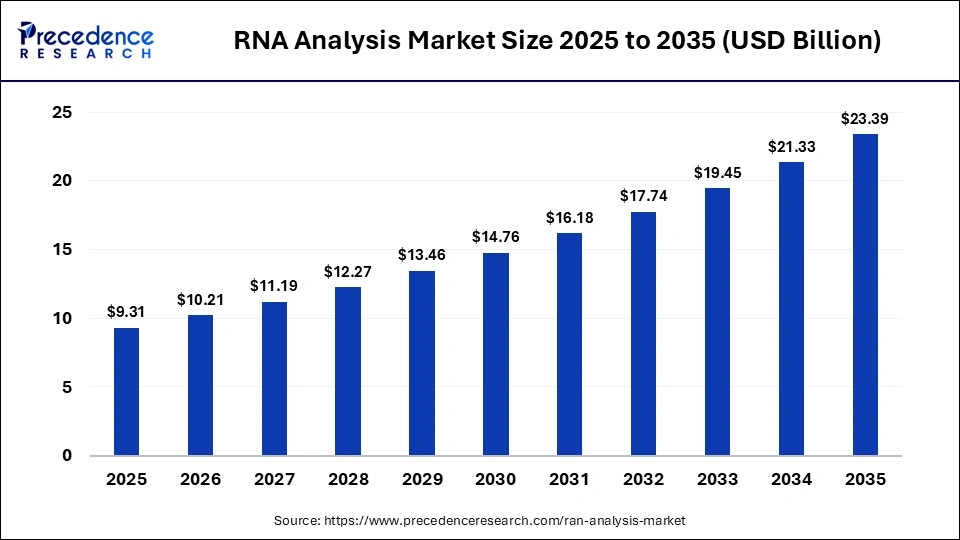
The expansion is being supported by the growing adoption of personalized medicine, rising chronic disease burden, increasing biotechnology research, advances in sequencing, and greater use of artificial intelligence and bioinformatics.
Download a Sample Report: https://www.precedenceresearch.com/sample/7448
Compact Scope Table of RNA Analysis
| Report Coverage | Details |
|---|---|
| Sector Size in 2025 | USD 9.31 Billion |
| Sector Size in 2026 | USD 10.21 Billion |
| Sector Size by 2035 | USD 23.39 Billion |
| Growth Rate from 2026 to 2035 | CAGR of 9.65% |
| Leading Region | North America |
| Fastest-Growing Region | Asia Pacific |
| Leading Product Type | Kits & Reagents |
| Fastest-Growing Product Type | Software & Bioinformatics |
| Leading Technology | Sequencing |
| Leading Application | Clinical Diagnostics |
| Fastest-Growing Application | Biomarker Discovery/Epigenetics |
| Leading End User | Pharmaceutical & Biotechnology Companies |
| Fastest-Growing End User | Hospitals & Diagnostic Labs |
| Base Year | 2025 |
| Forecast Period | 2026–2035 |
What Is RNA Analysis
RNA analysis refers to technologies and analytical tools used to study RNA molecules, including their sequence, expression levels, structure, abundance, and biological function.
RNA plays an important role in transferring genetic information and regulating cellular processes. By examining RNA, researchers can understand how genes are expressed, how diseases alter cellular activity, and how individuals may respond to different treatments.
RNA analysis technologies include:
- Polymerase chain reaction and quantitative PCR
- RNA sequencing
- Microarrays
- RNA interference
- Bioinformatics
- Transcriptomic analysis
- Single-cell RNA analysis
These tools are increasingly used in clinical diagnostics, drug discovery, biomarker identification, toxicogenomics, comparative transcriptomics, and therapeutic development.
Why RNA Analysis Is Growing
One of the strongest drivers is the increasing importance of personalized medicine.
Traditional treatment approaches often rely on population-level evidence. RNA analysis can provide information about gene activity at the individual or cellular level, supporting more precise disease characterization and treatment strategies.
The increasing prevalence of chronic diseases is also creating greater demand for advanced molecular diagnostics.
Cancer, cardiovascular disease, neurological disorders, infectious diseases, and other complex conditions can involve significant changes in gene expression. RNA analysis can help researchers identify these molecular changes and develop more targeted approaches.
The continued expansion of biotechnology and pharmaceutical R&D is another major contributor.
As drug developers investigate RNA-based therapeutics, biomarkers, vaccines, and targeted treatments, demand for RNA research tools and analytical platforms continues to grow.
AI Is Transforming RNA Analysis
Artificial intelligence is becoming one of the most important technologies shaping RNA analysis.
RNA sequencing can generate enormous quantities of complex data. AI and machine learning can process this information much faster than conventional manual approaches.
Algorithms can identify gene-expression patterns, predict RNA structures, detect potential biomarkers, and help researchers prioritize promising therapeutic targets.
AI can also reduce trial and error during RNA-based drug development.
Researchers can use computational models to evaluate possible sequences, predict biological behavior, and identify candidates that may have improved performance.
In diagnostics, AI can analyze RNA signatures associated with specific diseases and support earlier detection and patient classification.
The combination of AI, sequencing, and bioinformatics is therefore helping RNA analysis move toward a more automated and data-driven workflow.
Key RNA Analysis Trends
Single-Cell RNA Analysis Is Expanding
Single-cell RNA analysis allows researchers to study gene expression at the level of individual cells rather than analyzing a mixture of cells.
This can reveal rare cell populations and provide a much more detailed understanding of complex biological systems.
The approach is particularly valuable in cancer research, immunology, neuroscience, and developmental biology.
Advances in sequencing technologies are making single-cell analysis more accessible and scalable.
RNA Biomarkers Are Becoming More Important
RNA biomarkers can provide information about cellular activity and disease progression.
Researchers are increasingly studying RNA molecules as potential indicators for diagnosis, prognosis, treatment selection, and treatment monitoring.
Cancer research is one of the most important application areas, but RNA biomarkers are also being explored across neurological, cardiovascular, infectious, and metabolic conditions.
The growing emphasis on personalized treatment is further increasing demand for molecular biomarkers.
Point-of-Care RNA Diagnostics Are Emerging
RNA analysis is gradually moving beyond centralized laboratories.
Portable molecular diagnostic systems can provide rapid results closer to patients, potentially improving access to disease detection and monitoring.
Point-of-care RNA testing can be particularly useful for infectious disease detection and settings where laboratory infrastructure is limited.
The combination of miniaturized instruments, simplified sample preparation, and automated analysis is helping make decentralized RNA testing more practical.
Sequencing Is Becoming More Accessible
Next-generation sequencing has transformed RNA research by enabling large-scale analysis of transcripts.
Sequencing can provide detailed information about gene-expression patterns and transcript variants.
Greater automation, reduced sequencing costs, and improved computational tools are expanding the use of RNA sequencing across research and clinical applications.
Kits and Reagents Remain the Leading Product Category
Kits and reagents accounted for approximately 58% of the product segment in 2025.
They remain essential to RNA extraction, amplification, sequencing, library preparation, purification, and molecular analysis.
Researchers often prefer standardized kits because they can simplify workflows, improve reproducibility, and reduce the need for extensive manual preparation.
Automation-compatible reagent kits are becoming particularly important as laboratories seek higher throughput and greater workflow efficiency.
Software and Bioinformatics Are Growing Rapidly
The software and bioinformatics segment is expected to grow at a CAGR of 8.6% from 2026 to 2035.
The increasing volume of RNA sequencing data requires advanced computational tools to organize, process, visualize, and interpret results.
User-friendly software platforms can help researchers analyze transcriptomic datasets without requiring extensive programming expertise.
Automation is also becoming more valuable as laboratories face shortages of highly trained bioinformatics professionals.
Sequencing Leads RNA Analysis Technologies
Sequencing represented approximately 40% of the technology segment in 2025.
RNA sequencing provides high-throughput, high-resolution information about gene expression and transcript diversity.
Next-generation sequencing has become particularly important because it can analyze large numbers of transcripts simultaneously and support comprehensive molecular profiling.
The integration of AI and bioinformatics is further improving the usefulness of sequencing by enabling researchers to interpret complex datasets more efficiently.
qPCR and PCR Remain Essential
PCR and qPCR-based technologies continue to provide rapid, sensitive, and cost-effective molecular analysis.
They are widely used for gene-expression studies, infectious disease detection, transcript quantification, and validation of sequencing results.
The ability to quantify RNA in real time makes qPCR particularly valuable for applications requiring fast and targeted analysis.
Automation and multiplexing are also expanding throughput.
Clinical Diagnostics Hold the Largest Application Share
Clinical diagnostics accounted for approximately 35% of applications in 2025.
RNA analysis can support the identification of disease-associated molecular signatures and provide information that complements conventional diagnostic approaches.
Growing demand for earlier diagnosis and more personalized treatment is supporting the use of molecular analysis in clinical settings.
The technology is particularly valuable in areas such as oncology and infectious disease testing.
Biomarker Discovery and Epigenetics Offer Strong Growth
Biomarker discovery and epigenetics are expected to grow at a CAGR of 8.5%.
RNA analysis can help researchers identify molecular signatures associated with disease development, progression, and treatment response.
These capabilities are important for pharmaceutical companies developing targeted therapies and companion diagnostics.
They are also increasingly relevant to clinical research and translational medicine.
Pharmaceutical and Biotechnology Companies Lead End Users
Pharmaceutical and biotechnology companies represented approximately 36% of end-user demand in 2025.
These organizations rely heavily on RNA analysis for drug discovery, biomarker research, target identification, toxicology studies, and therapeutic development.
The growing number of RNA-based treatments and precision medicines is encouraging pharmaceutical and biotechnology companies to increase investment in molecular research technologies.
Hospitals and Diagnostic Laboratories Are Growing Rapidly
Hospitals and diagnostic laboratories are expected to grow at a CAGR of 8.8% from 2026 to 2035.
The expansion is supported by rising patient volumes, increasing demand for advanced diagnostics, and growing adoption of molecular testing.
Improved laboratory infrastructure and greater availability of automated systems are also helping healthcare providers incorporate RNA-based approaches into clinical workflows.
North America Remains the Largest Region
North America accounted for approximately 45% of the global sector in 2025.
The region benefits from strong biotechnology and pharmaceutical ecosystems, advanced academic research institutions, high R&D investment, and supportive regulatory infrastructure.
The United States is the primary contributor, with extensive investment in RNA therapeutics, molecular diagnostics, sequencing, and biotechnology.
Research and strategic collaborations between technology companies, pharmaceutical organizations, and academic institutions are further strengthening the regional ecosystem.
The U.S. Is a Major RNA Research Center
The U.S. RNA analysis sector was valued at approximately USD 1.89 billion in 2025 and is projected to reach nearly USD 4.79 billion by 2035, expanding at a CAGR of 9.86% from 2026 to 2035.
The country’s strong biotechnology infrastructure, research institutions, pharmaceutical companies, and molecular diagnostics capabilities support continued adoption.
RNA-based drug development is also increasing demand for advanced sequencing and analytical technologies.
Initiatives supporting RNA biology research are creating additional opportunities for innovation.
Asia Pacific Is Growing Fastest
Asia Pacific is expected to record the fastest growth, with a projected 10.0% CAGR from 2026 to 2035.
The region benefits from expanding healthcare infrastructure, increasing biotechnology investment, rising demand for precision medicine, and lower manufacturing costs.
Governments are also supporting biotechnology research and domestic pharmaceutical capabilities.
China, Japan, India, and South Korea are emerging as important contributors to the regional RNA ecosystem.
China Is Expanding RNA Capabilities
China is investing heavily in biotechnology and molecular research.
Government support for R&D, increasing domestic sequencing capabilities, and growing pharmaceutical investment are strengthening the country’s RNA research infrastructure.
China is also becoming an important center for RNA technology development, including self-amplifying RNA research and molecular diagnostics.
Government-supported programs are further encouraging research involving advanced sequencing, AI, and precision medicine.
India Is Strengthening Research and Biotechnology
India is expanding its biotechnology and research infrastructure through government-backed initiatives and growing private-sector investment.
The country’s large healthcare system and increasing interest in affordable diagnostics create opportunities for RNA analysis technologies.
The expansion of molecular diagnostics and biotechnology manufacturing could further strengthen India’s position in the regional ecosystem.
Europe Continues to Advance RNA Research
Europe is expected to experience steady growth as governments, academic institutions, and pharmaceutical companies increase investment in RNA research and personalized medicine.
Strong research infrastructure and pharmaceutical capabilities in countries such as Germany, France, Italy, and the UK support continued development.
AI-assisted RNA analysis, advanced delivery technologies, biosensing, and RNA therapeutics are among the areas attracting research attention.
Germany Maintains a Strong Position
Germany is an important European center for biotechnology and pharmaceutical research.
Government and private investment in mRNA vaccines, RNA therapeutics, and molecular research is strengthening the country’s capabilities.
Academic research networks and specialized biotechnology companies are supporting innovation across RNA biology and therapeutic development.
Latin America and Middle East and Africa Are Developing
Latin America is gradually expanding molecular diagnostics and biotechnology infrastructure.
Brazil is an important contributor because of its large healthcare system, research institutions, and growing interest in advanced diagnostics.
The Middle East and Africa are also investing in healthcare modernization and biotechnology.
Improving diagnostic infrastructure and rising demand for precision medicine could create additional opportunities for RNA-based testing and research technologies.
The RNA Analysis Value Chain
The RNA analysis ecosystem extends from research and sample preparation through sequencing, analysis, diagnostics, and clinical application.
Research and Development
R&D activities include sequencing innovation, RNA extraction, molecular biology, CRISPR-based research, AI-assisted analysis, and therapeutic discovery.
Major participants include Moderna, Roche Diagnostics, and Alnylam Pharmaceuticals.
Sample Preparation and Laboratory Analysis
Laboratories use reagents, extraction kits, PCR systems, sequencing technologies, and analytical instruments to process RNA samples.
This stage creates recurring demand for kits, reagents, instruments, and laboratory consumables.
Data Analysis and Bioinformatics
RNA datasets are processed using bioinformatics platforms, machine learning, and visualization tools.
This stage is becoming increasingly important as sequencing volumes grow and researchers require more sophisticated interpretation capabilities.
Clinical and Regulatory Support
RNA-based diagnostic technologies may require clinical validation and regulatory approval before being used in patient care.
Organizations including IQVIA, BioNTech, Labcorp, FDA, EMA, and NMPA contribute across various aspects of clinical development and regulatory processes.
Major Companies in RNA Analysis
The competitive landscape includes major life science companies, sequencing specialists, molecular diagnostics providers, reagent manufacturers, and bioinformatics developers.
Key participants include:
- Thermo Fisher Scientific, Inc.
- Illumina, Inc.
- Agilent Technologies, Inc.
- QIAGEN N.V.
- F. Hoffmann-La Roche AG
- Bio-Rad Laboratories, Inc.
- Eurofins Scientific
- Merck KGaA
- Pacific Biosciences of California, Inc.
- Danaher Corporation
- Promega Corporation
- Lexogen GmbH
- New England Biolabs, Inc.
- Takara Bio Inc.
- Oxford Nanopore Technologies Ltd.
Competition is increasingly focused on sequencing performance, reagent quality, automation, bioinformatics, AI integration, workflow speed, data accuracy, and the ability to support clinical as well as research applications.
Recent Industry Developments
In August 2025, 10x Genomics launched Xenium Protein, an addition to its Xenium Spatial Platform. The platform enables simultaneous RNA and protein detection in the same cell and tissue section in a single automated run, supporting deeper analysis of cellular biology.
In January 2025, Argobio and the University of Southern Denmark launched Inverna Therapeutics, a Denmark-based biotechnology company focused on RNA therapeutics and sequence-based, allele-specific targeting.
In September 2025, Tempus AI received U.S. FDA 510(k) clearance for its RNA-based Tempus xR IVD device, a next-generation sequencing-based in vitro diagnostic tool intended to support drug-development applications.
These developments demonstrate the expanding connection between RNA analysis, spatial biology, precision medicine, AI, and clinical diagnostics.
Challenges Facing RNA Analysis
Despite strong growth, RNA analysis faces several challenges.
RNA molecules can be unstable and sensitive to sample-handling conditions, making collection, extraction, storage, and processing important factors in obtaining reliable results.
The high volume and complexity of sequencing data also creates computational challenges.
Laboratories need specialized bioinformatics capabilities to process and interpret increasingly large datasets.
The cost of advanced sequencing instruments and computational infrastructure can also limit adoption among smaller laboratories and research institutions.
Regulatory requirements become particularly important when RNA analysis is used for clinical diagnostics or treatment decisions.
Data privacy and cybersecurity must also be considered as genomic and molecular information becomes increasingly connected to digital healthcare platforms.
What Biotechnology and Healthcare Companies Should Watch
Biotechnology companies, pharmaceutical organizations, diagnostic laboratories, research institutions, investors, and healthcare technology providers should closely monitor:
- Single-cell RNA analysis
- RNA sequencing
- qPCR and PCR technologies
- RNA biomarkers
- AI-powered bioinformatics
- Point-of-care RNA diagnostics
- Spatial transcriptomics
- Molecular diagnostics
- RNA therapeutics
- Precision medicine
- Digital biomarkers
- Automated laboratory workflows
The Road Ahead
RNA analysis is moving toward a more automated, precise, integrated, and clinically focused future.
Sequencing will remain a major technology because of its ability to generate high-resolution information about gene expression and transcript diversity.
At the same time, qPCR will continue to play an important role in rapid and targeted RNA quantification.
The next phase of development will increasingly combine RNA sequencing, AI, bioinformatics, single-cell analysis, spatial technologies, and clinical diagnostics.
AI will help researchers process complex datasets faster, identify biomarkers more efficiently, and discover promising therapeutic targets.
The expansion of RNA-based medicines and personalized healthcare will also create new opportunities for molecular analysis technologies across pharmaceutical development and clinical care.
The biggest opportunity lies in building an integrated RNA ecosystem where sample preparation, sequencing, computational analysis, biomarker discovery, diagnostics, and therapeutic development work together.
As biotechnology continues to advance and precision medicine becomes increasingly important, RNA analysis will remain a critical technology for understanding disease, developing therapies, and delivering more personalized healthcare.
Also Read About: https://healthcareprism.com/neuropharmacology-research-is-expanding-toward-gene-and-rna-based-treatments/
Buy this report: https://www.precedenceresearch.com/checkout/7448
About Us
Healthcare Prism is a dedicated healthcare insights and outreach platform, operating as an extension of Precedence Research. We share relevant perspectives, industry developments, emerging trends, and research-driven insights across the global healthcare sector. Our content is built on the knowledge, research standards, and expertise of Precedence Research, with a focus on making healthcare information clear, accessible, and useful for industry professionals, businesses, researchers, and healthcare stakeholders. Healthcare Prism serves as a focused platform to extend the reach of Precedence Research’s healthcare insights and connect them with a broader professional audience.
You can place an order or ask any questions, please feel free to contact us at [email protected]
Quick Contact:
Europe Region: +44 778 256 0738
North America Region: +1 8044 4193 44
APAC Region: +91 9356 9282 04 and +65 31065601
Visit Our Website: Precedence Research – Advisory, Research & Reports