
The U.S. mRNA synthesis raw materials sector is entering a powerful growth phase as biotechnology and pharmaceutical companies expand mRNA-based vaccines, therapeutics, oncology programs, and personalized medicine research. Valued at USD 682.25 million in 2025, the sector is projected to reach USD 777.98 million in 2026 and approximately USD 2.59 billion by 2035, expanding at a CAGR of 14.26% from 2026 to 2035.
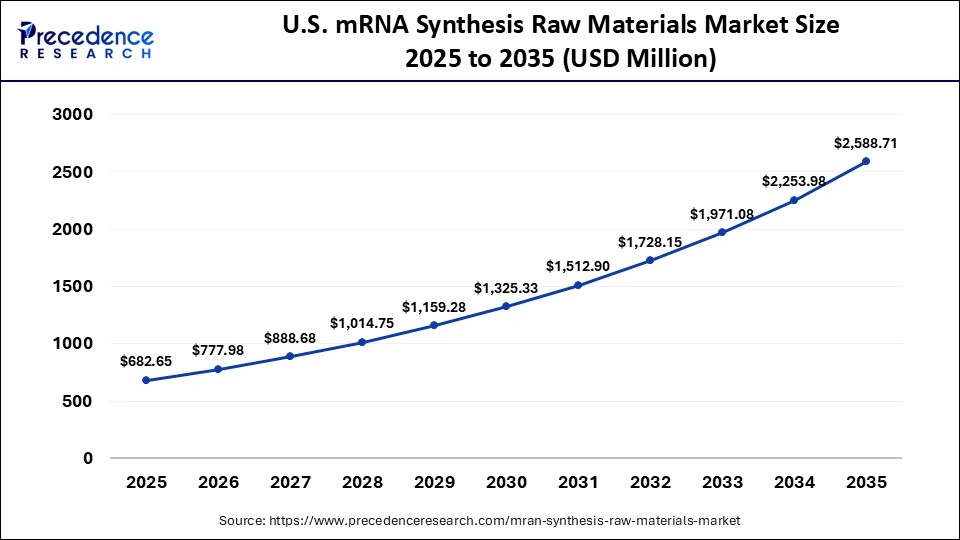
The expansion is being supported by strong research and development investment, demand for GMP-grade inputs, advances in mRNA manufacturing, supply-chain localization, and growing development of therapeutic applications beyond vaccines.
Download a Sample Report: https://www.precedenceresearch.com/sample/7369
Compact Scope Table of U.S. mRNA Synthesis Raw Materials
| Report Coverage | Details |
|---|---|
| 2025 Value | USD 682.25 Million |
| 2026 Value | USD 777.98 Million |
| 2035 Value | USD 2.59 Billion |
| CAGR 2026–2035 | 14.26% |
| Leading Product Type | Nucleotides |
| Fastest-Growing Product Type | Capping Agents |
| Leading Application | Vaccine Production |
| Fastest-Growing Application | Therapeutics Production |
| Leading End User | Biopharmaceutical & Pharmaceutical Companies |
| Fastest-Growing End User | CROs & CMOs |
| Key Growth Themes | GMP Materials, AI, Automation, Supply-Chain Resilience |
mRNA Innovation Is Expanding Beyond Vaccines
The success of mRNA vaccine technology has created a strong foundation for broader applications across healthcare. U.S. biotechnology and pharmaceutical companies are now exploring mRNA platforms for cancer immunotherapy, rare genetic diseases, protein replacement, infectious diseases, and other therapeutic applications.
This expansion is increasing demand for specialized raw materials across the full development cycle, from early-stage research to clinical and commercial manufacturing.
The vaccine production segment maintained the leading position in 2025 because of the established mRNA vaccine manufacturing ecosystem. However, therapeutics production is expected to grow more rapidly as clinical pipelines diversify and developers require increasingly specialized mRNA constructs.
Nucleotides Remain Essential to mRNA Production
Nucleotides represented the leading product category in 2025. Adenine, uracil, cytosine, and guanine form the fundamental building blocks required to create mRNA strands through in-vitro transcription.
The growing use of modified nucleotides is also creating new opportunities. Modified components can help improve mRNA stability, support efficient translation, and reduce unwanted immune activation.
As mRNA production becomes more sophisticated, manufacturers require high-purity and highly consistent nucleotide supplies capable of meeting increasingly demanding research and manufacturing specifications.
Capping Agents Are Becoming More Strategic
The capping agents segment is expected to grow rapidly through 2035.
5′ capping is critical to protecting mRNA from degradation and supporting efficient protein translation. Advanced capping technologies are therefore becoming increasingly important as developers seek improved stability, consistency, and therapeutic performance.
The industry is increasingly exploring efficient enzymatic and advanced capping approaches that can improve yield and simplify production workflows.
For suppliers, this creates opportunities to develop next-generation capping reagents that can support both research-scale and GMP manufacturing.
GMP-Grade Materials Are Reshaping the Supply Chain
One of the most important developments in the U.S. is the shift toward high-purity and GMP-grade raw materials.
As more mRNA candidates enter clinical development, suppliers must provide materials with strong traceability, consistent quality, documented specifications, and reliable batch performance.
Biopharmaceutical manufacturers are also seeking greater control over critical inputs to reduce supply disruptions. This is encouraging strategic partnerships, long-term procurement arrangements, and investment in domestic production capabilities.
Supply-chain resilience is becoming increasingly important because shortages or inconsistencies in enzymes, nucleotides, templates, or capping reagents can delay development and manufacturing timelines.
AI Is Modernizing Raw Material Production
Artificial intelligence is creating new opportunities across mRNA manufacturing and raw material production.
AI-powered systems can support predictive analytics, production optimization, digital twins, automated process control, and supply forecasting.
Digital twins can simulate manufacturing processes before physical changes are implemented, helping companies optimize workflows, improve yields, minimize waste, and identify potential equipment problems.
AI can also analyze biological datasets to identify promising mRNA targets and support drug development. On the manufacturing side, predictive models can improve demand planning and help ensure that critical raw materials are available when required.
The integration of AI with automation is therefore moving mRNA raw material production toward a more data-driven and responsive model.
Biopharmaceutical Companies Lead Demand
Biopharmaceutical and pharmaceutical companies represented the leading end-user segment in 2025.
Large developers are investing in mRNA production capabilities, research infrastructure, and long-term supply strategies to support vaccine and therapeutic pipelines.
Companies such as Moderna and BioNTech have helped strengthen the U.S. mRNA ecosystem through investments in manufacturing and research. The expansion of mRNA programs across oncology and rare diseases is further increasing demand for enzymes, nucleotides, capping materials, DNA templates, and other specialized inputs.
Meanwhile, CROs and CMOs are expected to grow at the fastest rate as smaller biotechnology companies increasingly outsource research, development, process optimization, and manufacturing activities.
These organizations can provide specialized infrastructure without requiring emerging companies to build complete internal production systems.
California Is a Major Innovation Hub
California remains an important center for biotechnology and mRNA-related innovation.
The state’s concentration of biotechnology startups, technology companies, research institutions, and investment capital supports the development of advanced mRNA manufacturing and raw material technologies.
The broader technology ecosystem also creates opportunities for AI, automation, computational biology, and digital manufacturing to converge with biopharmaceutical production.
As companies seek greater supply-chain control and domestic access to critical inputs, California can continue to play an important role in research, process development, and specialized manufacturing.
Massachusetts Strengthens the Biopharmaceutical Ecosystem
Massachusetts is another major U.S. biotechnology center, supported by leading universities, research institutions, pharmaceutical companies, and venture investment.
Companies operating in the region are increasingly advancing mRNA vaccines and therapeutics, generating demand for high-quality synthesis materials.
The state’s strong connections between academic research and commercial biotechnology also support technology transfer, early-stage innovation, and development of next-generation mRNA production methods.
Federal research organizations and funding programs further strengthen this ecosystem.
Vaccine Production Remains Important
The vaccine production segment led applications in 2025 because of the proven scalability of mRNA platforms and continued development of vaccines for infectious diseases.
One major advantage of mRNA technology is the ability to rapidly modify sequences in response to emerging pathogens and changing health requirements. This creates ongoing demand for synthesis inputs even as the technology expands beyond pandemic-related applications.
Future vaccine pipelines targeting influenza, respiratory viruses, cancer, and other conditions could provide additional demand for specialized raw materials.
Therapeutics Represent the Next Major Opportunity
The therapeutic potential of mRNA is expanding quickly.
Researchers are studying mRNA-based approaches for oncology, rare diseases, autoimmune disorders, protein replacement, and other complex conditions.
Therapeutic programs can require more specialized constructs and manufacturing approaches than traditional vaccine production. This can increase demand for advanced enzymes, modified nucleotides, high-performance capping technologies, and customized DNA templates.
As clinical programs mature, therapeutics production is expected to become an increasingly important driver of raw material consumption.
Companies Are Strengthening the U.S. Ecosystem
Major participants include Thermo Fisher Scientific, TriLink BioTechnologies, Aldevron, Merck KGaA, New England Biolabs, Moderna, Pfizer, BOC Sciences, Creative Biogene, Evonik, Integrated DNA Technologies, Promega, Arcturus Therapeutics, Ginkgo Bioworks, and AGC Biologics.
These companies are contributing through enzymes, nucleotides, DNA templates, capping technologies, manufacturing services, and related bioprocessing capabilities.
Competition is increasingly focused on purity, consistency, manufacturing scale, delivery speed, regulatory readiness, technical support, and supply reliability.
Recent Developments
In May 2025, TriLink BioTechnologies announced a major donation program for academic laboratories in the U.S. and Europe following the launch of its first mRNA synthesis kit featuring CleanCap capping technology. The initiative is designed to support research while demonstrating the growing importance of advanced capping solutions.
In September 2024, Elegen launched ENFINIA IVT Ready DNA, a high-fidelity linear DNA template designed for immediate use in mRNA development. The technology is intended to accelerate workflows by reducing dependence on traditional plasmid-based template preparation.
In June 2025, Cytiva completed expansions across the U.S., Europe, and Asia as part of a $1.6 billion investment since 2019, strengthening regional manufacturing capabilities for products supporting biopharmaceutical production.
The Road Ahead
The future of U.S. mRNA synthesis raw materials will increasingly be shaped by therapeutic expansion, GMP-grade inputs, advanced capping technologies, modified nucleotides, AI-powered manufacturing, and supply-chain resilience.
The sector is projected to reach approximately USD 2.59 billion by 2035, reflecting the rapid expansion of the broader mRNA ecosystem.
Companies that can provide high-purity materials, scalable manufacturing, reliable supply, regulatory-ready quality systems, and advanced technical capabilities will be well positioned as mRNA moves from a vaccine-focused technology toward a broader therapeutic platform.
Buy this report: https://www.precedenceresearch.com/checkout/7369
About Us
Healthcare Prism is a dedicated healthcare insights and outreach platform, operating as an extension of Precedence Research. We share relevant perspectives, industry developments, emerging trends, and research-driven insights across the global healthcare sector. Our content is built on the knowledge, research standards, and expertise of Precedence Research, with a focus on making healthcare information clear, accessible, and useful for industry professionals, businesses, researchers, and healthcare stakeholders. Healthcare Prism serves as a focused platform to extend the reach of Precedence Research’s healthcare insights and connect them with a broader professional audience.
You can place an order or ask any questions, please feel free to contact us at [email protected]
Quick Contact:
Europe Region: +44 778 256 0738
North America Region: +1 8044 4193 44
APAC Region: +91 9356 9282 04 and +65 31065601
Visit Our Website: Precedence Research – Advisory, Research & Reports