
The global Penicillin G Sodium sector is expanding steadily as demand for established antibiotic therapies continues to rise. Valued at USD 283.69 million in 2025, the sector is projected to reach USD 297.87 million in 2026 and approximately USD 462.1 million by 2035, expanding at a CAGR of 5.00% from 2026 to 2035.
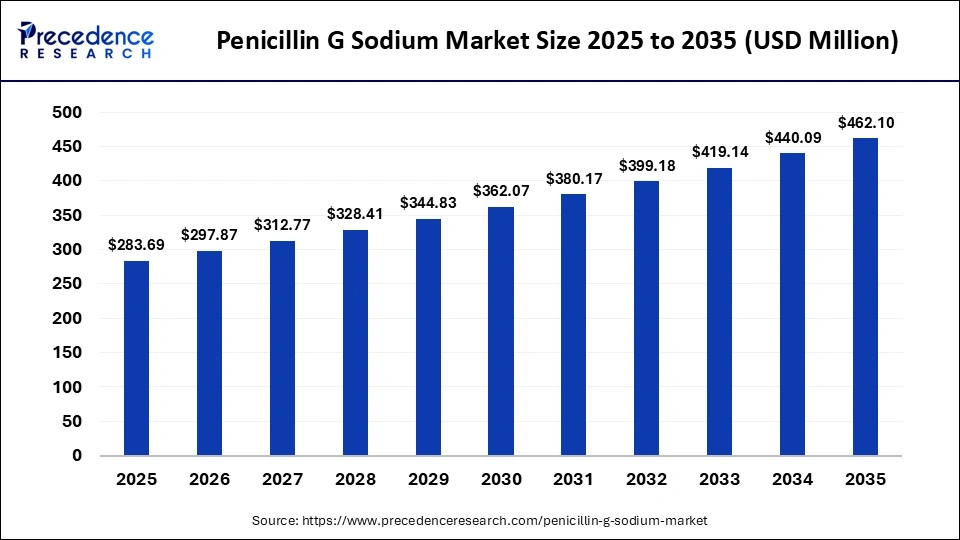
Rising bacterial infections, increasing congenital syphilis cases, growing healthcare access, pharmaceutical manufacturing investments, and advances in production technologies are supporting long-term expansion.
Download a Sample Report: https://www.precedenceresearch.com/sample/7694
Compact Scope Table
| Report Coverage | Details |
|---|---|
| 2025 Value | USD 283.69 Million |
| 2026 Value | USD 297.87 Million |
| 2035 Value | USD 462.1 Million |
| CAGR 2026-2035 | 5.00% |
| Leading Region | Asia Pacific |
| Fastest-Growing Region | North America |
| Leading Sales Channel | Direct Sales |
| Leading Application | Bacterial Infections |
| Leading Purity Grade | ≥99% Purity |
| Leading End User | Hospitals & Clinics |
| Fastest-Growing Application | Meningitis Treatment |
Bacterial Infection Treatment Remains a Core Driver
Penicillin G Sodium is an established narrow-spectrum beta-lactam antibiotic used for treating serious bacterial infections. Its clinical effectiveness, affordability, and established position in healthcare continue to support demand across hospitals and clinics.
The bacterial infections segment accounted for approximately 40% share in 2025, while meningitis treatment is expected to grow at the fastest pace. Increasing awareness, improved diagnosis, and healthcare infrastructure development are supporting greater access to antibiotic treatment.
Pharmaceutical Manufacturing Is Becoming More Strategic
The direct sales channel held approximately 55% share in 2025, supported by direct relationships between manufacturers, hospitals, distributors, and other healthcare organizations. Direct distribution can also improve supply-chain visibility, product handling, and regulatory compliance.
Pharmaceutical companies are increasingly investing in production facilities and research capabilities to strengthen antibiotic supply. Expansion of manufacturing capacity is particularly important as healthcare systems seek reliable access to essential medicines.
AI Is Improving Antibiotic Manufacturing
Artificial intelligence is introducing new opportunities across pharmaceutical production. AI-assisted systems can support fermentation optimization, real-time process monitoring, quality control, predictive maintenance, and production efficiency.
Machine learning can also help manufacturers identify production anomalies earlier and improve consistency across batches. These technologies are becoming increasingly valuable as pharmaceutical companies seek stronger quality systems and more efficient manufacturing operations.
Asia Pacific Leads While North America Accelerates
Asia Pacific accounted for approximately 45% of the global share in 2025, supported by strong pharmaceutical manufacturing capabilities, large patient populations, expanding healthcare infrastructure, and increasing demand for antibiotics.
China and India remain important contributors due to their established pharmaceutical production bases and growing healthcare requirements.
North America is expected to record the fastest growth at approximately 5.2% CAGR, supported by healthcare investment, improved infectious disease management, and pharmaceutical manufacturing expansion.
Companies Are Strengthening Production Capabilities
Leading companies including Henan Xinxiang Huaxing Pharmaceutical, CSPC Zhongnuo Pharmaceutical, Shandong Lukang Pharmaceutical Group, Kangyuan Pharmaceutical Group, Sinopharm Weiqida Pharmaceutical, Pfizer, Cipla, Fresenius Kabi, Sandoz, Panpharma, and Biocon are contributing across API production, finished medicines, and pharmaceutical supply.
Recent manufacturing developments further highlight the importance of supply security. Investments and production expansions in the U.S., China, and India are supporting greater capacity and improving access to established antibiotic therapies.
The Road Ahead
The future of Penicillin G Sodium will be shaped by reliable pharmaceutical production, antibiotic accessibility, manufacturing automation, AI-enabled quality control, and rising demand for infectious disease treatment.
As healthcare systems continue strengthening essential medicine supply chains, ongoing investment in production capacity and technology is expected to support steady growth through 2035.
Buy this report: https://www.precedenceresearch.com/checkout/7694
About Us
Healthcare Prism is a dedicated healthcare insights and outreach platform, operating as an extension of Precedence Research. We share relevant perspectives, industry developments, emerging trends, and research-driven insights across the global healthcare sector. Our content is built on the knowledge, research standards, and expertise of Precedence Research, with a focus on making healthcare information clear, accessible, and useful for industry professionals, businesses, researchers, and healthcare stakeholders. Healthcare Prism serves as a focused platform to extend the reach of Precedence Research’s healthcare insights and connect them with a broader professional audience.
You can place an order or ask any questions, please feel free to contact us at [email protected]
Quick Contact:
Europe Region: +44 778 256 0738
North America Region: +1 8044 4193 44
APAC Region: +91 9356 9282 04 and +65 31065601
Visit Our Website: Precedence Research – Advisory, Research & Reports