
The global transdermal drug delivery systems sector was valued at USD 78.20 billion in 2025 and is projected to reach USD 87.46 billion in 2026 and approximately USD 239.43 billion by 2035, expanding at a CAGR of 11.84% from 2026 to 2035.
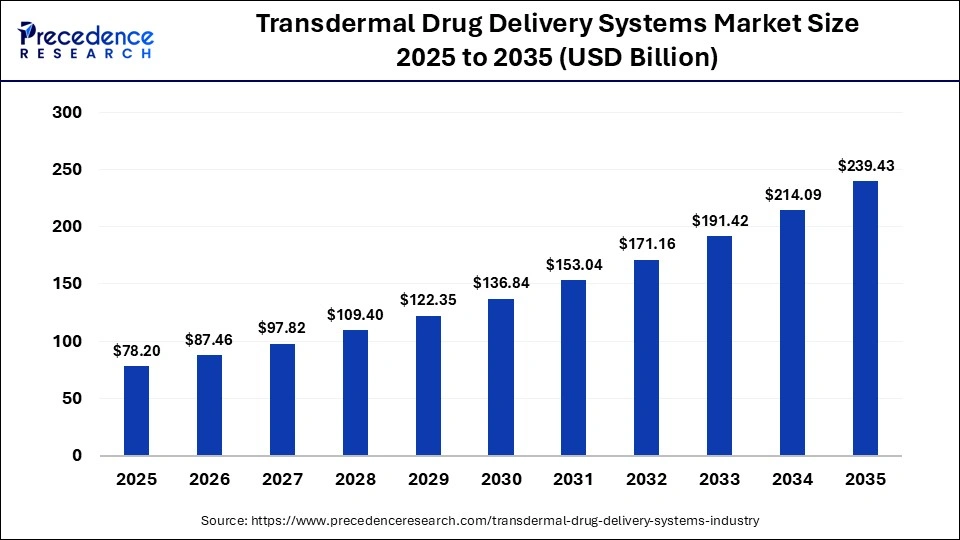
Strong growth is being supported by increasing demand for painless and non-invasive drug administration, better patient compliance, expanding home-based care, and continuous innovation in patches, microneedles, and advanced delivery technologies.
Download a Sample Report: https://www.precedenceresearch.com/sample/8074
Transdermal Drug Delivery Systems Overview
Transdermal drug delivery systems are designed to deliver therapeutic substances through the skin and into the bloodstream. Common approaches include drug-in-adhesive patches, matrix patches, reservoir patches, microreservoir systems, microneedle platforms, and iontophoretic technologies.
These systems offer several advantages over conventional oral or injectable administration. They can provide controlled drug release, reduce dosing frequency, avoid gastrointestinal degradation, and offer a convenient option for patients managing chronic conditions. Their growing use in pain management, hormone replacement therapy, contraception, neurological disorders, cardiovascular treatment, and smoking cessation is increasing their importance in modern healthcare.
Why Are Transdermal Drug Delivery Systems Gaining Momentum?
The growing preference for self-administered and minimally invasive treatment is one of the strongest factors supporting adoption. Patches and gels can provide sustained drug release over an extended period, helping patients maintain more consistent therapy while reducing the inconvenience associated with repeated administration.
Another important advantage is patient comfort. Transdermal administration eliminates the need for needles in many applications and can simplify treatment routines for patients requiring long-term medication. This is particularly valuable in homecare environments where convenient and easy-to-use therapies are increasingly preferred.
Advances in formulation science are also allowing developers to improve drug stability, skin penetration, adhesion, and controlled release. These developments are broadening the range of molecules that can potentially be delivered through the skin.
AI Is Transforming Transdermal Drug Delivery Systems
Artificial intelligence is creating new opportunities across the development and use of transdermal drug delivery systems. AI and machine learning can analyze large datasets to identify relationships between drug characteristics, skin permeability, formulation properties, and patient responses.
AI-supported tools can help researchers predict drug absorption and optimize formulations before extensive laboratory testing. These capabilities can shorten development cycles and support the design of more effective delivery platforms.
Digital technologies are also enhancing connected patches and wearable delivery devices. Smart systems can incorporate sensors to monitor physiological parameters, treatment adherence, and device performance. This creates opportunities for more personalized treatment and remote monitoring.
Powerful Trends Shaping Transdermal Drug Delivery Systems
Rapid Growth of Non-Invasive Treatment
Patients and healthcare providers are increasingly interested in alternatives to injections and other invasive procedures. Transdermal systems provide a convenient route for delivering selected therapies while improving comfort and supporting adherence.
Microneedle Technology Is Advancing
Microneedle platforms are emerging as one of the most promising areas of innovation. These tiny structures can create temporary pathways through the outer skin layer, helping deliver compounds that may otherwise have difficulty crossing the skin barrier.
Researchers are investigating microneedles for peptides, proteins, vaccines, and other advanced therapies. Their potential to combine minimal invasiveness with improved delivery efficiency is attracting significant interest.
Smart Patches Are Becoming More Sophisticated
Next-generation patches are increasingly incorporating sensors, connectivity, and digital monitoring. These smart systems may help track medication delivery and provide healthcare professionals with useful information about treatment performance.
Nanotechnology Improves Drug Permeation
Nanotechnology is supporting the development of formulations that can improve skin penetration and control drug release. Nanoparticles, nanoemulsions, and other advanced carriers are being evaluated to overcome limitations associated with conventional transdermal delivery.
Drug-in-Adhesive Patches Continue to Lead
The drug-in-adhesive patches segment held a revenue share of 36.70% in 2025. These patches integrate the drug directly into the adhesive layer, creating a relatively simple and convenient delivery structure.
Their widespread use is supported by ease of application, controlled delivery, and suitability for several therapeutic applications. Improvements in adhesive chemistry are also helping manufacturers address important requirements such as skin compatibility, adhesion strength, stability, and consistent drug release.
The microneedle transdermal systems segment is expected to expand at the fastest rate during the forecast period. These systems can enhance the delivery of hydrophilic and larger molecules that face difficulty crossing the skin barrier naturally. Continued research into vaccines, peptides, proteins, and biologics is creating substantial opportunities for this technology.
Pain Management Remains a Major Application
The pain management segment accounted for a revenue share of 34.60% in 2025. Transdermal delivery is well suited for pain therapies because it can provide controlled and sustained drug release while avoiding repeated oral dosing.
The technology can also help maintain relatively stable drug levels and improve convenience for patients managing chronic pain. These benefits continue to support the use of transdermal patches in long-term pain management.
The smoking cessation segment is expected to grow rapidly. Nicotine replacement patches provide a controlled supply of nicotine and can help reduce withdrawal symptoms for individuals attempting to stop smoking. Increasing awareness of smoking-related health risks and broader access to cessation programs are supporting continued demand.
Homecare Is Becoming a Major Treatment Setting
The homecare segment held the leading position in 2025 with a revenue share of 36.70%. Transdermal products are particularly suitable for home use because they are easy to apply, require limited equipment, and can provide drug delivery over extended periods.
The ability to remove a patch quickly in response to an adverse reaction also provides a practical safety advantage for certain therapies. Growing healthcare decentralization and increasing patient preference for treatment outside hospitals are expected to further strengthen homecare adoption.
Retail Pharmacies Lead Distribution
The retail pharmacies segment accounted for approximately 54.70% of revenue in 2025. Pharmacies remain important distribution points because patients can access prescription and non-prescription transdermal products conveniently.
Pharmacists can also provide guidance regarding correct patch placement, dosing schedules, potential interactions, and safe usage. The online pharmacies segment is expected to grow rapidly as digital healthcare expands and consumers increasingly value prescription delivery and home-based medication access.
North America Holds a Strong Position
North America accounted for 38.60% of global revenue in 2025. The region benefits from advanced healthcare infrastructure, strong pharmaceutical research capabilities, high healthcare expenditure, and early adoption of innovative drug delivery technologies.
The United States remains the primary contributor, supported by a strong pharmaceutical ecosystem and increasing consumer interest in non-invasive and self-administered therapies. Research into smart patches, microneedle systems, and connected healthcare devices is further strengthening innovation.
Asia Pacific Emerges as the Fastest-Growing Region
Asia Pacific is expected to experience the fastest growth through 2035. Expanding healthcare infrastructure, rising healthcare expenditure, increasing chronic disease prevalence, and growing awareness of patient-friendly treatment options are supporting adoption.
Japan, China, India, and other regional economies are increasing investments in pharmaceutical research and advanced drug delivery technologies. Growth in homecare, digital healthcare, and personalized treatment is also creating new opportunities for transdermal technologies.
Europe is progressing steadily because of strong pharmaceutical research, established healthcare systems, and increasing interest in home-based treatment. Regulatory developments and ongoing research into innovative drug delivery technologies are supporting long-term expansion.
Emerging Investment in Advanced Transdermal Platforms
Investment in microneedle and advanced transdermal technologies continues to increase as developers seek alternatives to conventional injections and oral administration. Companies are investigating dissolvable microneedles, wearable patches, and advanced formulations for oncology, vaccines, hormone therapies, and other applications.
The development of thermostable vaccine delivery systems using microneedle technology is also generating interest because such platforms could potentially simplify distribution and reduce dependence on conventional cold-chain requirements.
Recent Developments
In December 2025, Viatris announced U.S. FDA approval for a generic version of Sandostatin LAR Depot. The company also highlighted regulatory progress involving a low-dose estrogen weekly patch for contraception.
In November 2024, Novartis emphasized its transformation into an innovative medicines company and its focus on technology platforms to support long-term pharmaceutical development.
Future Outlook for Transdermal Drug Delivery Systems
The future of transdermal drug delivery systems is being shaped by smart patches, microneedle arrays, nanotechnology, AI-assisted formulation development, and connected healthcare. These innovations are helping developers overcome traditional skin-barrier limitations while improving convenience and treatment adherence.
With the global sector projected to reach approximately USD 239.43 billion by 2035, continued innovation is expected to expand the role of transdermal technologies across chronic disease management, pain therapy, hormone treatments, vaccines, biologics, and personalized healthcare. The combination of painless administration, controlled drug release, homecare compatibility, and digital monitoring positions transdermal drug delivery as a powerful component of next-generation pharmaceutical care.
Buy this report: https://www.precedenceresearch.com/checkout/8074
About Us
Healthcare Prism is a dedicated healthcare insights and outreach platform, operating as an extension of Precedence Research. We share relevant perspectives, industry developments, emerging trends, and research-driven insights across the global healthcare sector. Our content is built on the knowledge, research standards, and expertise of Precedence Research, with a focus on making healthcare information clear, accessible, and useful for industry professionals, businesses, researchers, and healthcare stakeholders. Healthcare Prism serves as a focused platform to extend the reach of Precedence Research’s healthcare insights and connect them with a broader professional audience.
You can place an order or ask any questions, please feel free to contact us at [email protected]
Quick Contact:
Europe Region: +44 778 256 0738
North America Region: +1 8044 4193 44
APAC Region: +91 9356 9282 04 and +65 31065601
Visit Our Website: Precedence Research – Advisory, Research & Reports