
In Vivo CAR-T Therapy is emerging as one of the most promising advances in next-generation cancer treatment. The global In Vivo CAR-T Therapy market size was valued at USD 650.00 million in 2025 and is projected to rise to USD 861.25 million in 2026. By 2035, it is expected to reach approximately USD 10,841.07 million, expanding at a remarkable CAGR of 32.50% from 2026 to 2035.
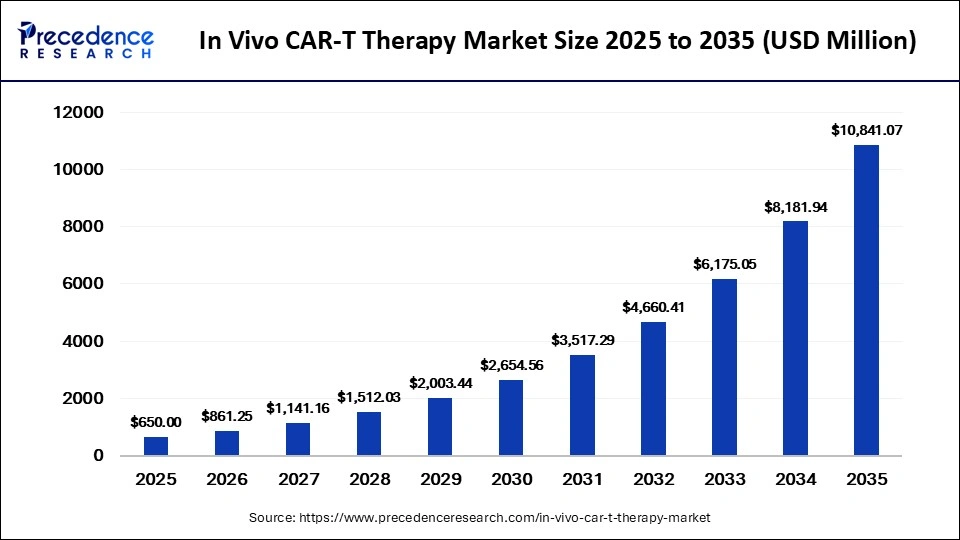
The rapid expansion is being supported by the rising global cancer burden, growing clinical research, advances in gene delivery technologies, and the potential to overcome several manufacturing challenges associated with conventional CAR-T treatment.
Download a Sample Report: https://www.precedenceresearch.com/sample/8380
What Is In Vivo CAR-T Therapy
In Vivo CAR-T Therapy represents a major shift from conventional ex vivo CAR-T approaches. Instead of collecting a patient’s T cells, modifying them in a specialized laboratory, expanding them, and returning them to the patient, in vivo approaches aim to genetically reprogram T cells directly inside the body.
This strategy can use viral vectors, lipid nanoparticles, mRNA-based systems, and other non-viral delivery platforms to transport CAR-encoding genetic material directly to T cells. By simplifying the manufacturing pathway, the technology could potentially reduce treatment preparation time, improve scalability, and broaden access to personalized cancer therapies.
The technology is particularly promising in hematologic malignancies, where CAR-T has already demonstrated strong therapeutic potential. Researchers are also working to expand the approach into multiple myeloma, solid tumors, and autoimmune diseases.
Powerful Role of Artificial Intelligence in In Vivo CAR-T Therapy
Artificial intelligence is becoming an important enabler of In Vivo CAR-T Therapy development. AI and machine learning can analyze large biological datasets to support CAR construct design, identify promising target antigens, and predict potential treatment responses.
AI is also being applied to gene delivery research and safety modeling. Researchers can use computational systems to study tumor heterogeneity, predict off-target effects, optimize vector design, and identify patient characteristics that may influence treatment outcomes.
These capabilities can shorten development cycles and improve decision-making throughout preclinical and clinical research. As in vivo approaches become more sophisticated, AI is expected to play a stronger role in creating more precise and personalized therapeutic strategies.
Key Trends Strengthening In Vivo CAR-T Therapy
One of the strongest trends is the development of advanced gene delivery platforms. Viral vectors, lipid nanoparticles, polymeric nanoparticles, circular RNA, mRNA systems, and CRISPR-enabled approaches are being investigated to improve delivery efficiency, selectivity, and safety.
Another important trend is next-generation CAR engineering. Researchers are developing more advanced CAR structures with multiple signaling elements designed to improve T-cell activation, persistence, and activity against difficult tumor environments.
The field is also witnessing a growing experimental pipeline. Candidate programs such as GT-801 demonstrate how direct T-cell programming could potentially simplify manufacturing and accelerate access to CAR-T therapies.
Key Growth Drivers
The rising prevalence of cancer remains a major factor supporting In Vivo CAR-T Therapy growth. The continuing need for effective treatments for relapsed and refractory cancers is increasing interest in innovative cell and gene therapy platforms.
Another major driver is the limitation of conventional ex vivo CAR-T manufacturing. Traditional approaches require complex cell collection, genetic modification, expansion, quality testing, and logistics. In vivo methods aim to reduce these steps by programming cells directly within the patient.
Growing investments in biotechnology and gene therapy are also accelerating research. Pharmaceutical companies, biotechnology firms, academic institutions, and specialized cancer centers are increasing funding for delivery technologies, clinical studies, and next-generation immune therapies.
Key Challenges That Could Slow Adoption
Despite significant potential, In Vivo CAR-T Therapy still faces several challenges. Immunogenicity and vector stability remain important concerns, particularly for viral delivery systems. Immune responses against vectors may affect treatment efficiency and limit repeat administration.
Another challenge is achieving highly selective delivery. Genetic material must reach the intended T cells while minimizing exposure to unwanted tissues. This requires sophisticated delivery systems with strong targeting capabilities.
Regulatory development is another important consideration. Because the technology combines gene delivery, immune engineering, and advanced therapeutics, safety, manufacturing consistency, and long-term monitoring requirements can be complex.
Major Opportunities Ahead
In Vivo CAR-T Therapy offers an important opportunity to make CAR-T treatment more scalable and potentially more accessible. Reducing or eliminating ex vivo manufacturing could simplify logistics and decrease treatment preparation requirements.
The technology could also support broader treatment applications. While hematologic malignancies currently represent the dominant application, researchers are increasingly targeting solid tumors, which are expected to record the fastest growth during the forecast period.
Localized delivery is another important opportunity. By directing therapeutic systems closer to tumor sites, researchers aim to increase treatment concentration while reducing unnecessary systemic exposure.
Segment Insights
Viral Vector-Based In Vivo CAR-T Therapy
Viral vector-based approaches dominated in 2025, accounting for approximately 65% of the total share. Their leadership is supported by established gene delivery capabilities and ongoing clinical research involving AAV and lentiviral platforms.
However, non-viral vector-based approaches are expected to grow much faster, with a projected CAGR of 38.5% between 2026 and 2035. Their potential benefits include improved scalability, greater cargo flexibility, and reduced immunogenicity.
CD19 Leads Target Antigen Applications
The CD19 segment accounted for around 35% in 2025, supported by the established role of CD19 as a target for B-cell malignancies.
The solid tumor targets segment is positioned for exceptional growth, with a projected CAGR of 40.0%. Progress in identifying tumor-specific antigens and improving receptor sensitivity is increasing the potential application of CAR-T approaches beyond blood cancers.
Hematologic Malignancies Remain the Core Application
Hematologic malignancies represented approximately 60% of the share in 2025. This reflects the established clinical success of CAR-T approaches in leukemia, lymphoma, and multiple myeloma.
Solid tumors accounted for about 25% and are expected to expand at the fastest CAGR of 40.5%, reflecting significant unmet treatment needs and growing research activity.
Specialized Cancer Centers Gain Momentum
Hospitals led end-use applications with a 45% share in 2025, supported by advanced infrastructure and multidisciplinary capabilities.
Specialized cancer centers accounted for approximately 40% and are expected to record the fastest growth at a CAGR of 34.0%. Their specialized expertise, advanced treatment infrastructure, and access to clinical trials make them increasingly important for next-generation immunotherapy development.
Regional Growth Outlook
North America Leads Current Development
North America dominated the In Vivo CAR-T Therapy landscape with a 50% share in 2025. The region benefits from advanced biotechnology infrastructure, strong research funding, specialized cancer centers, and an extensive clinical trial ecosystem.
The U.S. remains the primary contributor, with its In Vivo CAR-T Therapy size estimated at USD 243.75 million in 2025 and projected to reach nearly USD 4.13 billion by 2035, representing a CAGR of 32.72%.
Asia Pacific Shows Exceptional Potential
Asia Pacific is expected to experience the fastest growth over the forecast period. Increasing biotechnology investments, expanding clinical research infrastructure, rising cancer incidence, and supportive regulatory developments are strengthening the regional outlook.
China is emerging as a major contributor because of its growing biotechnology capabilities, advanced clinical trial infrastructure, and significant investment in gene-editing and cell therapy research.
Europe Strengthens Its Position
Europe continues to benefit from strong academic research, strategic collaborations, advanced healthcare infrastructure, and evolving regulatory support for advanced therapies. Germany is an important contributor due to healthcare investments, specialized treatment centers, and increasing research collaboration.
Competitive Landscape
The competitive environment is shaped by biotechnology companies, pharmaceutical organizations, and emerging gene therapy innovators. Leading companies include Capstan Therapeutics, Interius BioTherapeutics, Umoja Biopharma, Sana Biotechnology, Cellectis, Beam Therapeutics, Precision BioSciences, Poseida Therapeutics, CRISPR Therapeutics, Intellia Therapeutics, Novartis, Gilead Sciences, Bristol Myers Squibb, Legend Biotech, and Caribou Biosciences.
Companies are focusing on advanced gene delivery systems, improved CAR designs, targeted antigens, solid tumor applications, and scalable manufacturing strategies. Strategic acquisitions and collaborations are also helping accelerate development.
In April 2026, Eli Lilly agreed to acquire Kelonia Therapeutics, strengthening its position in in vivo gene delivery. Kelonia’s technology uses engineered lentiviral-based particles designed to target T cells inside the body, highlighting growing pharmaceutical interest in direct cellular reprogramming.
Future Outlook
The future of In Vivo CAR-T Therapy appears highly promising as the technology moves toward more efficient gene delivery, improved targeting, and simplified treatment workflows. The global value is projected to rise from USD 861.25 million in 2026 to approximately USD 10.84 billion by 2035, reflecting the exceptionally strong growth expected during the forecast period.
The next phase of development will likely focus on safer non-viral delivery platforms, advanced CAR engineering, solid tumor targeting, localized administration, and AI-supported treatment optimization. As research progresses and more candidates enter clinical development, In Vivo CAR-T Therapy could become an increasingly important component of next-generation precision oncology.
Buy this report: https://www.precedenceresearch.com/checkout/8380
About Us
Healthcare Prism is a dedicated healthcare insights and outreach platform, operating as an extension of Precedence Research. We share relevant perspectives, industry developments, emerging trends, and research-driven insights across the global healthcare sector. Our content is built on the knowledge, research standards, and expertise of Precedence Research, with a focus on making healthcare information clear, accessible, and useful for industry professionals, businesses, researchers, and healthcare stakeholders. Healthcare Prism serves as a focused platform to extend the reach of Precedence Research’s healthcare insights and connect them with a broader professional audience.
You can place an order or ask any questions, please feel free to contact us at [email protected]
Quick Contact:
Europe Region: +44 778 256 0738
North America Region: +1 8044 4193 44
APAC Region: +91 9356 9282 04 and +65 31065601
Visit Our Website: Precedence Research – Advisory, Research & Reports