
The thrombus aspiration catheter sector is expanding as the global burden of stroke, cardiovascular disease, pulmonary embolism, and deep vein thrombosis continues to increase.
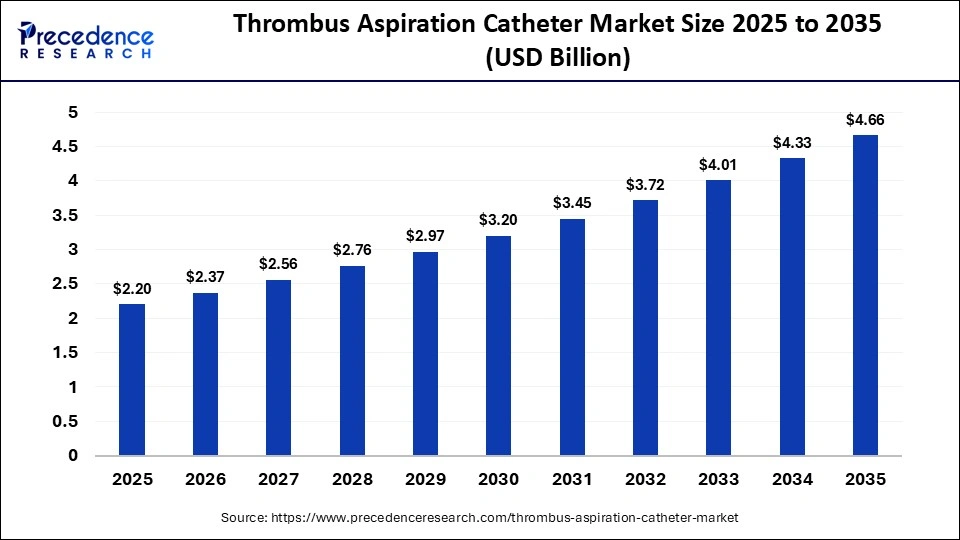
Valued at USD 2.20 billion in 2025, it is projected to reach USD 4.66 billion by 2035, growing at a CAGR of 7.80% from 2026 to 2035. Rising adoption of minimally invasive thrombectomy, improvements in catheter design, and advances in real-time imaging are supporting this growth.
Download a Sample Report:https://www.precedenceresearch.com/sample/8288
Why Thrombus Aspiration Catheters Are Becoming More Important
Thrombus aspiration catheters are minimally invasive devices designed to remove blood clots from vessels using controlled suction. They are increasingly used in interventional procedures for conditions such as acute coronary syndrome, pulmonary embolism, deep vein thrombosis, and ischemic stroke.
The growing emphasis on rapid clot removal is strengthening demand for these devices. In acute vascular emergencies, restoring blood flow as quickly as possible is critical to reducing tissue damage and improving patient outcomes. This has encouraged hospitals and specialized cardiovascular centers to invest in advanced thrombectomy technologies.
The wider adoption of mechanical thrombectomy is also creating strong opportunities. Improvements in catheter flexibility, trackability, suction performance, and navigation are helping physicians treat increasingly complex vascular conditions.
AI Is Transforming Thrombectomy Workflows
Artificial intelligence is becoming an important part of modern stroke and vascular care. AI-powered imaging platforms can analyze CT and MRI scans and help identify large vessel occlusions or other vascular abnormalities more rapidly.
AI can support:
- Faster identification of eligible patients
- Automated imaging interpretation
- Treatment prioritization
- Stroke pathway coordination
- Real-time clinical decision support
- Post-procedure monitoring
The integration of AI with digital stroke networks can help reduce delays between diagnosis and intervention. This is particularly important in ischemic stroke, where treatment timing can have a major effect on clinical outcomes.
Advanced Aspiration Technologies Are Driving Innovation
The technology landscape is moving beyond conventional manual aspiration toward more sophisticated mechanical and powered systems.
The manual aspiration catheters segment accounted for 40% in 2025, supported by their familiarity, relatively simple operation, and broad clinical use.
However, the mechanical aspiration catheters segment held 35% and is projected to grow at a CAGR of 8.2%. These systems are gaining attention because they can improve clot retrieval efficiency, reduce repeated device passages, and support more complex thrombectomy procedures.
Powered aspiration systems are also gaining momentum as healthcare providers seek greater procedural control, higher first-pass success, and faster clot removal.
Acute Coronary Syndrome Remains the Leading Application
The acute coronary syndrome segment represented 45% in 2025, making it the largest application segment.
The increasing burden of cardiovascular disease and continued demand for interventional procedures are supporting catheter adoption in cardiac care. Aspiration technologies can assist clinicians in managing thrombotic complications and restoring vessel patency during selected interventions.
Pulmonary embolism accounted for 25% in 2025 and is expected to maintain strong growth as awareness and adoption of catheter-based clot removal increase. Advancements in aspiration technology are enabling physicians to treat larger thrombus burdens with increasingly efficient workflows.
Hospitals Continue to Lead End Use
Hospitals accounted for 55% in 2025 because they manage high-acuity cardiovascular and neurovascular conditions and have the infrastructure required for advanced interventional procedures.
Hospitals typically have catheterization laboratories, imaging systems, specialized physicians, and emergency care teams that support rapid thrombectomy procedures.
Cardiovascular centers represented 25% and are also expanding their role as specialized facilities invest in advanced catheter technologies, physician training, and dedicated procedural programs.
Ambulatory surgical centers are expected to experience faster growth as selected interventional procedures increasingly move toward efficient outpatient care models.
North America Maintains a Strong Leadership Position
North America accounted for approximately 35% in 2025, supported by advanced healthcare infrastructure, high procedure volumes, strong reimbursement systems, and rapid adoption of interventional technologies.
The United States remains a major contributor, supported by a high burden of cardiovascular and cerebrovascular disease and extensive access to specialized stroke and cardiac centers.
The region is also benefiting from ongoing innovation from leading device manufacturers, clinical research, and increasing integration of advanced imaging and AI into vascular care.
Asia Pacific Is Emerging as a Powerful Growth Engine
Asia Pacific is expected to experience the fastest growth through 2035. Rising healthcare expenditure, expanding hospital infrastructure, and increasing prevalence of cardiovascular and cerebrovascular disorders are encouraging broader adoption of thrombectomy procedures.
China is an important contributor to regional growth. The rapid expansion of mechanical thrombectomy procedures and improvements in interventional care infrastructure are creating greater demand for advanced aspiration technologies.
Increasing physician training and investment in specialized stroke centers are expected to further strengthen adoption across the region.
How Leading Companies Are Positioning
Leading medical device companies are competing through catheter innovation, improved navigation, aspiration efficiency, automation, and integration with broader thrombectomy platforms.
Penumbra is strengthening its position through computer-assisted vacuum thrombectomy technologies designed to improve clot detection and removal efficiency.
Medtronic, Stryker, Boston Scientific, Abbott, and Terumo continue to expand their portfolios across cardiovascular and neurovascular intervention.
Recent product launches also demonstrate a clear shift toward aspiration-first approaches, improved distal access, and more automated clot-removal systems. Companies are increasingly combining catheter design with imaging, AI-assisted workflows, and procedural automation to improve efficiency and clinical performance.
Recent Developments
In March 2026, Johnson & Johnson launched the CEREGLIDE 42 and CEREGLIDE 57 aspiration catheters, along with the INNERGLIDE 7 delivery aid, expanding its aspiration-first stroke portfolio.
In January 2026, Penumbra introduced the Lightning Flash 3.0 Computer Assisted Vacuum Thrombectomy system, featuring enhanced clot detection algorithms, larger tubing, and automated backflush capabilities for pulmonary and venous thrombus removal.
In January 2025, Imperative Care launched the Zoom 4S Catheter, designed to broaden the use of aspiration-based thrombectomy and support more efficient clot removal across different patient anatomies.
The Future of Thrombus Aspiration Technology Looks Highly Promising
The future of thrombus aspiration technology is moving toward greater precision, faster intervention, improved navigation, and increasingly intelligent procedural systems.
Advanced imaging, AI-assisted patient selection, aspiration-first techniques, and next-generation catheter designs are expected to improve the efficiency of clot-removal procedures. At the same time, expanding stroke and cardiovascular care infrastructure will create new opportunities across emerging healthcare systems.
As clinicians continue to prioritize minimally invasive treatment and rapid restoration of blood flow, thrombus aspiration catheters are expected to play an increasingly important role in modern interventional care.
Buy this report: https://www.precedenceresearch.com/checkout/8288
About Us
Healthcare Prism is a dedicated healthcare insights and outreach platform, operating as an extension of Precedence Research. We share relevant perspectives, industry developments, emerging trends, and research-driven insights across the global healthcare sector. Our content is built on the knowledge, research standards, and expertise of Precedence Research, with a focus on making healthcare information clear, accessible, and useful for industry professionals, businesses, researchers, and healthcare stakeholders. Healthcare Prism serves as a focused platform to extend the reach of Precedence Research’s healthcare insights and connect them with a broader professional audience.
You can place an order or ask any questions, please feel free to contact us at [email protected]
Quick Contact:
Europe Region: +44 778 256 0738
North America Region: +1 8044 4193 44
APAC Region: +91 9356 9282 04 and +65 31065601
Visit Our Website: Precedence Research – Advisory, Research & Reports