
Particle therapy is emerging as one of the most advanced approaches in radiation oncology, offering highly precise radiation delivery while helping reduce exposure to surrounding healthy tissues. Growing investment in proton therapy centers, heavy ion research, compact treatment systems, and AI-powered treatment planning is strengthening adoption worldwide.
The global particle therapy sector was valued at approximately USD 1.86 billion in 2025 and is projected to reach around USD 3.92 billion by 2035, growing at a CAGR of 7.75% from 2026 to 2035.
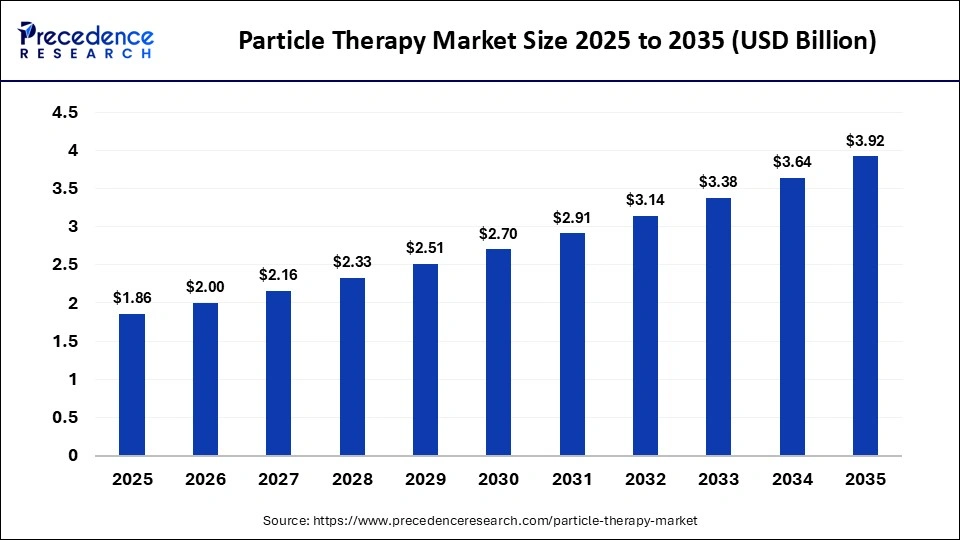
Growing cancer incidence, increasing demand for precision oncology, technological advancements, and the expansion of specialized cancer treatment facilities are supporting this growth.
Download a Sample Report: https://www.precedenceresearch.com/sample/8142
Why Is Particle Therapy Gaining Attention?
Particle therapy is a form of external-beam radiotherapy that uses charged particles, primarily protons and heavier ions, to deliver radiation to tumors.
Compared with conventional photon-based radiation, particle therapy can provide highly controlled dose distribution. This makes it especially valuable for tumors located close to sensitive organs and structures such as the brain, spinal cord, heart, and optic nerves.
The technology is increasingly being explored for pediatric cancers, recurrent tumors, skull-base tumors, and other complex cases where minimizing radiation exposure to healthy tissue is particularly important.
AI Is Making Particle Therapy More Precise
Artificial intelligence is becoming an important part of modern particle therapy workflows.
AI can support:
- Treatment planning and beam-angle selection
- Dose calculation and optimization
- Patient positioning
- Image analysis
- Quality assurance
- Treatment monitoring
- Follow-up analysis
Machine learning can process complex imaging and clinical data to help clinicians develop more consistent treatment plans. AI-based systems can also support adaptive radiotherapy by identifying changes in a patient’s anatomy and helping adjust treatment accordingly.
In May 2026, Flatiron Health launched Flatiron Telescope, an AI-enabled platform designed to provide cancer-related insights to researchers, reflecting the broader growth of AI-driven oncology data and analytics.
Proton Therapy Maintains Its Leadership
Proton therapy accounted for approximately 88% of the sector in 2025, making it the dominant technology.
Its strong position is supported by its precision, growing clinical adoption, and continued technological development. Innovations such as pencil beam scanning, image-guided proton therapy, compact accelerator systems, and FLASH radiotherapy research are improving the flexibility of proton treatment.
Heavy ion therapy, particularly carbon ion therapy, is expected to grow at a faster pace as researchers investigate its biological advantages for tumors that may respond less effectively to conventional radiation.
Compact Single-Room Systems Are Expanding Access
Multi-room systems currently hold a leading position because they are widely deployed at major cancer institutes and academic medical centers.
However, single-room systems are gaining attention because they require less infrastructure and can be integrated into existing radiation oncology facilities.
Compact systems could help regional hospitals and smaller cancer centers introduce particle therapy without the extensive construction requirements associated with large multi-room facilities.
This shift may be important for improving access to advanced radiation treatment in more locations.
Pediatric Cancer Remains a Major Application
Pediatric cancer is an important area for particle therapy because children can be particularly sensitive to unnecessary radiation exposure.
Proton therapy can help limit radiation dose to healthy tissues surrounding the tumor, making it attractive for certain childhood cancers.
Research is also expanding into breast, lung, head and neck, and other complex tumors, while heavy ion therapy is being studied for tumors that are difficult to treat using conventional approaches.
How Leading Companies Are Positioning
The competitive landscape includes established radiation oncology and accelerator technology companies.
Ion Beam Applications (IBA) continues to focus strongly on proton therapy systems and related oncology solutions.
Mevion Medical Systems is advancing compact proton therapy platforms designed to make treatment systems more accessible to cancer centers.
Hitachi is developing advanced proton therapy facilities, including compact systems and rotating gantry technologies.
Varian, part of Siemens Healthineers, continues to expand its radiation oncology portfolio through imaging, treatment planning, and oncology management solutions.
Sumitomo Heavy Industries and Mitsubishi Electric are also contributing to accelerator and particle therapy technology development.
Recent innovation is increasingly centered on compact accelerators, improved imaging, AI-assisted planning, automated workflows, and greater treatment precision.
North America Leads the Sector
North America accounted for approximately 38% of the global sector in 2025.
The region benefits from advanced healthcare infrastructure, high cancer treatment expenditure, strong research capabilities, and the presence of leading proton therapy providers.
The United States remains a major contributor, supported by growing adoption of advanced radiation technologies and investments in precision oncology.
In April 2026, Stanford Medicine established a proton therapy facility in California, strengthening access to advanced proton treatment, particularly for pediatric patients.
Asia Pacific Is Expanding Rapidly
Asia Pacific is expected to record the fastest growth during the forecast period.
Increasing cancer incidence, improving healthcare infrastructure, medical tourism, and government investment in advanced oncology facilities are supporting adoption.
China and Japan are particularly active in particle therapy development, while India is expanding access to advanced cancer treatment infrastructure.
In January 2026, the government of Assam announced an investment of approximately Rs. 500 crore for a proton therapy unit at the Cancer Institute of Gauhati Medical College Hospital, highlighting growing interest in advanced radiation treatment infrastructure in India.
Europe Strengthens Its Precision Oncology Ecosystem
Europe continues to benefit from advanced cancer research institutions, established healthcare infrastructure, and investments in precision oncology.
Germany, France, the UK, and other countries are supporting the development of advanced radiation treatment facilities and research programs.
In July 2025, Hitachi received an order for a new proton therapy facility at Tokyo Metropolitan Cancer and Infectious Diseases Center Komagome Hospital, demonstrating continued international investment in compact proton therapy infrastructure.
Key Challenges
Despite its clinical advantages, particle therapy requires substantial investment in accelerators, treatment rooms, specialized infrastructure, and trained professionals.
High capital costs, complex installation requirements, regulatory considerations, and limited availability of specialized expertise can restrict adoption, particularly in developing regions.
Improving compact system designs and treatment efficiency could help reduce some of these barriers over time.
What Comes Next?
The future of particle therapy will be shaped by the convergence of precision oncology, AI, advanced imaging, compact accelerator technology, and personalized treatment planning.
Proton therapy is likely to remain the dominant technology, while heavy ion therapy could gain greater attention as clinical evidence and research expand.
The broader opportunity lies in making highly precise radiation treatment more accessible while improving clinical workflows and reducing unnecessary radiation exposure.
With continued investment from healthcare institutions, governments, and technology companies, particle therapy is positioned to become an increasingly important part of the next generation of cancer care.
Buy this report: https://www.precedenceresearch.com/checkout/8142
About Us
Healthcare Prism is a dedicated healthcare insights and outreach platform, operating as an extension of Precedence Research. We share relevant perspectives, industry developments, emerging trends, and research-driven insights across the global healthcare sector. Our content is built on the knowledge, research standards, and expertise of Precedence Research, with a focus on making healthcare information clear, accessible, and useful for industry professionals, businesses, researchers, and healthcare stakeholders. Healthcare Prism serves as a focused platform to extend the reach of Precedence Research’s healthcare insights and connect them with a broader professional audience.
You can place an order or ask any questions, please feel free to contact us at [email protected]
Quick Contact:
Europe Region: +44 778 256 0738
North America Region: +1 8044 4193 44
APAC Region: +91 9356 9282 04 and +65 31065601
Visit Our Website: Precedence Research – Advisory, Research & Reports