
Brain health is becoming an increasingly important part of healthcare as neurological disorders, cognitive decline, and age-related conditions affect more people around the world. At the same time, healthcare providers are looking for better ways to identify changes in memory, attention, and cognitive function at an earlier stage.
The global cognitive assessment and brain health sector was valued at USD 9.40 billion in 2025 and is projected to reach approximately USD 28.69 billion by 2035, expanding at a CAGR of 11.80% from 2026 to 2035.
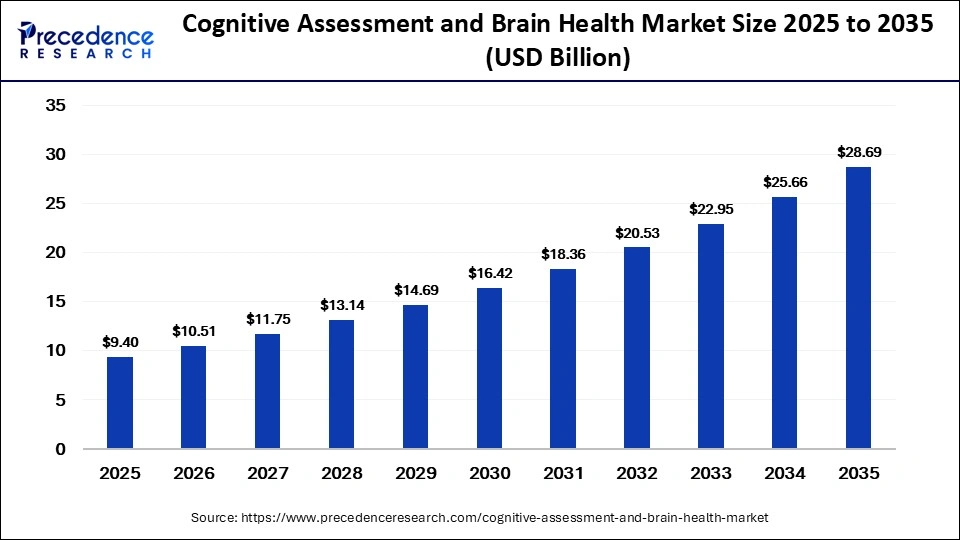
The growth is being supported by rising neurological disease prevalence, greater awareness of brain health, expanding digital healthcare, advances in artificial intelligence, and increasing demand for early cognitive assessment.
Download a Sample Report: https://www.precedenceresearch.com/sample/8519
Why Cognitive Assessment and Brain Health Are Becoming More Important
Cognitive assessment involves structured tests designed to evaluate functions such as memory, attention, reasoning, language, and problem-solving.
These assessments can help healthcare professionals understand changes in cognitive function and identify individuals who may require further neurological evaluation.
Brain health extends beyond memory alone. It includes cognitive, emotional, behavioral, sensory, and motor functions that contribute to a person’s ability to live independently and maintain quality of life.
As populations age, the need for accessible and repeatable cognitive assessment is increasing. Alzheimer’s disease, dementia, traumatic brain injuries, mental health conditions, and other neurological disorders are encouraging healthcare providers to focus more strongly on early detection and ongoing monitoring.
AI Is Changing Cognitive Assessment
Artificial intelligence is becoming one of the most important technologies in the cognitive assessment and brain health sector.
Traditional cognitive assessments can be time-consuming and may depend heavily on clinical interpretation. AI-enabled tools can analyze large datasets and identify patterns across cognitive tests, medical records, brain imaging, speech, movement, and other digital biomarkers.
Machine learning can support earlier identification of subtle changes that may otherwise be difficult to detect through a single clinical assessment.
AI can also personalize assessments by adapting questions or testing difficulty based on an individual’s responses.
Another important development is the use of smartphones, smartwatches, and wearable technologies. These devices can collect behavioral and physiological information continuously, creating a more detailed picture of cognitive and functional health.
The future is likely to involve a combination of clinical assessments, AI analytics, digital biomarkers, and neuroimaging rather than relying on a single test.
Key Trends Shaping Cognitive Assessment and Brain Health
Digital Cognitive Assessments Are Becoming More Accessible
Digital cognitive assessment platforms accounted for 46% of the technology category in 2025.
These platforms allow assessments to be performed using computers, tablets, and smartphones, making testing more convenient for hospitals, clinics, research organizations, and patients.
Digital systems can also make it easier to repeat assessments over time and compare changes in cognitive performance.
This is particularly valuable for neurological conditions where tracking progression is just as important as obtaining a single baseline measurement.
AI-Based Cognitive Analytics Are Growing Rapidly
AI-based cognitive analytics represented 19% in 2025 and are expected to grow at a 17.2% CAGR from 2026 to 2035.
AI can process large volumes of cognitive and behavioral information and identify relationships that may be difficult to recognize manually.
For researchers, these capabilities can support patient stratification, clinical trial analysis, and digital endpoint development.
For healthcare providers, AI can potentially assist in prioritizing patients who may benefit from additional evaluation.
Remote Cognitive Assessment Is Expanding
Cognitive testing is increasingly moving beyond hospitals and clinics.
Smartphones, tablets, wearables, and remote healthcare platforms allow some assessments to take place at home.
This can be particularly useful for older adults, patients with mobility challenges, and people living in areas with limited access to neurological specialists.
Remote testing also allows repeated measurements, which may provide a better understanding of gradual cognitive changes.
Multimodal Assessment Is Becoming the Future
One of the strongest emerging trends is combining multiple forms of information.
AI-based cognitive tests can be combined with blood-based biomarkers, MRI or PET imaging, wearable information, and patient history.
Rather than relying on a single data source, multimodal approaches can provide a broader view of brain health and may improve assessment accuracy.
How Leading Companies Are Positioning
The cognitive assessment and brain health landscape includes specialized cognitive testing companies, digital health providers, wearable technology firms, neurotechnology companies, and medical research organizations.
Cogstate focuses on computerized cognitive testing and provides digital assessment technologies used across clinical research and healthcare. Its platforms are designed to standardize cognitive testing and support reliable measurement.
Cambridge Cognition specializes in digital cognitive assessments and neuroscience technologies. Its solutions are used in clinical research and neurological studies to measure cognitive performance.
Pearson has extensive expertise in psychological and cognitive assessment. Its standardized assessment tools remain widely used by healthcare professionals, researchers, and educational institutions.
BrainCheck focuses on digital cognitive assessment tools designed to support screening and monitoring. Its platform aims to make cognitive testing more accessible across clinical and care settings.
Posit Science is known for digital brain training and cognitive wellness solutions. Its work reflects the growing interest in maintaining cognitive function rather than focusing only on disease detection.
Neurotrack develops digital cognitive health tools and assessments designed to support accessible evaluation of memory and cognitive performance.
Altoida is developing digital cognitive assessment technologies using smartphone and augmented reality-based approaches to collect functional information associated with cognitive health.
Creyos provides digital cognitive assessment tools that can be used across healthcare, research, and educational environments.
BrainScope combines neurological assessment technologies with portable systems designed to support brain injury evaluation.
EMOTIV develops wearable EEG technologies that can collect brain activity information outside traditional laboratory environments.
Muse focuses on wearable EEG and brain-sensing technologies, supporting applications in brain monitoring, wellness, and cognitive research.
The competitive environment is increasingly shaped by digital accessibility, AI integration, scientific validation, wearable compatibility, clinical usability, and the ability to provide meaningful data rather than simple test scores.
Segment Highlights
Cognitive Assessment Remains the Largest Assessment Type
Cognitive assessment accounted for 34% in 2025.
Its leading position is supported by the widespread use of structured cognitive tests across neurological care, memory clinics, hospitals, research programs, and routine screening.
As digital tools become more widely accepted, these assessments are also becoming easier to administer and repeat.
Memory Assessment Is Growing Quickly
Memory assessment is expected to grow at a 12.7% CAGR.
This growth is closely linked with increasing concern about Alzheimer’s disease and age-related cognitive decline.
Memory testing can help healthcare professionals identify potential cognitive changes and determine whether further neurological evaluation is needed.
Alzheimer’s and Dementia Management Leads Applications
The Alzheimer’s disease and dementia management segment held the largest application share at 31% in 2025.
Growing dementia prevalence and increased emphasis on early identification are encouraging greater use of cognitive screening, memory assessment, and digital monitoring.
The clinical research segment is expected to expand at a 13.7% CAGR, supported by growing neurological research and increasing use of digital cognitive endpoints in clinical studies.
Homecare Is Becoming More Important
Hospitals and clinics accounted for 42% of end use in 2025.
However, homecare settings are expected to grow at the fastest pace, with a projected 15% CAGR.
Remote cognitive assessment can make regular monitoring more convenient while helping healthcare providers follow changes between clinical appointments.
North America Leads the Sector
North America accounted for approximately 40% in 2025.
The region benefits from advanced healthcare infrastructure, higher awareness of cognitive disorders, extensive neurological research, and strong adoption of digital healthcare technologies.
The United States remains the primary contributor, supported by its large healthcare system, technology ecosystem, and concentration of cognitive health research organizations.
Healthcare providers are increasingly exploring digital assessments and remote monitoring to supplement conventional neurological evaluations.
Asia Pacific Is Growing Fastest
Asia Pacific is expected to grow at a 14.5% CAGR from 2026 to 2035.
The region is experiencing rising healthcare digitization, an expanding elderly population, and increasing awareness of neurological health.
China, Japan, India, and South Korea are among the important contributors to regional development.
Digital healthcare platforms are creating new opportunities to provide cognitive assessments outside major hospitals, particularly in regions where specialist access remains limited.
China is also increasing its focus on neuroscience research and brain health initiatives, creating a stronger foundation for digital assessment technologies.
Europe Continues to Strengthen Brain Health Research
Europe held the second-largest regional share at 28% in 2025.
The region benefits from established healthcare systems, strong neurological research institutions, and growing interest in early cognitive assessment.
Collaborative European research programs are also supporting the development of brain health technologies, biomarkers, digital endpoints, and personalized neurological care.
Germany remains an important contributor because of its strong healthcare infrastructure and research ecosystem, including organizations focused on neurodegenerative disease research.
Latin America and the Middle East Are Expanding Digital Access
Latin America is gradually adopting digital cognitive assessment technologies as healthcare organizations work to expand neurological services and improve access to screening.
Brazil is an important contributor due to its large healthcare infrastructure and growing interest in neurological research and healthy aging.
In the Middle East and Africa, digital healthcare initiatives and increasing healthcare investment are creating opportunities for remote assessment and monitoring technologies.
The UAE is particularly active in healthcare digitization and brain health initiatives, supporting the adoption of connected technologies.
The Role of Wearables in Brain Health
Wearable technologies are creating a new layer of information for cognitive and neurological assessment.
Smart devices can capture data related to sleep, movement, heart rate, activity, and other physiological signals.
When analyzed over time, these measurements may help researchers understand relationships between lifestyle, sleep, stress, physical activity, and cognitive performance.
Wearables are also making continuous monitoring more practical. Instead of assessing cognitive health only during occasional visits, digital technologies can provide information from everyday life.
The challenge is turning this continuous data into clinically meaningful insights while maintaining privacy, accuracy, and user engagement.
Challenges Facing Cognitive Assessment
Despite rapid technological progress, several challenges remain.
Data privacy is a major concern because digital cognitive platforms collect sensitive health information.
High subscription, licensing, and technology costs can also limit adoption, particularly in healthcare systems with restricted budgets.
Another challenge is validation. Digital cognitive assessments must demonstrate that their results are reliable, repeatable, and clinically meaningful.
Healthcare professionals also need clear guidance on how AI-generated insights should be incorporated into clinical decisions.
The technology should support clinicians rather than replace professional evaluation.
What Should Healthcare Companies Watch?
Healthcare providers, pharmaceutical companies, biotechnology firms, digital health companies, and investors should closely monitor:
- AI-based cognitive analytics
- Digital cognitive assessments
- Remote brain health monitoring
- Memory assessment technologies
- Wearable brain monitoring
- Digital biomarkers
- Neuroimaging-based assessment
- Cognitive training solutions
- Personalized brain health platforms
- Clinical trial digital endpoints
What Comes Next?
Cognitive assessment and brain health are moving toward a more digital, continuous, and personalized model of care.
The traditional approach of conducting occasional cognitive testing is gradually being supported by digital platforms that can collect information more frequently and in real-world environments.
AI will be particularly important in this transition. It can help analyze complex datasets, identify patterns, and support earlier recognition of potential cognitive changes.
The most promising future may come from combining cognitive assessments, AI, biomarkers, neuroimaging, wearable devices, and clinical expertise.
The goal is not simply to detect cognitive decline. It is to understand changes earlier, monitor them more effectively, and provide individuals with personalized guidance throughout their brain health journey.
As neurological disorders become a larger healthcare challenge, cognitive assessment technologies could become an increasingly important part of preventive healthcare, clinical research, and long-term patient management.
Buy this report: https://www.precedenceresearch.com/checkout/8519
About Us
Healthcare Prism is a dedicated healthcare insights and outreach platform, operating as an extension of Precedence Research. We share relevant perspectives, industry developments, emerging trends, and research-driven insights across the global healthcare sector. Our content is built on the knowledge, research standards, and expertise of Precedence Research, with a focus on making healthcare information clear, accessible, and useful for industry professionals, businesses, researchers, and healthcare stakeholders. Healthcare Prism serves as a focused platform to extend the reach of Precedence Research’s healthcare insights and connect them with a broader professional audience.
You can place an order or ask any questions, please feel free to contact us at [email protected]
Quick Contact:
Europe Region: +44 778 256 0738
North America Region: +1 8044 4193 44
APAC Region: +91 9356 9282 04 and +65 31065601
Visit Our Website: Precedence Research – Advisory, Research & Reports