
Multiple sclerosis (MS) is a long-term neurological condition that can affect movement, coordination, vision, muscle strength, and energy levels. As awareness and diagnosis improve, treatment is also changing rapidly, with a stronger focus on high-efficacy therapies, personalized care, and convenient treatment options.
The global multiple sclerosis therapeutics sector was valued at USD 34.80 billion in 2025 and is expected to reach approximately USD 66.80 billion by 2035, expanding at a CAGR of 6.90% from 2026 to 2035.
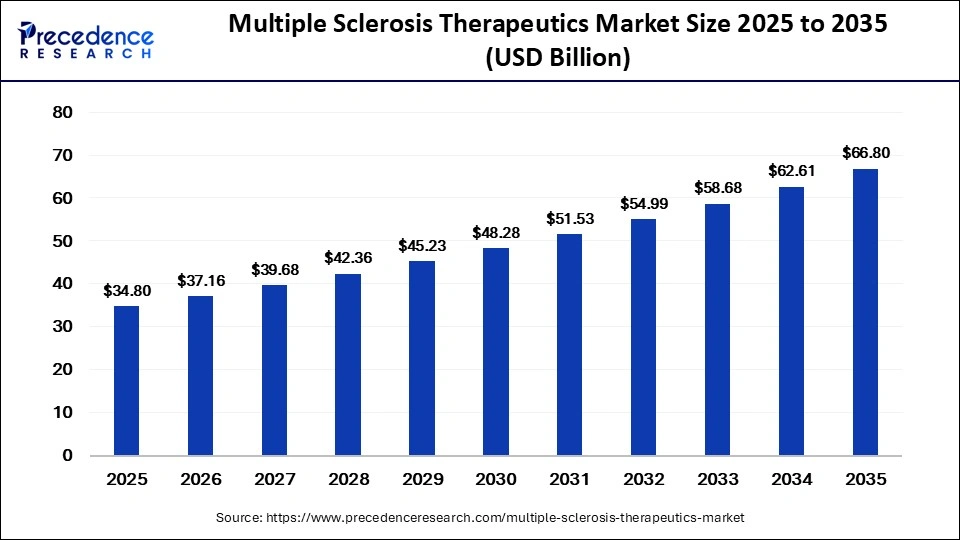
The biggest shift is not only in the number of therapies available. It is in how treatment is selected, monitored, and delivered to patients.
Download a Sample Report: https://www.precedenceresearch.com/sample/8432
Why MS Treatment Is Evolving
For many years, MS treatment relied heavily on therapies designed to manage relapses and reduce disease activity. Today, physicians have access to a broader range of disease-modifying treatments that can target the underlying immune mechanisms involved in MS.
High-efficacy medicines are receiving increasing attention because they can help reduce relapse frequency and slow disability progression in appropriate patients.
At the same time, treatment decisions are becoming more individualized. Disease type, patient age, symptom progression, treatment response, lifestyle, and other clinical factors can influence therapy selection.
AI Is Adding a New Layer to MS Care
Artificial intelligence is becoming an important tool across multiple sclerosis diagnosis, treatment planning, research, and patient monitoring.
AI can analyze MRI scans and neurological data to identify changes that may be difficult to recognize through conventional review alone. Machine learning models can also process large volumes of clinical information to identify patterns associated with relapse risk or disease progression.
For pharmaceutical companies, AI is helping accelerate drug discovery by identifying potential therapeutic targets and analyzing complex biological datasets.
Digital health tools can also support remote monitoring, treatment adherence, and personalized follow-up, giving clinicians a more continuous view of a patient’s condition.
Key Trends Shaping Multiple Sclerosis Therapeutics
Growing Use of High-Efficacy Therapies
Monoclonal antibodies are becoming increasingly important in MS treatment. These therapies can provide strong disease control and are particularly relevant as healthcare providers focus on reducing relapses and slowing disability progression.
The monoclonal antibodies segment accounted for 32% in 2025 and is projected to grow at the fastest rate, with a 10.5% CAGR through 2035.
Oral Therapies Continue to Gain Preference
Convenience remains an important factor in long-term treatment.
The oral segment held 44% in 2025 and is expected to expand at a 9.2% CAGR. Oral disease-modifying therapies reduce the need for frequent injections and may make treatment easier to manage for many patients.
More Attention on Progressive MS
Relapsing-remitting MS remains the largest disease type, accounting for 64% in 2025. However, research is increasingly focused on progressive forms of MS, where treatment options have historically been more limited.
The primary progressive MS segment is projected to grow at a 9.5% CAGR, reflecting greater attention toward therapies that can address long-term neurological disability and disease progression.
Biosimilars Could Improve Treatment Access
The introduction of biosimilar versions of established biologic therapies could help improve affordability and expand access to advanced MS treatment.
The U.S. launch of Tyruko, a natalizumab biosimilar from Sandoz, represents an important development for patients with relapsing forms of MS.
Home-Based Care Is Expanding
The homecare segment is expected to grow at the fastest pace among end-use settings, with a projected 10.5% CAGR.
The growth is being supported by oral therapies, self-administered treatments, telehealth, remote monitoring, and broader efforts to make chronic disease management more convenient.
How Leading Companies Are Positioning
Leading pharmaceutical companies are strengthening their MS portfolios through high-efficacy biologics, oral medicines, targeted therapies, and next-generation treatment research.
Biogen remains a major player in neurological therapeutics, with a long-standing focus on multiple sclerosis treatments and disease management.
Novartis is investing in innovative therapies across different MS disease types and continues to focus on treatments that can improve long-term outcomes.
Roche is advancing high-efficacy antibody-based treatment options while also strengthening its focus on personalized neurological care.
Sanofi is expanding research into progressive MS, including therapies designed to address disability progression in patients with limited treatment options.
Merck KGaA continues to develop and commercialize therapies for relapsing forms of MS while investing in long-term neurological research.
Bristol Myers Squibb has strengthened its presence in MS through its neurological portfolio and continued development of disease-modifying treatments.
Teva Pharmaceuticals remains important in established MS therapies and patient support programs, particularly around long-term treatment management.
A notable recent development came in April 2025, when Sanofi reported Phase 3 HERCULES trial results for tolebrutinib in non-relapsing secondary progressive MS. The company reported a 31% reduction in the six-month confirmed disability progression rate compared with placebo in the studied population.
Segment Highlights
The treatment landscape remains centered on several key areas.
Monoclonal antibodies led drug classes with 32% in 2025, reflecting the growing preference for high-efficacy disease-modifying approaches.
Relapsing-remitting MS accounted for 64%, making it the largest disease type and an important focus for pharmaceutical development.
Oral therapies represented 44%, highlighting the importance of convenience and treatment adherence.
By distribution channel, hospital pharmacies held 46%, supported by the use of specialty and infusion-based treatments. However, online pharmacies are expected to grow at an 11.8% CAGR, reflecting broader healthcare digitalization and demand for home delivery.
Among end users, hospitals accounted for 40%, while homecare settings are expected to grow at 10.5%, showing the gradual movement of chronic MS management closer to the patient’s home.
North America Leads While Asia Pacific Gains Momentum
North America accounted for 42% in 2025, supported by advanced neurological care infrastructure, high healthcare spending, strong pharmaceutical research, and broad access to disease-modifying therapies.
The U.S. remains a major center for MS treatment innovation, clinical research, MRI-based disease monitoring, and adoption of high-efficacy medicines.
Asia Pacific is expected to grow fastest at a 10.8% CAGR from 2026 to 2035. Increasing healthcare spending, better awareness of MS, expanding neurology services, and improving access to advanced treatments are contributing to this growth.
China is strengthening neurological care infrastructure, while other countries across the region are improving access to specialty treatment and expanding clinical research.
Europe also remains an important region, supported by established healthcare systems, neurological research capabilities, and increasing use of disease-modifying therapies.
Challenges in MS Treatment
Despite significant progress, treatment remains expensive for many patients, particularly when biologics and monoclonal antibodies require long-term use.
Access to advanced medicines also varies considerably between countries. Patients may face challenges related to reimbursement, specialist availability, regular monitoring, infusion infrastructure, and treatment affordability.
Another important challenge is progressive MS, where slowing disability progression remains a major clinical need.
What Should Healthcare Companies Watch?
Companies operating in MS care should closely monitor:
- High-efficacy monoclonal antibodies
- Therapies for progressive MS
- Oral disease-modifying treatments
- Biosimilar adoption
- AI-assisted disease monitoring
- MRI-based digital analysis
- Personalized treatment strategies
- Home-based MS management
- Remote patient monitoring
- Biomarker development
What Comes Next?
The future of multiple sclerosis therapeutics is moving toward earlier intervention, higher-efficacy treatment, greater personalization, and more convenient care delivery.
The next stage of innovation will likely focus not only on reducing relapses but also on slowing disability progression, improving treatment adherence, and giving clinicians better tools to understand how each patient responds to therapy.
With AI, digital health, biologics, biosimilars, and personalized medicine developing together, MS care is gradually becoming more patient-specific.
The larger opportunity is to move from simply managing symptoms toward long-term disease control that helps patients maintain neurological function and quality of life for as long as possible.
Buy this report: https://www.precedenceresearch.com/checkout/8432
About Us
Healthcare Prism is a dedicated healthcare insights and outreach platform, operating as an extension of Precedence Research. We share relevant perspectives, industry developments, emerging trends, and research-driven insights across the global healthcare sector. Our content is built on the knowledge, research standards, and expertise of Precedence Research, with a focus on making healthcare information clear, accessible, and useful for industry professionals, businesses, researchers, and healthcare stakeholders. Healthcare Prism serves as a focused platform to extend the reach of Precedence Research’s healthcare insights and connect them with a broader professional audience.
You can place an order or ask any questions, please feel free to contact us at [email protected]
Quick Contact:
Europe Region: +44 778 256 0738
North America Region: +1 8044 4193 44
APAC Region: +91 9356 9282 04 and +65 31065601
Visit Our Website: Precedence Research – Advisory, Research & Reports