
The global stem cell umbilical cord blood market is entering a new phase of expansion as healthcare providers, biotechnology companies, and families increasingly recognize the long-term value of stem cell preservation and regenerative medicine. The market size is projected to rise from USD 19.49 billion in 2026 to nearly USD 30.16 billion by 2035, growing at a CAGR of 4.97% during the forecast period. The rising prevalence of cancer, blood disorders, and chronic illnesses, along with growing awareness about cord blood banking, is expected to sustain demand across both developed and emerging economies.
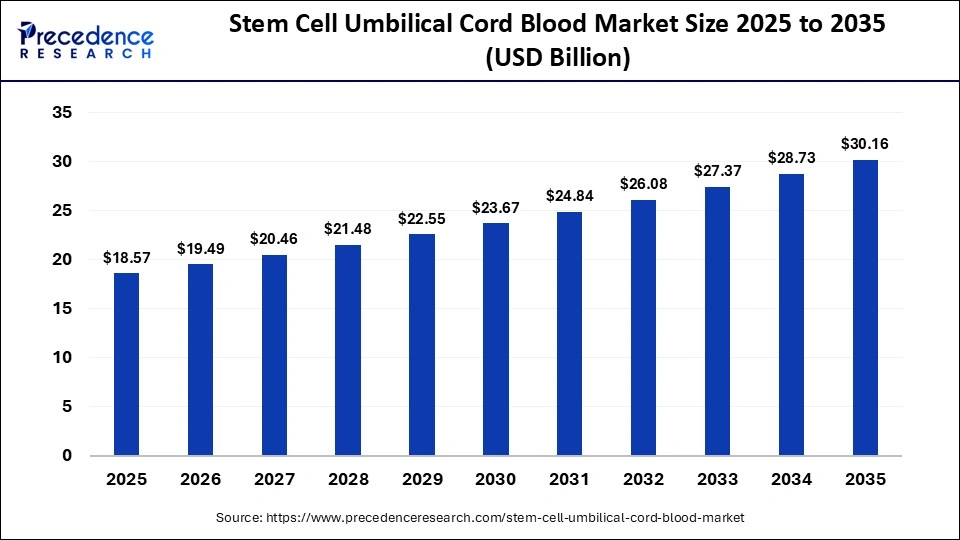
Cord blood banking is evolving from a niche healthcare service into a mainstream long-term medical investment for families. Stem cells collected from umbilical cord blood are increasingly being used in the treatment of leukemia, lymphoma, sickle cell anemia, thalassemia, and various immune disorders. At the same time, advancements in gene editing, cryopreservation, and stem cell processing are expanding the potential applications of cord blood in regenerative medicine and personalized therapies.
Read Also: Transradial Access Market
Quick Insights
- The global stem cell umbilical cord blood market is expected to reach USD 19.49 billion in 2026 and expand to USD 30.16 billion by 2035.
- North America remained the leading regional market in 2025, accounting for 38% of total market revenue.
- Asia Pacific is projected to witness the fastest growth, expanding at a CAGR of nearly 19% between 2026 and 2035.
- Private cord blood banks dominated the storage type segment with an 80% market share in 2025.
- Cancer treatment remained the largest application area, contributing 44.3% of the total market in 2025.
- Storage and preservation services generated 62% of the total market revenue in 2025.
- Major companies operating in the market include Cord Blood Registry (CBR), Cryo-Cell International, Inc., ViaCord, Global Cord Blood Corporation, Cordlife Group Limited, and LifeCell International Pvt. Ltd.
How is AI Transforming the Stem Cell Umbilical Cord Blood Market?
Artificial intelligence is increasingly becoming a critical tool in the stem cell umbilical cord blood market. AI-driven platforms are helping researchers analyze large genetic datasets, identify optimal donor-recipient matches, and improve transplantation success rates. Machine learning algorithms are also being used to predict treatment outcomes, enabling physicians to personalize therapies for cancer patients, blood disorder cases, and regenerative medicine applications.
AI is also improving operational efficiency in cord blood banking. Smart automation tools are being integrated into storage, retrieval, and cryopreservation processes to reduce human error and improve quality control. As AI becomes more sophisticated, it is expected to make stem cell therapies more scalable, affordable, and accessible worldwide.
What are the Major Growth Factors Driving the Market?
The market is being driven by the increasing adoption of regenerative medicine and personalized therapies. Stem cells derived from cord blood have demonstrated potential in treating more than 80 diseases, including cancers, immune deficiencies, and metabolic disorders. As public awareness grows, more families are choosing to preserve cord blood as a future medical safeguard.
Technological advancements are also supporting market growth. Innovations in cryopreservation, stem cell expansion, processing, and storage are improving the long-term viability of stem cells. Meanwhile, rising healthcare investments and stronger collaboration between biotechnology firms and research institutions are accelerating clinical innovation.
Why is Private Cord Blood Banking Becoming More Popular?
Private cord blood banking remains the dominant segment because it offers families exclusive access to preserved stem cells for personal or family use. Parents increasingly view cord blood banking as a long-term investment in future healthcare security, particularly as stem cell therapies continue to expand into new disease areas. The ability to secure immediate access to autologous stem cells is one of the strongest factors supporting private banking demand.
Public banking is also growing steadily due to rising donor awareness and government support. Public banks make cord blood units available to compatible patients, helping expand treatment accessibility for broader populations. Hybrid models are emerging as a flexible solution, allowing families to reserve a portion of cord blood for personal use while donating the remainder to public registries.
What Opportunities are Emerging in Regenerative Medicine?
Regenerative medicine is expected to be one of the fastest-growing application areas in the coming decade. Researchers are exploring cord blood stem cells for use in neurological disorders, diabetes, cardiovascular diseases, and tissue regeneration. Emerging technologies such as gene editing and tissue engineering are creating new therapeutic possibilities that could significantly expand the value of stored stem cells.
The increasing use of tools such as CRISPR is expected to further strengthen the market by enabling targeted treatment of genetic disorders. As clinical trials advance and new therapies gain regulatory approval, regenerative medicine could become one of the most important long-term growth pillars for the industry.
Regional Analysis
Why Does North America Continue to Lead?
North America remained the dominant market in 2025 with a 38% share due to its advanced healthcare infrastructure, high awareness of cord blood banking, and strong investments in stem cell research. The region also benefits from a well-established network of both public and private cord blood banks, robust clinical research, and supportive regulatory frameworks.
The United States continues to be the largest contributor within the region due to its advanced biotechnology ecosystem, strong funding for stem cell research, and high adoption of cord blood banking services.
Why is Asia Pacific Emerging as the Fastest-Growing Region?
Asia Pacific is projected to grow at the fastest CAGR of 19% due to rising healthcare expenditure, improving infrastructure, and growing awareness about stem cell therapies. The region’s large birth rates, expanding middle-class population, and increasing disposable incomes are driving adoption of both public and private cord blood banking services.
China is leading regional growth through strong government support and expansion of public and private banking infrastructure, while India is emerging rapidly due to growing awareness and improved access to healthcare.
Competitive Landscape and Recent Developments
The competitive landscape is becoming increasingly dynamic as biotechnology firms, healthcare providers, and banking service companies invest in more sophisticated preservation and processing capabilities.
Leading companies in the market include:
- Cord Blood Registry (CBR)
- Cryo-Cell International, Inc.
- ViaCord
- Global Cord Blood Corporation
- Cordlife Group Limited
- LifeCell International Pvt. Ltd.
- StemCyte, Inc.
- FamiCord Group
- Cryoviva Biotech Pvt. Ltd.
- Americord Registry
In January 2026, the Cord Blood Council launched a nonprofit initiative aimed at supporting public cord blood banks and expanding access to high-quality stem cell units. The initiative is expected to modernize operations and improve collaboration across the cord blood ecosystem.
In December 2025, the approval of omidubicel-onlv marked a major milestone in the treatment of severe aplastic anemia. The therapy is expected to reshape cell therapy manufacturing through more scalable production and advanced processing techniques.
What Challenges Could Slow Market Expansion?
Despite strong growth potential, the market still faces several challenges. Ethical concerns regarding stem cell storage and use remain a barrier in certain regions. High storage and treatment costs also make private banking inaccessible for many families, especially in developing economies. Regulatory complexity and regional disparities in healthcare access further limit broader adoption.
Consumer discussions also highlight skepticism around the value of private banking versus public donation, particularly because personal use of privately stored stem cells remains relatively uncommon. However, rare real-world cases where preserved stem cells have successfully treated siblings with immune disorders continue to reinforce the emotional and medical value of cord blood storage for some families.
Case Study: Cord Blood Banking Saving a Sibling’s Life
A recent consumer discussion highlighted how one family used previously banked cord blood from their first child when a second child was born with a severe immune deficiency. The preserved stem cells provided a perfect match and played a major role in the sibling’s treatment and recovery. While such cases are relatively uncommon, they illustrate the potential life-saving role of stem cell preservation in certain families.
Get Sample Report: https://www.precedenceresearch.com/sample/8304
For inquiries regarding discounts, bulk purchases, or customization requests, please contact us at [email protected]