
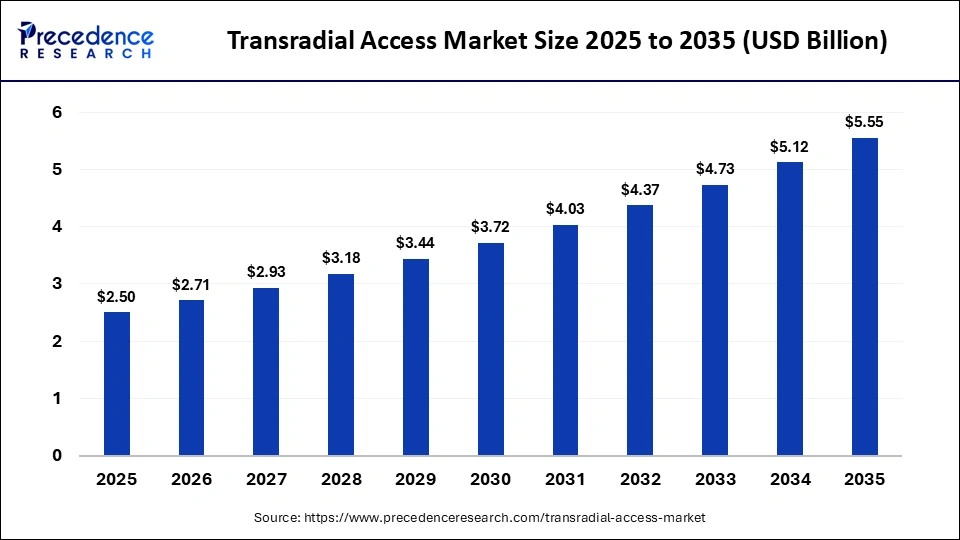
The global transradial access market is entering a strong growth phase as healthcare providers increasingly shift toward minimally invasive cardiovascular procedures. The market size was valued at USD 2.50 billion in 2025 and is projected to rise from USD 2.71 billion in 2026 to approximately USD 5.55 billion by 2035, registering a CAGR of 8.30% from 2026 to 2035. The rapid adoption of radial artery access for coronary interventions, angiography, and outpatient cardiac procedures is creating strong demand for catheters, guidewires, sheaths, and associated devices.
Unlike traditional femoral access, transradial procedures provide greater patient comfort, lower bleeding risks, shorter hospital stays, and faster recovery times. These benefits are encouraging hospitals, ambulatory surgical centers, and specialized cardiac clinics to increasingly prefer radial-first approaches for diagnostic and interventional cardiology.
Read Also: Flexible and Semi-Rigid Ureteroscopy Market
Quick Insights
- The global transradial access market is expected to reach USD 2.71 billion in 2026 and expand to USD 5.55 billion by 2035.
- North America remained the leading regional market in 2025, accounting for 35% of total revenue.
- Asia Pacific is projected to witness the fastest growth, with a CAGR of nearly 9% during the forecast period.
- Radial artery catheters emerged as the leading product segment, contributing 40% of market share in 2025.
- Coronary angiography remained the dominant procedure segment, capturing 45% of market revenue in 2025.
- Hospitals led the end-use landscape with a 55% market share in 2025.
- Major companies operating in the market include Terumo Corporation, Abbott Laboratories, Boston Scientific Corporation, Medtronic plc, and Teleflex Incorporated.
How is Artificial Intelligence Transforming the Transradial Access Market?
Artificial intelligence is gradually becoming a critical tool in transradial access procedures by improving imaging accuracy, catheter navigation, and clinical decision-making. AI-powered imaging platforms can help clinicians identify vascular anatomy more precisely, improving procedural success rates and minimizing complications during coronary interventions.
In addition, AI-based predictive analytics are supporting personalized patient care by helping physicians determine the most suitable access route, assess bleeding risks, and optimize recovery protocols. As healthcare systems increasingly integrate AI into cardiovascular care, transradial access procedures are expected to become more efficient, safer, and more accessible across outpatient and inpatient settings.
What are the Major Growth Factors Driving the Market?
Why is demand for minimally invasive procedures increasing?
The growing burden of cardiovascular diseases is creating a higher demand for minimally invasive diagnostic and treatment options. Patients increasingly prefer procedures that offer reduced pain, shorter recovery times, and lower risk of complications. Transradial access aligns perfectly with these expectations, making it a preferred approach in modern interventional cardiology.
How are technological advancements influencing market growth?
Innovations in catheter design, guidewire flexibility, imaging technologies, and sheath systems are improving procedural outcomes. Enhanced device precision and improved patient comfort are helping healthcare providers adopt transradial techniques across a broader range of cardiovascular interventions.
Why are outpatient cardiac procedures becoming more common?
The shift toward outpatient care and same-day discharge procedures is driving strong demand for transradial access. Since radial procedures allow patients to walk and recover faster, ambulatory surgical centers are increasingly using radial access techniques for coronary angiography and PCI procedures.
Opportunity Spotlight: Can Emerging Economies Unlock the Next Phase of Growth?
Emerging economies across Asia Pacific and Latin America present major growth opportunities for transradial access technologies. Improving healthcare infrastructure, rising awareness about cardiovascular diseases, and broader access to advanced medical procedures are increasing demand for minimally invasive cardiac interventions.
Countries such as China and India are witnessing growing investments in healthcare modernization, while governments are actively supporting the expansion of cardiovascular care services. This is expected to significantly boost the adoption of transradial devices over the coming decade.
Segment Analysis
Product Type Analysis
Radial artery catheters dominated the market in 2025, accounting for 40% of total revenue. Their widespread use in coronary interventions and diagnostic procedures, combined with better patient outcomes compared to femoral access, continues to strengthen their market leadership.
Guidewires held the second-largest share at 25% and are expected to witness strong growth due to advancements in material technology and increasing procedural complexity. Balloon dilatation catheters are forecast to grow at the fastest pace because of their rising use in coronary angioplasty and peripheral artery disease management.
Procedure Analysis
Coronary angiography represented the largest procedure segment in 2025, contributing 45% of total market revenue. This dominance is linked to the growing prevalence of coronary artery disease and the increasing use of radial access for diagnostic procedures.
Meanwhile, PCI procedures are expected to register the fastest growth due to the rising preference for radial-based interventions that offer reduced complication rates and shorter hospital stays.
End-Use Analysis
Hospitals remained the largest end-user segment with a 55% market share in 2025 because of their advanced facilities, experienced clinicians, and ability to manage complex cardiovascular procedures.
However, ambulatory surgical centers are expected to expand at the fastest rate as healthcare providers continue to shift low-risk procedures to outpatient settings. Their ability to deliver cost-effective care, convenience, and faster patient throughput is supporting rapid growth.
Regional Analysis
Why Did North America Lead the Market?
North America dominated the global transradial access market in 2025 with a 35% share. The region benefits from a highly developed healthcare system, strong physician adoption of radial-first techniques, and increasing preference for minimally invasive cardiovascular treatments. The U.S. remains the largest contributor due to its advanced healthcare infrastructure and growing use of transradial access in outpatient care settings.
Why is Asia Pacific the Fastest-Growing Region?
Asia Pacific is projected to grow at the fastest CAGR of nearly 9% through 2035. Expanding healthcare infrastructure, growing cardiovascular disease burden, and rising awareness about minimally invasive procedures are supporting market expansion across the region. Countries such as Japan, China, and India are expected to remain key growth engines.
How is Europe Emerging as a Key Market?
Europe continues to benefit from strong investments in precision medicine, cardiovascular care, and minimally invasive surgery. Countries such as Germany and United Kingdom are increasing adoption of radial access due to strong hospital infrastructure and advanced cardiology practices.
Competitive Landscape and Recent Developments
The competitive landscape remains highly dynamic, with leading companies investing heavily in advanced catheters, guidewires, and vascular access technologies.
Key companies operating in the transradial access market include:
- Terumo Corporation
- Abbott Laboratories
- Boston Scientific Corporation
- Medtronic plc
- Cordis Corporation
- Teleflex Incorporated
- Johnson & Johnson
- Asahi Intecc Co., Ltd.
- Cook Medical
- Merit Medical Systems, Inc.
What Challenges Could Impact Market Growth?
Despite its strong outlook, the transradial access market faces several challenges. Clinical complications such as hemorrhage, hematoma, and radial artery occlusion can limit adoption in certain high-risk patient groups. Additionally, the learning curve associated with transradial procedures may discourage some clinicians from transitioning away from traditional femoral access.
Cost pressures related to advanced catheters, imaging systems, and staff training can also impact adoption, particularly in developing markets where healthcare budgets remain constrained.
Case Study: How Hospitals are Benefiting from Radial-First Approaches
Large hospitals and cardiac centers are increasingly reporting improved patient outcomes after adopting radial-first programs. Patients undergoing coronary angiography and PCI through the radial artery typically experience lower bleeding rates, reduced hospitalization time, and faster return to normal activity. These benefits are helping hospitals improve patient satisfaction scores while reducing operational costs associated with longer inpatient stays.
Get Sample Report: https://www.precedenceresearch.com/sample/8303
For inquiries regarding discounts, bulk purchases, or customization requests, please contact us at [email protected]