
The global AI in omics studies market is expected to witness remarkable expansion over the next decade due to increasing demand for precision medicine, rapid advancements in artificial intelligence, and the growing need to analyze large-scale biological data. AI is transforming genomics, proteomics, transcriptomics, and metabolomics by helping researchers process complex datasets more accurately and efficiently.
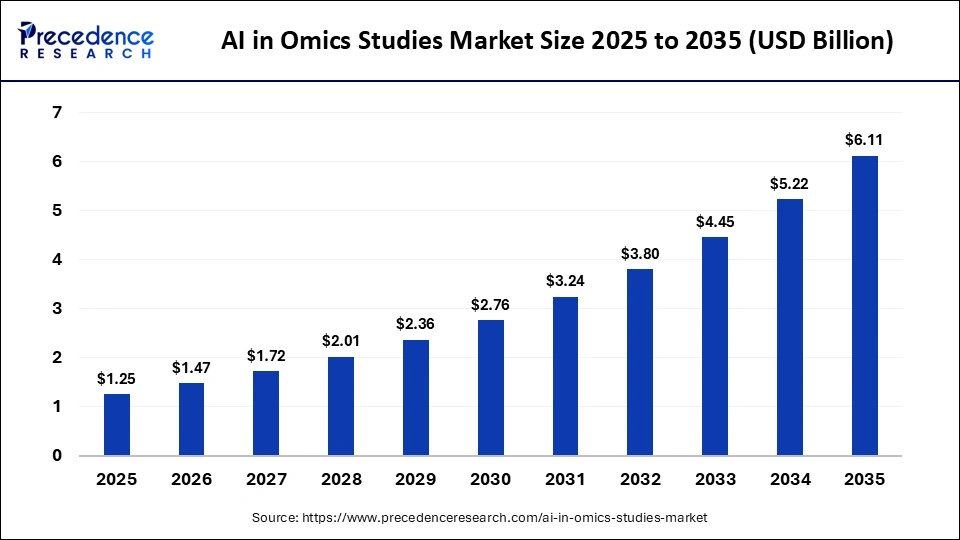
The global AI in omics studies market size accounted for USD 1.25 billion in 2025 and is predicted to increase from USD 1.47 billion in 2026 to approximately USD 6.11 billion by 2035, expanding at a CAGR of 17.20% from 2026 to 2035. Growing use of AI in drug discovery, disease diagnostics, and personalized treatment planning is supporting long-term market growth.
Read Also: AI-Powered Embryo Selection Market
Market Overview
AI in omics studies refers to the use of artificial intelligence, machine learning, deep learning, and data analytics tools to process and interpret large volumes of biological data. Omics fields such as genomics, proteomics, transcriptomics, and metabolomics generate massive datasets that traditional analysis methods often struggle to manage.
AI technologies enable researchers to identify disease biomarkers, understand genetic variations, improve drug discovery, and develop more personalized treatment strategies. By turning complex biological data into actionable insights, AI is becoming an essential tool across healthcare, biotechnology, and pharmaceutical industries.
Key Takeaways
- North America held the largest market share of 42% in 2025.
- Asia Pacific is expected to grow at the fastest CAGR of 19.5% between 2026 and 2035.
- By omics type, the genomics segment dominated the market with a 40% share in 2025.
- By component, the software segment led the market with a 55% share in 2025.
- By application, the drug discovery segment dominated the market with a 35% share in 2025.
- By end use, pharmaceutical and biotechnology companies accounted for 50% of the market in 2025.
- Hospitals and clinics are expected to grow at the fastest CAGR of 18% during the forecast period.
Market Drivers
Increasing Demand for Precision Medicine
One of the major factors driving the AI in omics studies market is the growing demand for precision medicine. Healthcare providers increasingly rely on AI tools to analyze patient-specific genetic and molecular information to develop personalized treatment plans.
AI can help identify disease-causing mutations, predict treatment responses, and improve clinical outcomes. This is particularly important in oncology, rare diseases, and chronic disease management, where patient-specific therapies can deliver better results than generalized treatment approaches.
Growing Adoption of AI in Drug Discovery
AI is becoming a critical tool in drug discovery because it significantly reduces research timelines and costs. Pharmaceutical companies use AI to analyze multi-omics datasets, identify therapeutic targets, and predict how potential drug candidates may perform.
Traditional drug development can take several years, but AI allows researchers to rapidly screen large chemical libraries, improve target identification, and reduce failure rates during clinical development. This is increasing adoption of AI across the pharmaceutical sector.
Expansion of Multi-Omics Data
Advancements in next-generation sequencing, proteomics platforms, and high-throughput laboratory technologies are generating unprecedented amounts of biological data. AI is helping researchers manage and interpret this information by integrating data across multiple omics disciplines.
The ability to combine genomics, proteomics, transcriptomics, and metabolomics into a unified analysis framework is enabling deeper understanding of disease pathways and accelerating biomarker discovery.
Market Trends
One of the biggest trends in the market is the increasing development of AI systems capable of analyzing multi-omics disease signatures and recommending approved therapies that target specific biological pathways. This approach is particularly valuable in treating rare diseases and complex disorders.
There is also a growing shift from traditional “black box” AI systems toward more transparent “glass box” models that can explain how they reach conclusions. Explainable AI is becoming increasingly important for clinical documentation, regulatory approval, and physician trust.
Researchers are increasingly prioritizing biologically relevant relationships rather than purely statistical associations when building AI models. This helps improve the scientific accuracy and clinical usefulness of AI-generated insights.
Community discussions in the AI and biotech space also highlight rising interest in “lab-in-the-loop” systems, where AI-driven hypothesis generation is combined with automated laboratory testing and continuous model refinement. This trend is expected to shorten drug discovery timelines and improve predictive accuracy.
Segment Analysis
By Omics Type
The genomics segment dominated the market with a 40% share in 2025 due to large-scale sequencing data generation and strong AI adoption for genomic analysis, disease prediction, and personalized medicine.
The proteomics segment held a 20% share in 2025 and is expected to grow at a CAGR of 17.5% during the forecast period because of the complexity of protein data and the growing need for biomarker discovery.
The transcriptomics segment accounted for 15% of the market in 2025 and is projected to grow at the fastest CAGR of 18%. This is because transcriptomics plays a critical role in understanding gene expression and disease mechanisms.
The metabolomics segment also held a 15% share in 2025, supported by its growing role in precision medicine and real-time clinical diagnostics.
By Component
The software segment dominated the market with a 55% share in 2025 because software tools are essential for analyzing massive omics datasets, automating variant calling, and generating predictive insights.
The services segment held a 30% share in 2025 and is expected to grow at a CAGR of 16.5% due to increasing demand for AI integration, consulting, regulatory compliance, and technical support.
The hardware segment represented 15% of the market in 2025 because high-performance computing systems and cloud infrastructure are required to handle large-scale omics data processing.
By Application
The drug discovery segment led the market with a 35% share in 2025 because pharmaceutical companies increasingly use AI to accelerate drug target identification, improve screening efficiency, and shorten development timelines.
The precision medicine segment held a 25% share in 2025 and is expected to grow at the fastest CAGR of 18.5% between 2026 and 2035 due to increasing demand for targeted therapies, particularly in oncology and rare diseases.
The biomarker discovery segment accounted for 20% of the market in 2025, driven by the need for early disease detection and personalized treatment planning.
The clinical diagnostics segment represented 15% of the market in 2025 because AI is increasingly being used to improve diagnostic accuracy and support personalized healthcare strategies.
Regional Insights
North America
North America dominated the AI in omics studies market with a 42% share in 2025. This is mainly due to high research and development spending, a strong biotechnology ecosystem, and rapid adoption of precision medicine.
Government-supported initiatives such as the “All of Us” program by the NIH are also helping drive regional growth by promoting genomic research and personalized healthcare. The presence of leading technology companies and pharmaceutical firms further strengthens North America’s leadership position.
Asia Pacific
Asia Pacific is expected to grow at the fastest CAGR of 19.5% during the forecast period. Growth is being driven by rising healthcare spending, increasing adoption of AI technologies, and expanding genomics research programs in countries such as China, India, Japan, and South Korea.
The region is also benefiting from rising investments in biotechnology infrastructure and growing awareness of precision medicine.
Europe
Europe is the second-largest regional market and is expected to grow at a CAGR of 16.8% during the forecast period. Strong pharmaceutical industries, advanced research institutes, and supportive regulatory frameworks are helping drive adoption of AI in omics studies.
Germany is emerging as a leading market in Europe due to government-backed AI initiatives, strong digital infrastructure, and rising demand for precision diagnostics and personalized medicine.
AI in Omics Studies Market Companies
- Illumina, Inc.
- Thermo Fisher Scientific Inc.
- QIAGEN N.V.
- Agilent Technologies, Inc.
- NVIDIA Corporation
- IBM Corporation
- Microsoft Corporation
- Google (Alphabet Inc.)
- Benevolent AI
- Insilico Medicine
- Deep Genomics
- SOPHiA GENETICS
- DNAnexus, Inc.
- Tempus Labs, Inc.
- Genedata AG
Recent Developments
In January 2026, Florida Atlantic University College of Engineering and Computer Science introduced the Center for Omics Technologies and Data Engineering to develop scalable and interpretable computational methods for extracting biological insights from omics data.
In September 2025, Mayo Clinic announced the launch of the BabyFORce program, which integrates rapid whole-genome sequencing, AI, and functional omics to improve personalized treatment for children.
Segments Covered in the Report
By Omics Type
- Genomics
- Proteomics
- Transcriptomics
- Metabolomics
Others
By Component
- Software
- Services
- Hardware
By Application
- Drug Discovery
- Precision Medicine
- Biomarker Discovery
- Clinical Diagnostics
- Others
By End-Use
- Pharmaceutical & Biotechnology Companies
- Research Institutes
- Hospitals & Clinics
- Others
By Region
- North America
- Latin America
- Europe
- Asia-pacific
- Middle and East Africa
Get Sample Link: https://www.precedenceresearch.com/sample/8296
For inquiries regarding discounts, bulk purchases, or customization requests, please contact us at [email protected]