
The US pharmaceutical excipients market is expanding steadily, supported by rising drug production, growing demand for biologics, and increasing investments in advanced drug delivery technologies. Innovations in multifunctional excipients and the shift toward personalized medicine are expected to create significant growth opportunities through 2035.
US Pharmaceutical Excipients Market Size and Forecast 2026 to 2035
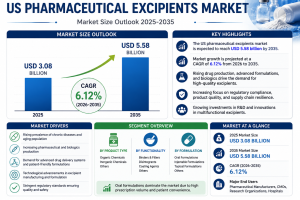
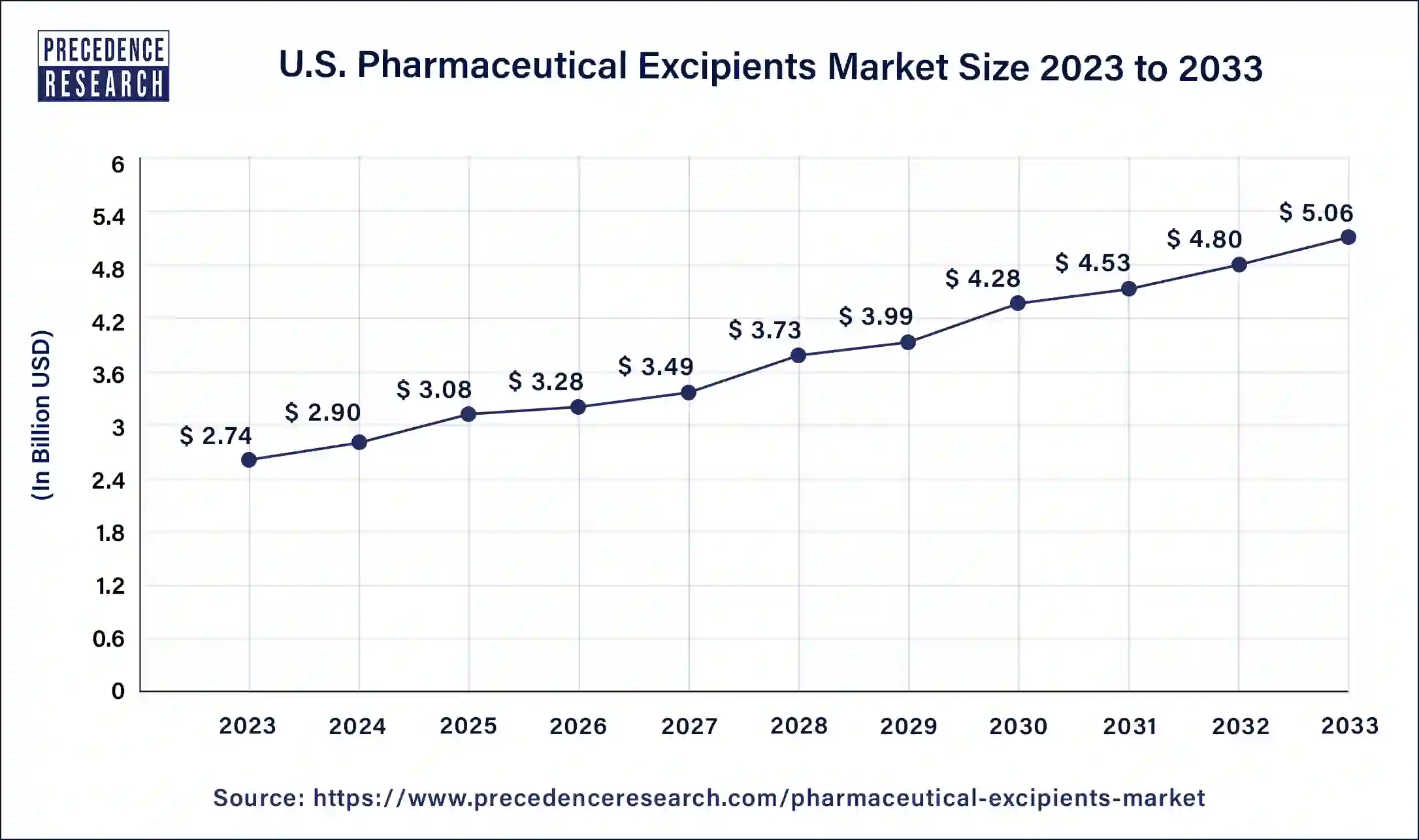
The US pharmaceutical excipients market size accounted for USD 3.08 billion in 2025 and is predicted to increase from USD 3.28 billion in 2026 to approximately USD 5.58 billion by 2035, expanding at a CAGR of 6.12% from 2026 to 2035. The market growth is attributed to rising demand for biologics, specialty drugs, and advanced pharmaceutical formulations requiring high-performance excipients.
Market Highlights
- By functionality, the fillers and diluents segment accounted for the largest share of the market in 2025, driven by their widespread use in improving tablet size, stability, and manufacturing efficiency across pharmaceutical formulations.
- The coating agents segment is expected to witness substantial growth during the forecast period, supported by the increasing demand for modified-release formulations, enhanced drug protection, and improved patient compliance.
- Based on excipient type, lactose-based excipients dominated the market in 2025 owing to their excellent compressibility, cost-effectiveness, and extensive application in tablets, capsules, and dry powder formulations.
- The cellulose-based excipients segment is projected to register significant growth between 2026 and 2035, fueled by the rising adoption of multifunctional excipients, growing preference for plant-derived ingredients, and increasing demand for advanced drug delivery systems.
Market Overview
The US pharmaceutical excipients market plays a critical role in the country’s pharmaceutical manufacturing ecosystem. Excipients are inactive ingredients used in drug formulations to enhance stability, improve bioavailability, facilitate drug delivery, and ensure consistent manufacturing performance. These substances are widely utilized in tablets, capsules, injectables, topical formulations, and biologics.
Growing demand for prescription medicines, over-the-counter drugs, and specialty pharmaceuticals is driving the need for high-quality excipients. The increasing prevalence of chronic diseases, coupled with an aging population, has created strong demand for innovative formulations that improve therapeutic outcomes and patient compliance.
The industry is undergoing rapid transformation as pharmaceutical manufacturers focus on advanced drug delivery systems and complex formulations. Functional excipients capable of enhancing solubility and controlling drug release are gaining considerable attention. At the same time, biologics and biosimilars are creating demand for highly specialized excipients with superior stability and compatibility.
Regulatory standards and quality requirements remain among the most important factors influencing the market. Manufacturers are investing heavily in compliance, quality assurance, and supply chain resilience to meet stringent standards established by regulatory agencies. The trend toward continuous manufacturing and sustainable production practices is also shaping the future of the industry.
Over the long term, technological advancements and increasing pharmaceutical innovation are expected to strengthen the outlook for the US pharmaceutical excipients market. Opportunities are emerging in personalized medicine, novel drug delivery technologies, and high-performance multifunctional excipients designed for next-generation therapeutics.
AI Impact
Artificial intelligence is transforming pharmaceutical formulation development by enabling researchers to identify optimal excipient combinations more efficiently. Machine learning models can analyze extensive datasets to predict interactions between active pharmaceutical ingredients and excipients, reducing development timelines and improving formulation success rates.
AI-powered predictive analytics are helping manufacturers optimize production processes and improve quality control. Real-time monitoring systems can detect deviations during manufacturing, reducing waste and ensuring product consistency. These technologies are particularly valuable for highly regulated pharmaceutical environments.
Artificial intelligence is also improving supply chain management by forecasting demand, optimizing inventory levels, and identifying potential disruptions before they affect production. This capability is becoming increasingly important as pharmaceutical companies seek to strengthen domestic manufacturing capabilities and reduce supply chain vulnerabilities.
Emerging AI applications are accelerating research into advanced drug delivery technologies, biologics, and personalized medicine. As computational capabilities continue to improve, AI is expected to become a major driver of innovation across the pharmaceutical excipients industry.
Market Trends
- Rising demand for multifunctional excipients in complex drug formulations.
- Growing adoption of AI and digital technologies in pharmaceutical development.
- Increasing use of excipients in biologics and biosimilar products.
- Strong focus on controlled-release and targeted drug delivery systems.
- Expansion of continuous manufacturing processes.
- Rising investments in domestic pharmaceutical production.
- Increasing demand for patient-friendly oral dosage forms.
- Development of co-processed excipients for enhanced performance.
- Growing emphasis on sustainable and environmentally responsible manufacturing.
- Strengthening regulatory standards for pharmaceutical ingredients and quality assurance.
Market Scope
| Report Coverage | Details |
| Market Size in 2025 | USD 3.08 Billion |
| Market Size in 2026 | USD 3.28 Billion |
| Market Size by 2035 | USD 5.58 Billion |
| Growth Rate from 2026 to 2035 | CAGR of 6.12% |
| Base Year | 2025 |
| Forecast Period | 2026 to 2035 |
| Segments Covered | Functionality, and Excipient Type |
Segment Insights
By Product Type
Organic chemicals represent a major segment of the market owing to their broad application across various pharmaceutical formulations. Carbohydrates, petrochemicals, and proteins are widely used because of their compatibility with active ingredients and their ability to improve drug stability.
Inorganic chemicals also account for a substantial market share. Calcium phosphates and metal oxides are commonly utilized in solid dosage forms because of their excellent compressibility and binding properties. Demand for these materials continues to rise with increasing pharmaceutical production.
By Functionality
Binders and fillers remain among the largest segments due to their extensive use in tablet manufacturing. These excipients ensure uniformity and improve the physical characteristics of drug products.
Coating agents and disintegrants are experiencing strong growth as manufacturers focus on improving patient compliance and enhancing drug release profiles. Advanced formulations increasingly require specialized excipients that can support controlled and targeted delivery.
By Formulation
Oral formulations dominate the market because tablets and capsules remain the most widely prescribed dosage forms in the United States. Injectable formulations are witnessing rapid growth, driven by increasing use of biologics, vaccines, and specialty therapies.
Competitive Landscape
The US pharmaceutical excipients market is characterized by strong competition among multinational ingredient manufacturers and specialized excipient suppliers. Companies are focusing on product innovation and expanding their portfolios to address the evolving requirements of pharmaceutical companies.
Strategic partnerships and acquisitions are becoming increasingly common as organizations seek to strengthen their manufacturing capabilities and broaden their technological expertise. Investments in high-performance excipients and biologics-compatible products are creating new avenues for growth.
Manufacturers are also prioritizing sustainability and supply chain resilience. Companies are expanding production facilities and implementing advanced manufacturing technologies to ensure consistent quality and regulatory compliance.
Digital transformation and AI-driven formulation technologies are emerging as key competitive differentiators. Businesses that can offer customized solutions and support next-generation drug delivery systems are expected to gain a significant advantage in the years ahead.
Top Leading Companies in the Market
- DuPont
- Ashland Inc.
- Roquette Frères
- BASF SE
- Evonik Industries AG
- Croda International Plc
- Colorcon Inc.
- Lubrizol Corporation
- Associated British Foods plc
- DFE Pharma
- JRS Pharma
- Kerry Group plc
- Ingredion Incorporated
- SPI Pharma
- Cargill Incorporated
Get Sample Link : https://www.precedenceresearch.com/sample/8492
Recent Developments
- In May 2026, Novartis will open a new facility in Morrisville, North Carolina, dedicated to the manufacturing of active pharmaceutical ingredients (APIs) for solid dosage forms such as tablets, capsules, and RNA therapeutics. With this addition, Novartis will expand its presence in North Carolina to five facilities across three sites.
- In May 2026, CordenPharma, a leading global CDMO, announced that it had agreed to acquire AmbioPharm, a U.S.-based peptide API CDMO. AmbioPharm operates two sites, one in South Carolina and another in Shanghai, China. The acquisition will enhance CordenPharma’s Peptides Platform by adding differentiated peptide manufacturing capabilities. This acquisition will provide customers with flexible options tailored to their specific manufacturing needs for complex, long, and high-purity peptide APIs.
Segments Covered in the Report
By Functionality
- Fillers and Diluents
- Suspending and Viscosity Agents
- Coating Agents
- Binders
- Disintegrants
- Colorants
- Lubricants and Glidants
- Preservatives
- Emulsifying Agents
- Flavoring Agents and Sweeteners
- Other Functionalities
By Excipient Type
- Lactose-based Excipients
- α-lactose monohydrate
- Anhydrous α-lactose
- Anhydrous β-lactose
- Amorphous Lactose
- Cellulose-based
- Microcrystalline Cellulose (MCC)
- Cellulose Ethers
- Others
- Starches
- Carboxymethylcellulose Sodium (CCS)
- Sodium Starch Glycolate (SSG)
- Fine Chemicals
- Mannitol
- Biopharma Excipients
- Others
Also Read Our Latest Article : Neuropharmacology Market