
The US stroke diagnostic and therapeutic market is witnessing significant growth due to the increasing prevalence of ischemic and hemorrhagic strokes, rising awareness regarding early diagnosis, and continuous advancements in imaging technologies and minimally invasive treatments. Growing adoption of AI-enabled diagnostics and expansion of stroke care centers are expected to create substantial opportunities through 2035.
According to Precedence Research the US stroke diagnostic and therapeutic market size accounted for USD 6.40 billion in 2025 and is predicted to increase from USD 6.97 billion in 2026 to approximately USD 15.04 billion by 2035, expanding at a CAGR of 8.92% from 2026 to 2035.
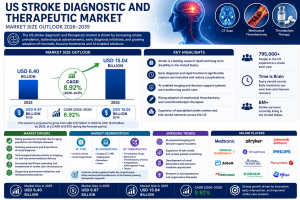
US Stroke Diagnostic and Therapeutic Market Overview
The US stroke diagnostic and therapeutic market represents a critical component of the country’s healthcare ecosystem, focusing on the early detection, diagnosis, treatment, and management of stroke-related conditions. Stroke remains one of the leading causes of disability and mortality in the United States, creating sustained demand for advanced diagnostic systems and effective therapeutic interventions.
Rapid diagnosis plays a crucial role in improving patient outcomes, making technologies such as computed tomography (CT), magnetic resonance imaging (MRI), angiography, and blood-based biomarkers increasingly important. On the therapeutic side, thrombolytic drugs, anticoagulants, antiplatelet agents, and mechanical thrombectomy procedures have significantly improved survival rates and recovery outcomes.
The growing burden of cardiovascular diseases, hypertension, diabetes, obesity, and aging populations continues to increase the incidence of stroke cases. Healthcare providers are investing heavily in dedicated stroke centers, emergency response systems, and telemedicine networks to enhance patient access to timely care.
Advancements in neurointerventional procedures and the emergence of precision medicine are transforming stroke management. Research activities focused on neuroprotection, regenerative medicine, and novel clot-removal technologies are opening new avenues for market expansion.
Despite strong growth prospects, challenges such as high treatment costs, disparities in healthcare access, and the need for rapid intervention remain important concerns. Continued investments in healthcare infrastructure and technological innovation are expected to strengthen the long-term outlook of the market.
AI Impact
Artificial intelligence is revolutionizing stroke diagnosis by enabling rapid interpretation of CT scans and MRI images. AI algorithms can detect large vessel occlusions, intracranial hemorrhages, and ischemic changes within minutes, helping physicians make faster treatment decisions and improving patient outcomes.
Machine learning models are also supporting predictive analytics by identifying patients at high risk of stroke recurrence. By analyzing electronic health records and clinical parameters, AI systems enable personalized treatment strategies and preventive interventions.
Hospitals are increasingly integrating AI-powered triage systems and tele-stroke platforms to optimize emergency workflows. These technologies help reduce treatment delays, particularly in remote and underserved areas where access to neurologists may be limited.
AI is also accelerating drug discovery and clinical research. Advanced analytics are supporting the development of novel neuroprotective therapies and enhancing clinical trial efficiency, contributing to innovation across the stroke treatment landscape.
Market Trends
- Increasing adoption of AI-based imaging and diagnostic platforms.
- Growing demand for minimally invasive mechanical thrombectomy procedures.
- Expansion of comprehensive stroke centers across the United States.
- Rising use of telemedicine and tele-stroke services.
- Increasing investments in neurovascular devices and catheter technologies.
- Growing focus on personalized medicine and precision therapies.
- Development of blood-based biomarkers for rapid stroke detection.
- Rising healthcare expenditure on emergency and critical care services.
- Increasing collaborations between medical device manufacturers and healthcare institutions.
- Expansion of remote patient monitoring and digital health solutions.
Segment Insights
By Type
Ischemic stroke accounts for the largest share of the market due to its high prevalence among stroke patients in the United States. Growing awareness regarding early intervention and increasing use of clot-removal procedures are supporting segment growth.
Hemorrhagic stroke represents a smaller but highly critical segment. Advances in imaging technologies and specialized neurocritical care units are improving diagnosis and treatment outcomes for these patients.
By Diagnostics
Imaging technologies dominate the diagnostic segment. CT scans remain the first-line diagnostic tool due to their speed and accessibility, while MRI systems provide detailed neurological assessments that assist in treatment planning.
Emerging biomarker-based diagnostics are gaining attention as researchers seek faster and more accurate methods to identify stroke subtypes and predict patient outcomes.
By Therapeutics
Thrombolytic drugs continue to represent a major therapeutic segment because they are essential for treating acute ischemic stroke. Mechanical thrombectomy is among the fastest-growing segments owing to increasing clinical evidence supporting its effectiveness and favorable patient outcomes.
Competitive Landscape
The US stroke diagnostic and therapeutic market is characterized by strong competition among pharmaceutical companies, medical device manufacturers, and diagnostic imaging providers. Companies are focusing on developing advanced neurovascular devices and innovative treatment approaches to improve patient outcomes.
Strategic collaborations between hospitals, research institutions, and industry participants are accelerating the adoption of next-generation stroke management technologies. Partnerships aimed at integrating AI and digital health capabilities are becoming increasingly common.
Major players are investing heavily in product innovation and expanding their portfolios through acquisitions and partnerships. Mechanical thrombectomy devices, AI-powered imaging solutions, and tele-stroke platforms are emerging as important areas of competition.
As healthcare providers emphasize faster diagnosis and personalized treatment, companies capable of delivering integrated solutions and advanced technologies are expected to strengthen their market positions.
Top Leading Key Players in the Market
- Medtronic plc
- Stryker Corporation
- Johnson & Johnson
- Siemens Healthineers
- GE HealthCare
- Koninklijke Philips N.V.
- Abbott Laboratories
- Boston Scientific Corporation
- Penumbra Inc.
- Terumo Corporation
- B. Braun SE
- Bristol Myers Squibb
- Pfizer Inc.
- Boehringer Ingelheim
- Roche Holding AG
Get Sample Link : https://www.precedenceresearch.com/sample/8491
Recent Developments
- In June 2026, the FDA cleared THUNDERBOLT, Penumbra’s computer-assisted vacuum thrombectomy system for acute ischemic stroke. The device uses advanced aspiration technology to detect and remove blood clots more efficiently, potentially improving procedural success, accelerating blood flow restoration, and enhancing patient outcomes in stroke care.
- In September 2025, GE Healthcare announced the acquisition of icometrix to meet the growing demand for MRI in personalized treatment planning. The acquisition aligns with GE Healthcare’s precision care strategy and is expected to strengthen the company’s clinical decision support applications for timely diagnosis and monitoring.
Segments Covered in the Report
By Type
- Diagnostics
- Magnetic Resonance Imaging (MRI)
- Computed Tomography Scan (CT scan)
- Electrocardiography
- Carotid Ultrasound
- Cerebral Angiography
- Others
- Therapeutics
- Tissue Plasminogen Activator
- Antiplatelet
- Antihypertensive
- Anticoagulant
By Application
- Haemorrhagic Stroke
- Ischemic Stroke
Also Read Our Latest Article : US Pharmaceutical Excipients Market