
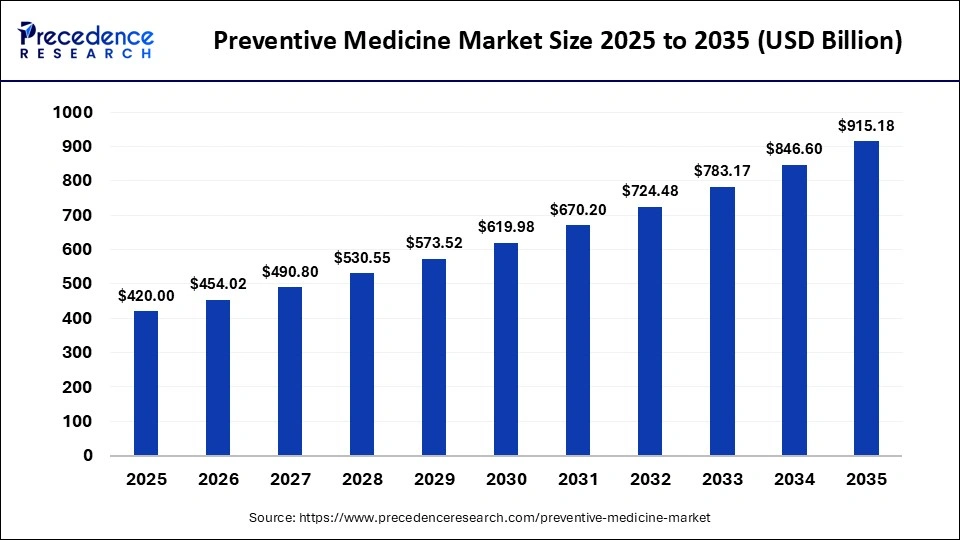
The global preventive medicine market is entering a strong growth phase as healthcare systems shift from reactive treatment to proactive disease prevention. The market was valued at USD 420.00 billion in 2025 and is projected to rise from USD 454.02 billion in 2026 to nearly USD 915.18 billion by 2035, expanding at a CAGR of 8.10% from 2026 to 2035. Rising cases of diabetes, obesity, cancer, cardiovascular disease, and infectious illnesses are increasing demand for vaccinations, screenings, preventive therapeutics, and remote monitoring solutions.
Preventive healthcare is becoming a strategic priority for governments, insurers, hospitals, and healthcare providers due to the rising cost of long-term disease management. At the same time, innovations in wearable health devices, digital diagnostics, AI-based analytics, and remote patient monitoring are enabling more personalized and accessible preventive care models.
Read Also: Nanomechanical Testing Market
Quick Insights
- The global preventive medicine market is expected to reach USD 915.18 billion by 2035 from USD 454.02 billion in 2026.
- North America led the market with a 38% share in 2025 due to strong healthcare infrastructure and broad access to preventive care.
- Asia Pacific is expected to register the fastest CAGR of 9.5% through 2035 due to improving healthcare access and growing awareness.
- Vaccines remained the leading type segment with a 35% share in 2025.
- Infectious diseases prevention accounted for 30% of total market revenue in 2025.
- Hospitals and clinics held the largest end-use share of 40% in 2025.
- Injectable preventive therapies dominated delivery modes with a 50% market share in 2025.
- Digital preventive healthcare is expected to witness the fastest CAGR of 12.5% through 2035.
Market Revenue Snapshot
| Metric | Value |
|---|---|
| Market Size 2025 | USD 420.00 Billion |
| Market Size 2026 | USD 454.02 Billion |
| Forecast Market Size 2035 | USD 915.18 Billion |
| CAGR 2026 to 2035 | 8.10% |
| Leading Region | North America |
| Fastest Growing Region | Asia Pacific |
How Is AI Reshaping the Preventive Medicine Market?
Artificial intelligence is transforming preventive medicine by helping healthcare providers identify health risks before symptoms become severe. AI tools analyze data from electronic health records, wearable devices, diagnostic tests, and lifestyle patterns to predict disease onset and recommend timely intervention. Predictive analytics is becoming increasingly important for managing chronic diseases such as diabetes, hypertension, and cardiovascular conditions.
AI-powered chatbots, digital wellness assistants, and remote monitoring systems are also improving patient engagement. These solutions provide real-time feedback, personalized recommendations, medication reminders, and behavioral coaching, helping patients adopt healthier lifestyles and reduce long-term healthcare costs. AI integration is expected to play a major role in expanding home-based preventive care and improving healthcare accessibility in both developed and emerging markets.
What Are the Major Growth Factors Driving the Preventive Medicine Market?
The increasing prevalence of chronic and lifestyle-related diseases remains the strongest driver of market growth. Rising rates of obesity, diabetes, hypertension, heart disease, and cancer are putting pressure on healthcare systems and creating demand for early diagnosis and preventive solutions. Growing awareness around healthy eating, physical fitness, smoking cessation, and routine checkups is also encouraging people to adopt preventive care strategies.
Another major growth factor is the increasing use of digital health platforms and wearable devices. Smartwatches, remote monitoring systems, and mobile health applications are making it easier for patients to monitor blood pressure, glucose levels, heart rate, and physical activity in real time. Healthcare providers are also using digital platforms to identify at-risk patients and deliver early interventions.
Government-backed vaccination drives, awareness campaigns, and screening programs are further supporting market expansion. Countries around the world are investing in preventive health infrastructure to reduce healthcare costs and improve population health outcomes.
Why Is Digital Preventive Healthcare Emerging as a Major Opportunity?
Digital preventive healthcare is becoming one of the most attractive growth opportunities in the market because it allows continuous monitoring and personalized health management without requiring frequent hospital visits. Wearable devices, telemedicine platforms, AI-powered wellness tools, and virtual consultations are improving access to preventive care while lowering costs. The segment is expected to grow at the fastest CAGR of 12.5% through 2035.
The rise of home healthcare is also creating new opportunities for market participants. Patients increasingly prefer preventive solutions that can be delivered at home through remote monitoring devices and mobile health applications. This trend is particularly important for elderly patients, people with chronic diseases, and individuals living in remote areas with limited access to hospitals.
Segment Analysis
Why Did Vaccines Dominate the Market in 2025?
The vaccines segment accounted for 35% of the market in 2025 due to large-scale immunization programs, pandemic preparedness initiatives, and rising awareness about infectious disease prevention. Booster doses, pediatric vaccines, and adult vaccination campaigns are expected to continue driving long-term segment growth.
The screening and early detection segment held a 30% share in 2025 and is expected to grow at a CAGR of 9.5% through 2035. Rising demand for early diagnosis of cancer, diabetes, cardiovascular disease, and metabolic disorders is boosting adoption of routine screening services.
Which Applications Are Generating the Most Revenue?
Infectious disease prevention remained the largest application segment with a 30% share in 2025, supported by widespread vaccination programs and public health campaigns. Chronic disease prevention is expected to be the fastest-growing application segment due to rising rates of diabetes, hypertension, obesity, and heart disease worldwide.
Cancer prevention is also emerging as a major opportunity area as healthcare systems invest more heavily in mammography, colonoscopy, genetic testing, and other early detection technologies. Cardiovascular disease prevention is seeing strong demand due to the growing burden of high cholesterol, obesity, and sedentary lifestyles.
Why Are Hospitals and Clinics Leading End-Use Demand?
Hospitals and clinics held the largest market share of 40% in 2025 because they remain the primary centers for vaccinations, routine checkups, preventive diagnostics, and specialist consultations. Their strong infrastructure and access to trained healthcare professionals make them the preferred setting for preventive care delivery.
Diagnostic centers are becoming increasingly important as demand rises for routine screenings and early disease detection services. Meanwhile, home healthcare is expected to witness the fastest growth because of increasing use of telehealth, wearable devices, and remote patient monitoring systems.
Regional Analysis
Why Did North America Lead the Preventive Medicine Market?
North America dominated the market with a 38% share in 2025 due to its advanced healthcare infrastructure, strong health awareness, and favorable reimbursement policies. The region has a well-developed preventive care ecosystem supported by hospitals, clinics, diagnostic centers, and digital health platforms. Government policies such as the Affordable Care Act have also expanded access to preventive services such as cancer screenings, vaccinations, and annual wellness visits.
The United States remains the largest contributor in the region because of high healthcare spending, strong adoption of advanced technologies, and rising use of wearable health devices and AI-based diagnostics.
Why Is Asia Pacific the Fastest-Growing Region?
Asia Pacific is expected to expand at the fastest CAGR of 9.5% through 2035 due to rapid urbanization, improving healthcare access, and rising awareness of preventive care. Countries such as China, India, Japan, and Australia are increasing investments in healthcare infrastructure, vaccination programs, screening initiatives, and digital health technologies.
Japan is emerging as a particularly important market because of its aging population and strong focus on early disease detection. The country is increasingly using robotics, AI-based diagnostics, and digital monitoring systems to improve preventive care delivery.
Leading Companies in the Preventive Medicine Market
- Pfizer Inc.
- GlaxoSmithKline plc (GSK)
- Merck & Co., Inc.
- Sanofi S.A.
- Johnson & Johnson
- Abbott Laboratories
- Roche Holding AG
- Siemens Healthineers AG
- Quest Diagnostics Incorporated
- Labcorp (Laboratory Corporation of America Holdings)
- Medtronic plc
- Thermo Fisher Scientific Inc.
- CVS Health Corporation
- UnitedHealth Group Incorporated
- Becton, Dickinson and Company (BD)
Case Study: How Preventive Healthcare Is Evolving in India
India is increasingly emerging as a major market for preventive healthcare because of its growing middle-class population, rising digital health adoption, and increasing chronic disease burden. The collaboration between Nervfit and MYCLNQ highlights how wearable devices, telehealth, and digital health coaching are being combined to improve early diagnosis and long-term wellness management. Such initiatives could significantly improve preventive care accessibility in emerging economies where healthcare infrastructure is still evolving.
Get Sample Copy: https://www.precedenceresearch.com/sample/8308
For inquiries regarding discounts, bulk purchases, or customization requests, please contact us at [email protected]