
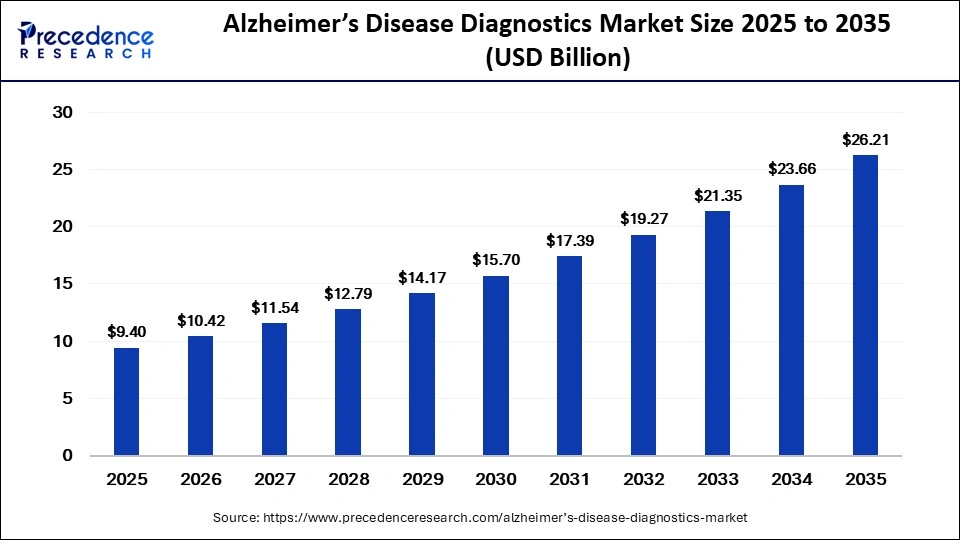
The global Alzheimer’s disease diagnostics market is projected to grow from USD 9.40 billion in 2025 to USD 26.21 billion by 2035, driven by AI-powered diagnostics, biomarker testing, and rising demand for early cognitive disease detection.
Alzheimer’s Disease Diagnostics Market: AI and Biomarker Innovations Reshaping Early Neurology Detection
The global Alzheimer’s disease diagnostics market is entering a transformative growth phase as healthcare systems worldwide prioritize early cognitive disease detection, precision neurology, and minimally invasive diagnostic technologies. The rising prevalence of dementia, increasing aging populations, and growing investments in neurodegenerative disease research are accelerating innovation across imaging, biomarker testing, and AI-powered diagnostics.
According to Precedence Research, the global Alzheimer’s disease diagnostics market size was valued at USD 9.40 billion in 2025 and is expected to reach approximately USD 26.21 billion by 2035, expanding at a CAGR of 10.80% between 2026 and 2035.
Read Also: Malaria Diagnostic Market
Understanding Alzheimer’s Disease Diagnostics
Alzheimer’s disease diagnostics involve a broad range of technologies and clinical tools used to identify cognitive decline, detect disease biomarkers, and monitor neurological degeneration. Diagnostic approaches have evolved significantly from traditional cognitive assessments to advanced neuroimaging, blood-based biomarker testing, molecular diagnostics, and AI-driven analytics.
Healthcare providers increasingly recognize the importance of detecting Alzheimer’s disease during its earliest stages, especially as new disease-modifying therapies become commercially available. Early intervention can help improve patient outcomes, delay cognitive deterioration, and support better treatment planning.
The market is now witnessing rapid adoption of innovative technologies that improve diagnostic speed, accessibility, and accuracy.
Key Market Highlights
- The Alzheimer’s disease diagnostics market was valued at USD 9.40 billion in 2025.
- The market is projected to reach USD 26.21 billion by 2035.
- North America accounted for 42% of total market revenue in 2025.
- Asia-Pacific is expected to grow at the fastest CAGR of 14%.
- Brain imaging dominated the diagnostic type segment with 38% market share.
- Biomarker testing is expected to witness the fastest CAGR of 16%.
- AI and digital diagnostics are projected to grow at an impressive CAGR of 18%.
Growing Demand for Early Alzheimer’s Detection Driving Market Expansion
One of the major factors fueling market growth is the increasing awareness surrounding early diagnosis and preventive neurological care. Healthcare systems are emphasizing cognitive screening programs and proactive neurological monitoring due to the rapidly increasing burden of dementia-related diseases.
The elderly population continues to rise globally, creating strong demand for advanced diagnostic technologies capable of identifying Alzheimer’s disease before severe symptoms emerge. Hospitals, diagnostic laboratories, and specialty neurology clinics are investing heavily in innovative tools that enable earlier intervention.
Government healthcare organizations are also expanding reimbursement policies and funding neurological research initiatives to support early-stage disease management.
Blood-Based Biomarker Testing Emerging as a Game-Changer
Blood-based biomarker testing is rapidly becoming one of the most disruptive innovations in Alzheimer’s diagnostics. Compared to PET imaging and spinal fluid testing, blood diagnostics offer faster, less invasive, and more affordable screening solutions.
Advanced biomarker assays can detect proteins associated with Alzheimer’s pathology, including beta-amyloid and phosphorylated tau proteins, through simple blood draws.
The commercialization of blood-based diagnostics is accelerating globally following major regulatory approvals and clinical breakthroughs.
Recently, the U.S. FDA cleared the first blood test for Alzheimer’s detection developed by Fujirebio Diagnostics. The Lumipulse blood test measures pTau217 and β-amyloid proteins associated with amyloid plaque buildup in the brain.
The emergence of blood-based testing is expected to significantly improve accessibility to early cognitive disease screening across primary healthcare settings.
Artificial Intelligence Revolutionizing Neurology Diagnostics
Artificial intelligence is transforming Alzheimer’s disease diagnostics by improving imaging interpretation, predictive analytics, and clinical decision-making.
AI-powered diagnostic platforms are helping clinicians identify subtle neurological changes that may not be visible through conventional analysis. These systems enhance the interpretation of MRI scans, PET imaging, biomarker results, and cognitive assessments.
The growing adoption of machine learning algorithms in neurology is supporting:
- Faster disease detection
- Improved diagnostic accuracy
- Reduced diagnostic errors
- Automated imaging analysis
- Personalized treatment planning
- Remote cognitive monitoring
AI and digital diagnostics are expected to witness the highest growth rate in the market due to increasing investments in healthcare automation and precision medicine.
Segmental Analysis
By Diagnostic Type
Brain Imaging Segment Dominates the Market
Brain imaging held the largest market share of 38% in 2025 due to its strong clinical reliability in detecting structural brain abnormalities and amyloid plaque accumulation.
PET scans and MRI technologies remain essential tools for diagnosing Alzheimer’s disease and evaluating disease progression.
Increasing investments in high-resolution neuroimaging technologies and AI-assisted imaging analysis continue to strengthen this segment.
Biomarker Testing Expected to Witness Fastest Growth
Biomarker testing is projected to grow at the fastest CAGR of 16% during the forecast period.
The rising commercialization of blood-based assays, growing focus on precision medicine, and increasing demand for minimally invasive diagnostics are driving segment expansion.
Biopharmaceutical companies and diagnostic firms are heavily investing in biomarker discovery and laboratory automation technologies.
Genetic Testing Gaining Momentum
Genetic testing technologies are becoming increasingly important for identifying patients at risk of neurodegenerative diseases.
Advancements in genome sequencing and personalized medicine strategies are improving the accuracy and accessibility of genetic diagnostics.
Cognitive Assessment Tests Continue to Support Primary Screening
Cognitive assessment tools remain widely used for early-stage cognitive impairment evaluation due to their affordability and simplicity.
Healthcare providers are increasingly integrating digital cognitive testing platforms into primary care settings.
Technology Insights
Imaging Technologies Lead the Market
Imaging technologies accounted for 45% of market revenue in 2025, driven by widespread adoption in hospitals and neurological research institutions.
High-resolution MRI and PET imaging technologies continue to improve diagnostic confidence and clinical efficiency.
Molecular Diagnostics Expanding Rapidly
Molecular diagnostics are gaining popularity due to increasing focus on precision neurology and targeted diagnostic solutions.
Advanced molecular testing technologies are improving understanding of Alzheimer’s disease progression and treatment response.
Immunoassays Supporting Biomarker Analysis
Immunoassay technologies are increasingly utilized for detecting Alzheimer’s biomarkers in blood and cerebrospinal fluid samples.
Automation and laboratory scalability improvements are supporting widespread adoption across diagnostic laboratories.
AI and Digital Diagnostics Emerging as High-Growth Technologies
AI-based cognitive monitoring systems and predictive analytics platforms are expected to reshape the future of neurological diagnostics.
Healthcare organizations are adopting AI tools to improve workflow efficiency and accelerate early-stage disease detection.
End-Use Insights
Hospitals Hold the Largest Market Share
Hospitals accounted for 45% of total market revenue in 2025 due to high patient inflow, access to advanced diagnostic infrastructure, and multidisciplinary neurology departments.
Hospitals continue to serve as primary centers for comprehensive Alzheimer’s disease diagnosis and treatment planning.
Diagnostic Laboratories Growing Rapidly
Diagnostic laboratories are expected to register the fastest growth due to increasing adoption of blood-based biomarker testing and laboratory automation technologies.
Growing demand for scalable and cost-effective neurological diagnostics is driving laboratory investments worldwide.
Specialty Neurology Clinics Expanding Globally
Specialty neurology clinics are experiencing rising demand as patients increasingly seek personalized cognitive care and advanced neurological evaluation services.
Regional Insights
North America
North America dominated the Alzheimer’s disease diagnostics market in 2025 due to:
- Strong healthcare infrastructure
- Advanced imaging technology adoption
- Favorable reimbursement policies
- Significant neurological research investments
- Rapid regulatory approvals
The United States remains a major innovation hub for AI-powered diagnostics and biomarker-based testing solutions.
Europe
Europe is witnessing strong market growth supported by aging populations, dementia awareness initiatives, and government-backed neurological research programs.
Countries including Germany, the UK, and France are investing heavily in precision neurology and cognitive health programs.
Asia-Pacific
Asia-Pacific is expected to witness the fastest growth rate during the forecast period due to:
- Rising geriatric population
- Increasing healthcare spending
- Expansion of healthcare infrastructure
- Growing awareness regarding cognitive disorders
- Government support for neurological healthcare
China, Japan, South Korea, and India are emerging as important markets for Alzheimer’s diagnostics innovation.
Competitive Landscape
The Alzheimer’s disease diagnostics market is highly competitive and innovation-focused. Companies are aggressively investing in:
- Blood-based biomarker platforms
- AI-powered imaging systems
- Precision neurology technologies
- Molecular diagnostics
- Strategic partnerships
- Clinical research collaborations
The increasing race toward early and scalable diagnosis is expected to intensify competition among biotechnology companies, diagnostic manufacturers, and healthcare technology providers.
Emerging Trends Shaping the Future of the Market
Rise of Precision Neurology
Personalized medicine approaches are enabling healthcare providers to tailor diagnostics and treatments based on patient-specific biomarker and genetic profiles.
Expansion of Digital Cognitive Monitoring
Remote monitoring platforms and digital cognitive assessments are gaining traction across home healthcare and telemedicine applications.
Increasing Clinical Trial Activity
Pharmaceutical companies are integrating advanced diagnostics into Alzheimer’s drug development programs to improve patient selection and treatment efficacy.
Regulatory Support Accelerating Innovation
Regulatory approvals for blood-based tests and AI-enabled diagnostics are accelerating commercialization opportunities worldwide.
Future Outlook
The future of the Alzheimer’s disease diagnostics market appears exceptionally promising as healthcare systems shift toward preventive neurology and early cognitive intervention.
The growing adoption of biomarker-based blood tests, AI-powered imaging analytics, and digital diagnostic platforms is expected to significantly improve disease detection and patient outcomes.
As global dementia prevalence continues to rise, demand for accurate, affordable, and scalable diagnostic technologies will remain strong throughout the forecast period.
Conclusion
The Alzheimer’s disease diagnostics market is undergoing a major technological transformation fueled by AI innovation, biomarker breakthroughs, and increasing healthcare investments.
From advanced neuroimaging systems to minimally invasive blood-based diagnostics, the industry is moving rapidly toward earlier, faster, and more precise disease detection.
With strong growth projections through 2035, the market presents substantial opportunities for healthcare providers, biotechnology firms, diagnostic laboratories, and investors aiming to capitalize on the future of precision neurology and cognitive healthcare.
Get a Sample Copy: https://www.precedenceresearch.com/sample/8427
For inquiries regarding discounts, bulk purchases, or customization requests, please contact us at [email protected]