
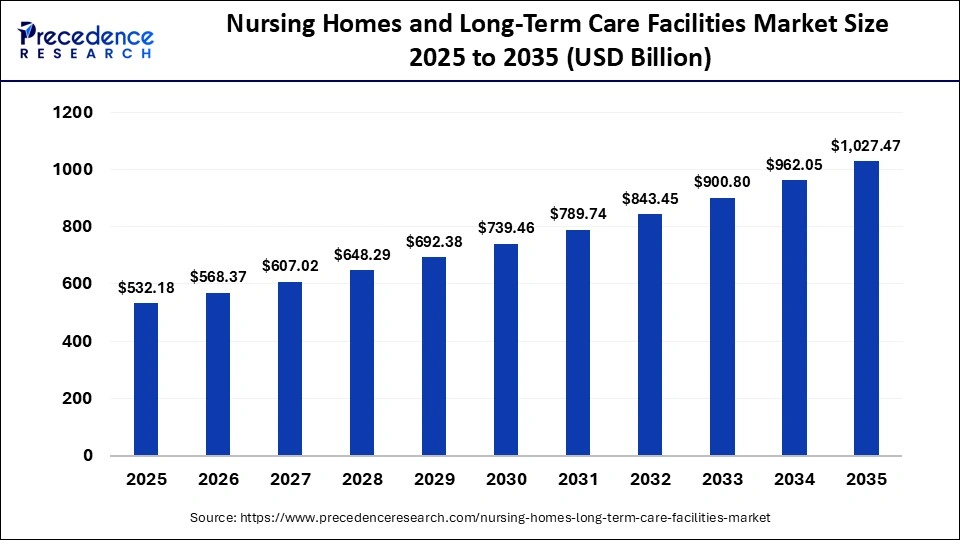
The global nursing homes and long-term care facilities market is witnessing sustained expansion as countries face a rapidly aging population and rising demand for elderly healthcare services. The market was valued at USD 532.18 billion in 2025 and is projected to grow from USD 568.37 billion in 2026 to approximately USD 1,027.47 billion by 2035, registering a CAGR of 6.80% during the forecast period. The growing prevalence of chronic diseases, increasing life expectancy, and the rising need for 24/7 support services are fueling demand for nursing homes, assisted living facilities, skilled nursing centers, and memory care services.
Healthcare systems across the world are under pressure to provide long-term support for elderly patients suffering from cardiovascular diseases, diabetes, respiratory illnesses, dementia, and other age-related conditions. As a result, nursing homes and long-term care facilities are becoming increasingly important in ensuring continuous medical supervision, rehabilitation, and quality-of-life support.
Read Also: Preventive Medicine Market
Quick Insights
- The global nursing homes and long-term care facilities market is expected to grow from USD 568.37 billion in 2026 to USD 1,027.47 billion by 2035.
- North America dominated the market with a 40% share in 2025 due to advanced elderly care infrastructure and high healthcare spending.
- Asia Pacific is expected to register the fastest CAGR of 8.5% between 2026 and 2035.
- Nursing homes remained the largest facility type segment with a 35% share in 2025.
- Long-term care services held the highest share of 45% in 2025.
- Private ownership accounted for 50% of the market in 2025.
- Public insurance remained the leading payer segment with a 45% share in 2025.
- Assisted living facilities are expected to grow at the fastest CAGR of 7.5% through 2035.
Market Revenue Snapshot
| Metric | Value |
|---|---|
| Market Size 2025 | USD 532.18 Billion |
| Market Size 2026 | USD 568.37 Billion |
| Forecast Market Size 2035 | USD 1,027.47 Billion |
| CAGR 2026 to 2035 | 6.80% |
| Leading Region | North America |
| Fastest Growing Region | Asia Pacific |
How Is AI Transforming Nursing Homes and Long-Term Care Facilities?
Artificial intelligence is increasingly being integrated into nursing homes and long-term care facilities to improve patient outcomes, reduce operational inefficiencies, and address staffing shortages. AI-powered predictive analytics tools are helping caregivers identify early signs of health deterioration, fall risk, cognitive decline, and medication non-compliance before conditions become critical. Facilities are also using AI for staff scheduling, reducing caregiver burnout, and improving resource allocation.
AI-based remote monitoring systems, wearable devices, and robotics are further improving patient care. Robotics are being used to support medication delivery, mobility assistance, companionship, and daily caregiving tasks, especially in facilities dealing with high patient volumes and limited workforce availability. These innovations are expected to significantly reshape elderly care delivery over the next decade.
What Are the Major Growth Drivers in the Nursing Homes and Long-Term Care Facilities Market?
The rapidly growing elderly population remains the primary driver of market expansion. According to OECD data referenced in the report, more than 242 million people in OECD countries were aged 65 and above in 2021, including over 64 million people aged 80 and above. As the elderly population grows, so does the demand for residential care, rehabilitation services, and memory care facilities.
Another major driver is the increasing prevalence of chronic diseases among older adults. Conditions such as cardiovascular diseases, diabetes, respiratory disorders, neurological diseases, and musculoskeletal disorders require long-term medical supervision and rehabilitation support. This is increasing demand for skilled nursing facilities and long-term care services.
Healthcare providers are also increasingly focusing on post-acute care and rehabilitation services to reduce hospital readmissions and improve patient recovery after surgery or major illness. The rising number of hospital discharges is creating new demand for short-term rehabilitation services and transitional care facilities.
Why Are Assisted Living Facilities Emerging as a Major Opportunity?
Assisted living facilities are becoming one of the fastest-growing segments in the market because they offer a balance between independent living and medical support. Many elderly individuals prefer assisted living because it provides help with daily activities, health monitoring, and social engagement without the intensity of full-time nursing care. The segment is projected to grow at a CAGR of 7.5% between 2026 and 2035.
Another major opportunity area is memory care. The growing burden of Alzheimer’s disease, dementia, and other cognitive disorders is increasing demand for specialized memory care units and dementia-focused facilities. Memory care services are expected to witness a CAGR of 8.2% during the forecast period due to rising cases of neurodegenerative diseases globally.
Segment Analysis
Why Did Nursing Homes Dominate the Market in 2025?
Nursing homes accounted for the largest facility type share of 35% in 2025 because they provide continuous medical supervision, medication management, rehabilitation, and assistance with daily living activities. They remain the preferred care model for elderly patients who require round-the-clock support. Expansion of specialized nursing homes focused on dementia, palliative care, and high-dependency care is further strengthening this segment.
Assisted living facilities held a 25% share of the market in 2025 and are expected to grow at the fastest pace because they offer a more flexible and less institutional care environment. Continuing care retirement communities are also gaining popularity as they allow residents to access different levels of care within the same facility.
Why Are Long-Term Care Services Leading the Market?
Long-term care services dominated the market with a 45% share in 2025 because of the increasing burden of chronic illnesses, disability, and age-related dependency. These services provide 24-hour care management, medication support, nutrition assistance, and mobility services for elderly patients who need sustained support.
Short-term rehabilitation services are expected to grow rapidly as hospitals increasingly discharge patients earlier after surgeries or acute illnesses. Meanwhile, memory care services are becoming a critical growth area due to rising dementia rates worldwide.
Why Did the Private Ownership Segment Lead?
Private ownership accounted for 50% of the market in 2025 because private operators are investing heavily in advanced infrastructure, premium elderly care services, and technology-enabled facilities. Private nursing homes and assisted living centers are increasingly offering luxury amenities, digital health monitoring, and personalized care plans.
Public facilities remain important for providing affordable elderly care to low- and middle-income populations, while non-profit organizations continue to play a major role in community-based and affordable care services.
Regional Analysis
Why Did North America Lead the Market?
North America led the nursing homes and long-term care facilities market with a 40% share in 2025 due to its advanced healthcare infrastructure, strong reimbursement systems, and widespread availability of skilled nursing facilities, assisted living centers, and post-acute care services. High life expectancy and rising chronic disease prevalence are also contributing to market growth in the region.
The United States remains the largest contributor because of its large elderly population and expanding long-term care infrastructure. In 2025, the Centers for Medicare and Medicaid Services reported more than 68 million Medicare enrollees, which continues to support elderly care demand.
Why Is Asia Pacific the Fastest-Growing Region?
Asia Pacific is expected to grow at the fastest CAGR of 8.5% through 2035 due to a rising elderly population, declining family-based caregiving systems, and increasing investments in elder care infrastructure. Governments across China, India, Japan, and other Asian countries are expanding insurance coverage and long-term care services to meet growing demand.
Japan is emerging as a particularly important market because of its rapidly aging population and established long-term care insurance system. Urbanization and shrinking family sizes are also increasing the need for professional elderly care facilities in the country.
Leading Companies in the Nursing Homes and Long-Term Care Facilities Market
- Amedisys, Inc.
- Brookdale Senior Living Inc.
- Care UK Ltd.
- Colisée Group
- Diversicare Healthcare Services, Inc.
- Ensign Group, Inc.
- Extendicare Inc.
- Genesis HealthCare, Inc.
- Golden LivingCenters
- Kindred Healthcare LLC
- Korian Group
- LHC Group, Inc.
- Orpea Group
- Sienna Senior Living Inc.
- Sunrise Senior Living, LLC
Get Sample Copy: https://www.precedenceresearch.com/sample/8309
For inquiries regarding discounts, bulk purchases, or customization requests, please contact us at [email protected]