
What is the Electronic Health Records Market Size?
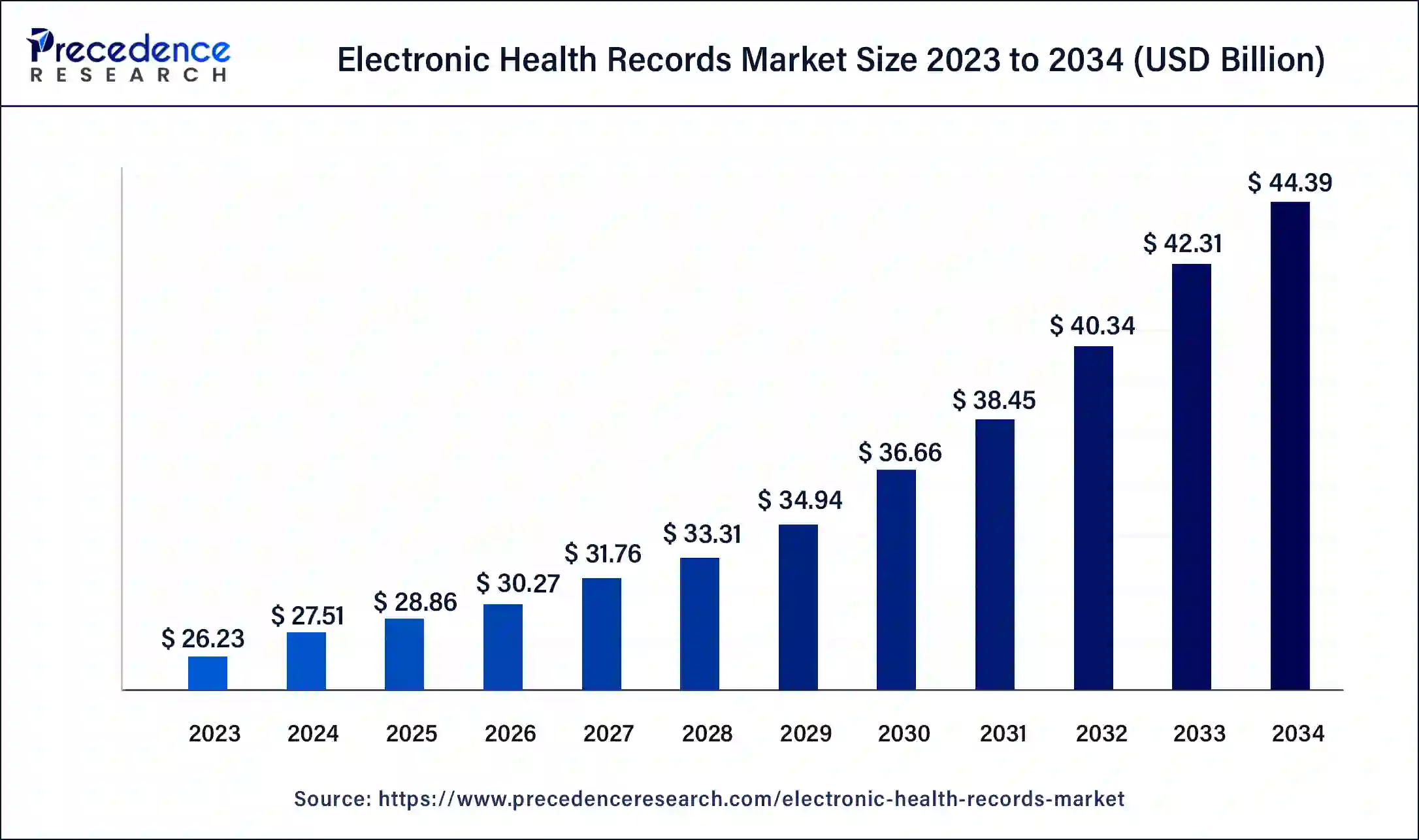
The global electronic health records market size accounted for USD 28.86 billion in 2025 and is expected to be worth around USD 46.40 billion by 2035, at a CAGR of 4.86% from 2026 to 2035. The North America electronic health records market size reached USD 12.07 billion in 2025.
Market Highlights
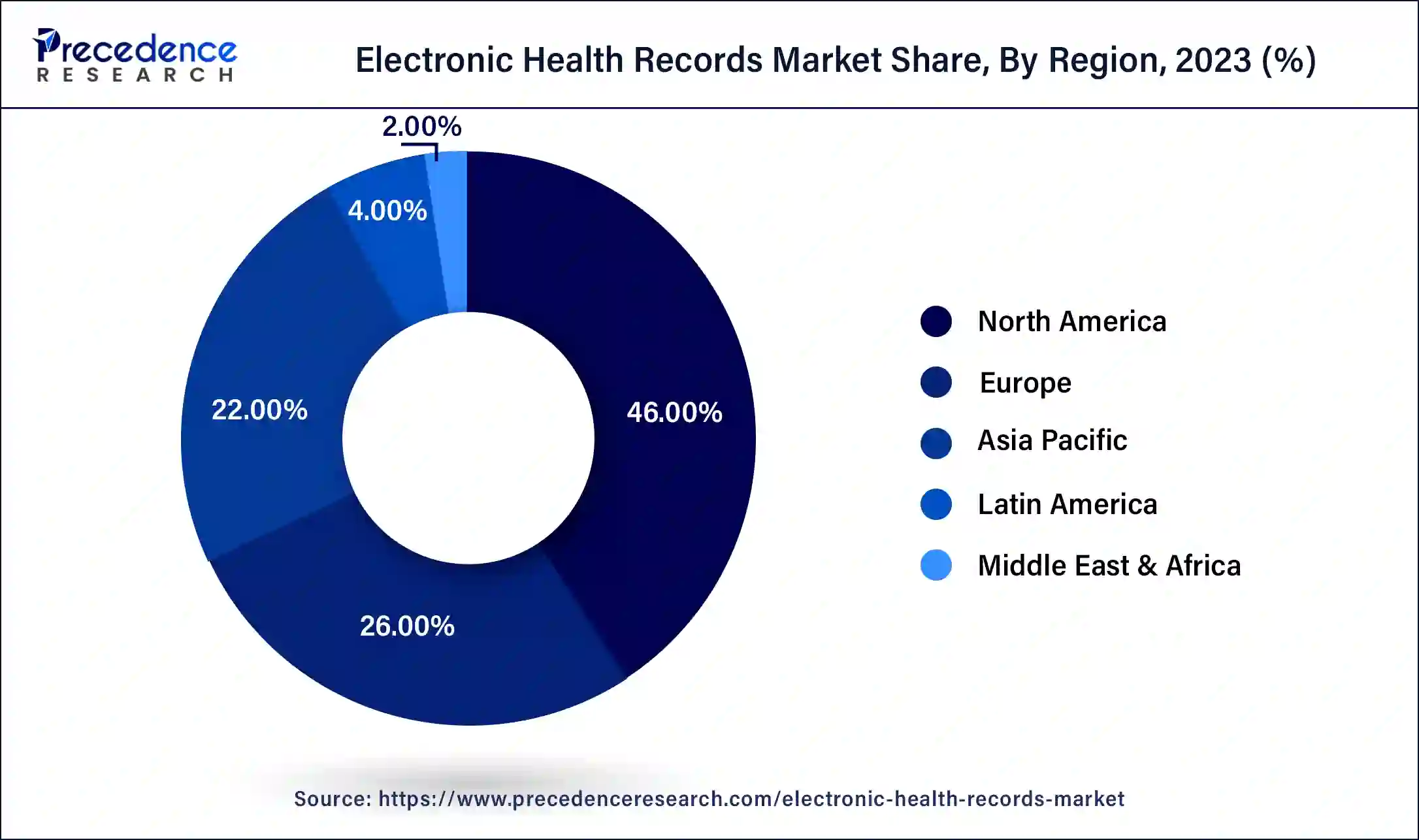
- North America led the global market with the highest market share of 46% in 2025.
- By business model, the professional services segment has accounted revenue share of 32% in 2025
- The professional services segment has captured a revenue share of 32% in 2025.
- The ambulatory surgical centers segment is expected to witness a CAGR of 7.8% from 2026 to 2035.
Electronic Health Records (EHR) Market Overview
The global electronic health records (EHR) market is witnessing strong growth due to the increasing digitalization of healthcare systems and rising demand for efficient patient data management solutions. EHR systems are digital platforms used to store, manage, and access patient medical records electronically, enabling healthcare providers to improve coordination, accuracy, and accessibility of patient information across healthcare facilities. These systems support clinical documentation, e-prescriptions, laboratory reports, medical imaging, billing, and healthcare analytics within a centralized digital environment.
The market is being driven by growing government initiatives promoting healthcare IT adoption, increasing healthcare expenditures, and the rising need for interoperable healthcare systems. Hospitals, clinics, and healthcare organizations are increasingly adopting cloud-based EHR solutions to improve workflow efficiency, reduce paperwork, and enhance patient care quality. In addition, the integration of artificial intelligence, machine learning, and predictive analytics into EHR platforms is further accelerating market growth by enabling smarter healthcare management and data-driven clinical decisions. The growing prevalence of chronic diseases, expanding telehealth services, and increasing focus on personalized healthcare are also contributing significantly to the expansion of the EHR market worldwide.
Impact of Artificial Intelligence on the Electronic Health Records (EHR) Market
Artificial intelligence is significantly transforming the electronic health records (EHR) market by improving operational efficiency, clinical accuracy, and patient care management. AI-powered EHR systems help automate routine administrative tasks such as appointment scheduling, medical billing, documentation, and patient record management, allowing healthcare professionals to focus more on patient treatment and clinical decision-making.
Advanced AI algorithms can analyze large volumes of healthcare data to support early disease detection, personalized treatment planning, and real-time patient monitoring. AI-enabled EHR platforms also help reduce medical errors by identifying potential risks such as adverse drug interactions, abnormal health conditions, and treatment complications. In addition, predictive analytics and intelligent clinical decision support systems provide healthcare providers with valuable insights that improve diagnosis accuracy and treatment outcomes. These technologies also contribute to cost reduction through optimized resource utilization, streamlined workflows, and lower hospital readmission rates.
Market Scope
| Report Highlights | Details |
| Market Size in 2025 | USD 28.86 Billion |
| Market Size in 2026 | USD 30.27 Billion |
| Market Size by 2035 | USD 46.40 Billion |
| Growth Rate from 2026 to 2035 | CAGR of 4.86% |
| Largest Market | North America |
| Fastest Growing Market | Asia Pacific |
| Base Year | 2025 |
| Forecast Period | 2026 to 2035 |
| Segments Covered | Type, Product, End User, Region |
| Regions Covered | North America, Asia Pacific, Europe, Latin America, Middle East and Africa |
Opportunity
Technological Enhancement
Emergences in technology, comprising cloud computing, artificial intelligence (AI), and machine learning, will probably transform the EHR landscape for increased system functionality and accessibility. Cloud-based EHR offers scalable, secure, and inexpensive options for data storage that can be accessed anytime and anywhere from any device, thereby permitting the smooth collaboration of healthcare providers. The inclusion of AI in the system, in turn, helps perform analytical tasks on data and performs automation of routine tasks and supports clinical decision-making, rendering EHR systems highly intuitive and efficient. Such technologies will certainly remove hurdles by streamlining user workflow and offering user-centric interfaces to globally grow the opportunity in the EHR market.
Regional Insights
North America remains a leading region in the electronic health records market due to the strong presence of advanced healthcare infrastructure, high healthcare IT spending, and widespread adoption of digital healthcare technologies. The United States and Canada are witnessing significant investments in AI-powered EHR systems, cloud-based healthcare platforms, and interoperability solutions to improve patient care and operational efficiency. Government regulations supporting electronic medical record adoption and the increasing use of telehealth services are further driving market growth across the region.
Europe is experiencing steady growth in the EHR market as healthcare providers increasingly adopt digital patient management systems and healthcare analytics platforms. Countries such as Germany, the United Kingdom, France, and the Nordic nations are investing heavily in healthcare digitalization and AI-integrated healthcare technologies. The region is also focusing on improving healthcare interoperability, patient data security, and electronic prescription systems to strengthen healthcare delivery and patient outcomes.
Asia Pacific is emerging as one of the fastest-growing regions in the EHR market due to rapid healthcare modernization, increasing healthcare investments, and expanding digital infrastructure. Countries including China, India, Japan, South Korea, and Australia are actively adopting electronic health record systems to improve healthcare accessibility and patient data management. Government initiatives supporting digital healthcare transformation, rising smartphone and internet penetration, and increasing adoption of cloud-based healthcare technologies are accelerating regional market growth.
Latin America is witnessing increasing adoption of electronic health record systems as healthcare organizations focus on improving operational efficiency and healthcare accessibility. Countries such as Brazil, Mexico, Argentina, and Chile are investing in healthcare IT infrastructure and digital patient management solutions to modernize healthcare systems. Growing awareness regarding the benefits of digital healthcare technologies and increasing government support for healthcare modernization are contributing to market expansion across the region.
The Middle East & Africa region is gradually expanding in the EHR market due to rising investments in healthcare digitalization and smart healthcare infrastructure. Countries such as the UAE, Saudi Arabia, South Africa, and Israel are increasingly implementing electronic health record systems to improve healthcare management, reduce administrative burdens, and enhance patient care quality. Government-led healthcare transformation programs and increasing adoption of AI-powered healthcare technologies are expected to further support market growth across the region.
Electronic Health Records Market Key Players
- Epic Systems Corp
- Cerner Corp
- GE Healthcare
- Allscripts Healthcare, LLC.
- eClinicalWorks
- CPSi
- McKesson Corp
- Medical Information Technology, Inc.
- NextGen Healthcare, Inc.
- HMS
Recent Developments
- In July 2025, the Delhi government introduced an expanded Health Information Management System (HIMS) to facilitate online appointment booking for patients, a significant move towards digital healthcare.
- In July 2025, the Trump Administration introduced a new initiative allowing Americans to share their medical records across various tech-managed apps, despite concerns about potential data security risks.
- In April 2023, Microsoft and Epic announced their strategic collaboration to develop and integrate generative AI into healthcare by combining the scale and power of Azure OpenAI Service with industry-leading electronic health record (EHR) software of Epic by focusing on delivering a comprehensive array of generative AI- powered solutions integrated with HER of Epic to increase productivity and enhance patient care.
- In October 2024, Oracle launched a brand-new electronic health record, its most significant health-care product update, where the latest EHR is equipped with cloud and artificial intelligence capabilities that will make it easier to navigate and set up. Also, there are no drop-down screens, and doctors can pull up the information they require by asking questions with their voices by enabling doctors to spend less time searching through records and more time caring for patients.
Key Companies Share Insights
The market is moderately fragmented with the presence of several local companies. These market players are striving to gain higher market share by adopting strategies, such as investments, partnerships, and acquisitions & mergers. Companies are also spending on the development of improved products. Moreover, they are also focusing on maintaining competitive pricing.
- In October 2019, Meditech and Google merged to provide electronic health records data through the Google Cloud.
The various developmental strategies like acquisition, partnerships, mergers, and government policies fosters market growth and offers lucrative growth opportunities to the market players.
Segments Covered in the Report
By Product Type
- Software
- On-premise EHR software
- Cloud-based EHR software
- Services
- Implementation services
- Support & maintenance
- Training & education
- Consulting services
- Managed Services
By Type of EHR
- Inpatient EHR
- Hospital Information Systems (HIS) integrated EHR
- Intensive Care Unit (ICU) EHR
- Emergency Department EHR
- Ambulatory EHR
- Outpatient clinics
- Physician offices
- Specialty care centers
- Specialty-specific EHR
- Oncology EHR
- Cardiology EHR
- Orthopedics EHR
- Mental health EHR
- Dental EHR
- Pediatrics EHR
By End-User
- Hospitals
- Clinics & Physician Offices
- Ambulatory Surgical Centers (ASCs)
- Specialty Centers
- Pharmacies
- Others (e.g., Rehabilitation Centers, Academic Institutions)
By Functionality
- Patient Demographics & Registration
- Clinical Documentation & Charting
- Medication Management
- Laboratory & Diagnostic Integration
- Radiology Information System Integration
- Clinical Decision Support
- Computerized Provider Order Entry (CPOE)
- Electronic Prescribing
- Others
By Region
- North America
- Latin America
- Europe
- Asia-pacific
- Middle and East Africa
Get Free Sample Link: https://www.precedenceresearch.com/sample/1379
Also Read Our Latest Article : Telemedicine Market