
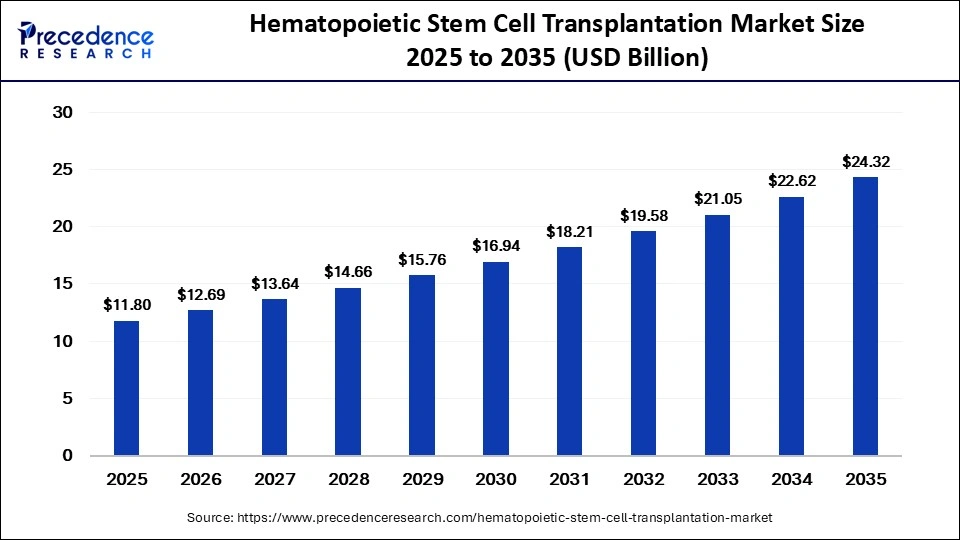
The global hematopoietic stem cell transplantation market is expected to grow from USD 12.69 billion in 2026 to USD 24.32 billion by 2035 at a CAGR of 7.50%, driven by increasing blood cancer incidence, AI integration, and regenerative medicine advancements.
The global hematopoietic stem cell transplantation market is entering a transformative growth phase, fueled by the increasing prevalence of blood cancers, autoimmune disorders, and genetic diseases worldwide. According to industry estimates, the market size was valued at USD 11.80 billion in 2025 and is projected to grow from USD 12.69 billion in 2026 to approximately USD 24.32 billion by 2035, registering a CAGR of 7.50% during the forecast period.
Hematopoietic stem cell transplantation (HSCT) has become one of the most effective treatment approaches for leukemia, lymphoma, multiple myeloma, and inherited immune deficiencies. Continuous advancements in donor matching technologies, stem cell preservation methods, and post-transplant care are significantly improving patient survival rates and treatment outcomes.
Rising Burden of Hematologic Disorders Driving Market Expansion
The rapid rise in hematologic malignancies and inherited blood disorders is creating substantial demand for advanced stem cell transplantation therapies. Diseases such as leukemia, lymphoma, anemia, and immune deficiencies require effective bone marrow restoration techniques, making HSCT a critical treatment option globally.
The growing aging population is another major factor accelerating market growth. Elderly individuals are more susceptible to blood cancers and immune-related disorders, increasing the demand for autologous and allogeneic transplantation procedures.
Healthcare providers are also witnessing increased awareness regarding early diagnosis and access to advanced treatment infrastructure, particularly in emerging economies.
AI Revolutionizing Hematopoietic Stem Cell Transplantation
Artificial intelligence is emerging as a game-changing technology in the hematopoietic stem cell transplantation market. AI-powered platforms are enhancing donor-recipient matching accuracy, streamlining treatment planning, and improving transplant success rates.
Hospitals and research laboratories are increasingly integrating machine learning and predictive analytics into stem cell research and transplantation procedures. AI-driven tools are helping clinicians optimize patient monitoring, reduce complications, and accelerate drug development processes.
The integration of AI with regenerative medicine is expected to reshape the future of transplantation therapies by enabling highly personalized treatment approaches and minimizing transplant rejection risks.
Key Market Highlights
- North America accounted for 38% of the global market share in 2025.
- Asia-Pacific is projected to witness the fastest CAGR of 9.2% through 2035.
- Autologous stem cell transplantation dominated the market with a 50% share in 2025.
- Allogeneic stem cell transplantation is expected to grow at a CAGR of 7.8%.
- Bone marrow-derived stem cells held 40% of the market share in 2025.
- Umbilical cord blood stem cells are gaining momentum due to lower GVHD risks.
- Hospitals contributed 60% of the overall market revenue in 2025.
- Research institutes are forecast to expand at the fastest CAGR of 8.5%.
Emerging Trends Reshaping the Industry
Expansion of Global Donor Registries
The expansion of international donor registries and improved donor matching techniques are significantly enhancing transplantation accessibility. Better compatibility testing is reducing complications such as graft-versus-host disease (GVHD), improving long-term treatment success.
Increasing Adoption of Cord Blood Stem Cells
Cord blood stem cells are gaining widespread attention due to their reduced rejection risks and broader donor compatibility. Their growing use in pediatric and adult hematologic treatments is expected to fuel market growth over the coming years.
Personalized Medicine and Gene Editing Technologies
Personalized medicine and gene-editing innovations such as CRISPR are creating revolutionary opportunities in regenerative healthcare. Patient-specific transplantation protocols are improving treatment precision while reducing adverse effects and transplant rejection rates.
Growing Investments in Regenerative Medicine
Governments and private organizations are significantly increasing investments in regenerative medicine research, stem cell banking, and specialized transplantation centers, supporting long-term market growth globally.
Segmental Insights
Autologous Stem Cell Transplantation Dominated the Market
The autologous stem cell transplantation (ASCT) segment accounted for 50% of the market share in 2025. ASCT remains the preferred option for treating lymphoma and multiple myeloma because it minimizes graft-versus-host disease risks and offers better patient compatibility.
Meanwhile, the allogeneic stem cell transplantation segment is projected to witness the fastest growth due to increasing cases of aggressive blood cancers and expanding unrelated donor registries.
Bone Marrow-Derived Stem Cells Held the Largest Share
Bone marrow-derived stem cells dominated the market with a 40% revenue share in 2025 owing to their extensive clinical applications in leukemia and lymphoma treatment. Peripheral blood stem cells and umbilical cord blood stem cells are also experiencing rising adoption due to advancements in collection technologies and improved transplant success rates.
Hematologic Malignancies Remain the Largest Application Area
The hematologic malignancies segment held 50% of the market share in 2025, driven by increasing leukemia, lymphoma, and multiple myeloma cases globally. Stem cell transplantation continues to serve as one of the most effective therapies for blood cancers requiring high-dose chemotherapy.
The autoimmune diseases segment is expected to grow rapidly due to increasing clinical research into regenerative medicine and immune system therapies.
Regional Insights
North America Maintains Market Leadership
North America dominated the global hematopoietic stem cell transplantation market in 2025 due to its advanced healthcare infrastructure, strong biotechnology ecosystem, and extensive adoption of innovative transplantation technologies.
The United States continues to lead regional growth owing to rising blood cancer incidence, increasing investments in regenerative medicine, and strong pharmaceutical R&D activities.
Asia-Pacific Emerging as the Fastest-Growing Region
Asia-Pacific is expected to witness the fastest market growth during the forecast period. Rapid healthcare modernization, increasing stem cell research initiatives, and growing awareness regarding advanced transplantation procedures are supporting regional expansion.
Countries such as Japan, China, and India are investing heavily in stem cell therapies and specialized transplant centers to address the growing burden of hematologic disorders.
Europe Witnessing Significant Growth Opportunities
Europe is experiencing notable growth due to government-backed stem cell research programs, advanced healthcare systems, and increasing adoption of personalized medicine approaches.
The UK is emerging as a key regional market supported by strong clinical research infrastructure and rising demand for innovative stem cell therapies.
Competitive Landscape
Major companies operating in the hematopoietic stem cell transplantation market include:
- Novartis
- Gilead Sciences
- Baxter International
- Fresenius Kabi
- Bristol Myers Squibb
- Medtronic
- Amgen
- Miltenyi Biotec
- Thermo Fisher Scientific
- Takeda Pharmaceutical Company
These companies are actively focusing on strategic collaborations, AI integration, regenerative medicine advancements, and personalized treatment development to strengthen their market presence.
Future Outlook
The future of the hematopoietic stem cell transplantation market looks highly promising as regenerative medicine, AI-powered diagnostics, personalized medicine, and gene-editing technologies continue to evolve rapidly.
The growing expansion of donor registries, increasing healthcare investments, and rising adoption of advanced transplantation procedures are expected to create substantial opportunities for healthcare providers, biotechnology firms, and research institutions over the next decade.
As precision medicine becomes increasingly integrated into stem cell therapies, the global HSCT market is poised to witness accelerated innovation, improved patient outcomes, and significant commercial expansion.
Get a Sample Copy: https://www.precedenceresearch.com/sample/8421
For inquiries regarding discounts, bulk purchases, or customization requests, please contact us at [email protected]