
The global endoscopy equipment and software sector is expanding rapidly as healthcare providers increasingly adopt minimally invasive procedures, advanced imaging, artificial intelligence, and disposable technologies. Valued at USD 53.82 billion in 2025, the sector is projected to reach USD 57.92 billion in 2026 and approximately USD 112.26 billion by 2035, expanding at a CAGR of 7.63% from 2026 to 2035.
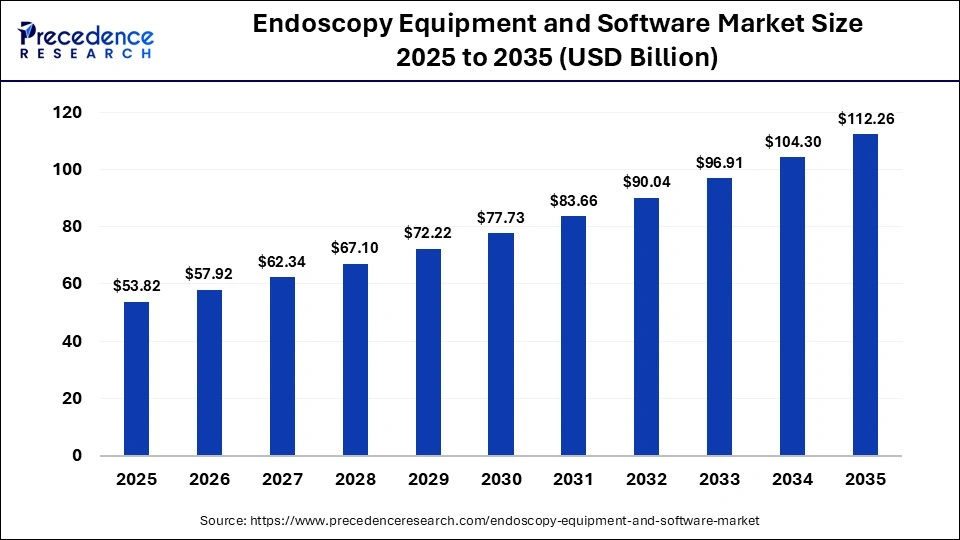
Rising chronic disease prevalence, increasing gastrointestinal procedures, technological innovation, and growing demand for faster patient recovery are creating strong opportunities across the endoscopy ecosystem.
Download a Sample Report: https://www.precedenceresearch.com/sample/7681
Compact Scope Table
| Report Coverage | Details |
|---|---|
| 2025 Value | USD 53.82 Billion |
| 2026 Value | USD 57.92 Billion |
| 2035 Value | USD 112.26 Billion |
| CAGR 2026–2035 | 7.63% |
| Leading Region | North America |
| Fastest-Growing Region | Asia Pacific |
| Leading Product Type | Flexible Endoscopy Systems |
| Fastest-Growing Product Type | Video Processors & Light Sources |
| Leading Software | Image Enhancement & Visualization |
| Fastest-Growing Software | AI-Assisted Detection & Decision Support |
| Leading End User | Hospitals & Surgical Centers |
| Fastest-Growing End User | Ambulatory Surgery Centers |
| Leading Procedure | Diagnostic Endoscopy |
| Leading Technology | HD Imaging Systems |
AI Is Transforming Endoscopic Diagnosis
Artificial intelligence is becoming one of the most important technology drivers in endoscopy.
AI-assisted software can analyze endoscopic images in real time and help clinicians identify abnormalities such as polyps and lesions. Computer-aided detection and diagnosis can act as an additional layer of support, potentially improving detection consistency and reducing variability between operators.
AI can also automate reporting, support lesion characterization, and improve workflow efficiency. This is creating strong opportunities for software developers and device manufacturers that can integrate intelligent analytics directly into endoscopy platforms.
Advanced Imaging Is Raising Clinical Precision
Flexible endoscopy systems accounted for approximately 44% share in 2025, supported by their maneuverability, high-quality visualization, and widespread use across gastrointestinal and respiratory procedures.
Meanwhile, video processors and light sources are expected to grow rapidly as providers transition toward higher-resolution imaging and AI-enabled visualization.
High-definition imaging led the technology segment with approximately 46% share in 2025, while 4K Ultra HD and advanced imaging are expected to experience strong growth as clinicians seek better tissue differentiation, depth perception, and procedural precision.
Single-Use Endoscopes Are Strengthening Infection Control
The adoption of single-use endoscopes is increasing as healthcare providers seek to reduce cross-contamination risks and simplify device reprocessing.
Disposable systems can reduce dependence on complex sterilization workflows and may provide greater flexibility for selected procedures. As infection prevention remains a major healthcare priority, single-use technologies are creating additional opportunities for manufacturers.
Therapeutic Procedures Are Expanding
Diagnostic endoscopy held approximately 42% share in 2025, supported by growing screening demand and the increasing prevalence of gastrointestinal, respiratory, urological, and other chronic conditions.
However, interventional and advanced therapeutic procedures are expected to grow rapidly. The transition from open surgery toward minimally invasive interventions is increasing demand for advanced endoscopes, specialized instruments, 3D visualization, and AI-supported systems.
Hospitals Lead While ASCs Accelerate
Hospitals and surgical centers represented approximately 61% share in 2025 because they handle complex procedures, emergency cases, and high patient volumes.
At the same time, ambulatory surgery centers are expected to experience the fastest growth as healthcare systems move suitable procedures into outpatient environments. ASCs benefit from shorter stays, lower costs, and efficient procedural workflows.
The expansion of outpatient endoscopy is increasing demand for compact, efficient, and easy-to-integrate equipment.
North America Leads While Asia Pacific Accelerates
North America accounted for approximately 38% of the global share in 2025, supported by advanced healthcare infrastructure, strong adoption of minimally invasive procedures, sophisticated reimbursement systems, and high investment in medical technology.
The U.S. remains a major center for endoscopy innovation, with companies investing heavily in AI, robotics, advanced imaging, and digital clinical workflows.
Asia Pacific is expected to record the fastest growth as healthcare infrastructure expands, chronic disease screening increases, and demand for advanced minimally invasive procedures rises across China, India, Japan, and other major economies.
Leading Companies Are Accelerating Innovation
The competitive landscape includes major medical technology companies such as Olympus Corporation, KARL STORZ, Fujifilm Holdings, Boston Scientific, Medtronic, Stryker, PENTAX Medical, Ambu, Smith & Nephew, Cook Medical, Richard Wolf, CONMED, Johnson & Johnson, Mindray, and Intuitive Surgical.
Recent developments highlight the industry’s shift toward AI-enabled and advanced visualization technologies. In May 2025, Olympus showcased its OLYSENSE platform with the CADDIE computer-aided detection device, designed to support polyp detection during colonoscopy.
In April 2025, FUJIFILM India launched its ELUXEO 8000 Therapeutic Endoscopy Solution, introducing advanced imaging and workflow technologies to support complex therapeutic procedures.
Medtronic also continues to expand AI capabilities through its GI Genius ecosystem, including the ColonPRO software upgrade for colorectal polyp detection.
The Road Ahead
The future of endoscopy equipment and software will increasingly focus on AI-assisted diagnosis, 4K and advanced imaging, single-use devices, robotic-assisted procedures, digital workflow integration, and outpatient care.
As endoscopy becomes more precise and increasingly software-driven, companies that combine high-quality hardware, intelligent analytics, infection-control solutions, and seamless clinical integration will be well positioned for long-term growth.
With the sector projected to reach USD 112.26 billion by 2035, the next generation of endoscopy will be defined by smarter visualization, faster decision-making, and increasingly minimally invasive patient care.
Buy this report: https://www.precedenceresearch.com/checkout/7681
About Us
Healthcare Prism is a dedicated healthcare insights and outreach platform, operating as an extension of Precedence Research. We share relevant perspectives, industry developments, emerging trends, and research-driven insights across the global healthcare sector. Our content is built on the knowledge, research standards, and expertise of Precedence Research, with a focus on making healthcare information clear, accessible, and useful for industry professionals, businesses, researchers, and healthcare stakeholders. Healthcare Prism serves as a focused platform to extend the reach of Precedence Research’s healthcare insights and connect them with a broader professional audience.
You can place an order or ask any questions, please feel free to contact us at [email protected]
Quick Contact:
Europe Region: +44 778 256 0738
North America Region: +1 8044 4193 44
APAC Region: +91 9356 9282 04 and +65 31065601
Visit Our Website: Precedence Research – Advisory, Research & Reports