
The global Obesity GLP-1 sector is experiencing exceptional growth as obesity becomes an increasingly important chronic health challenge and patients seek effective medical weight-management solutions. Valued at USD 8.21 billion in 2025, the obesity GLP-1 sector is projected to reach USD 10.12 billion in 2026 and approximately USD 66.57 billion by 2035, expanding at a CAGR of 23.28% from 2026 to 2035.
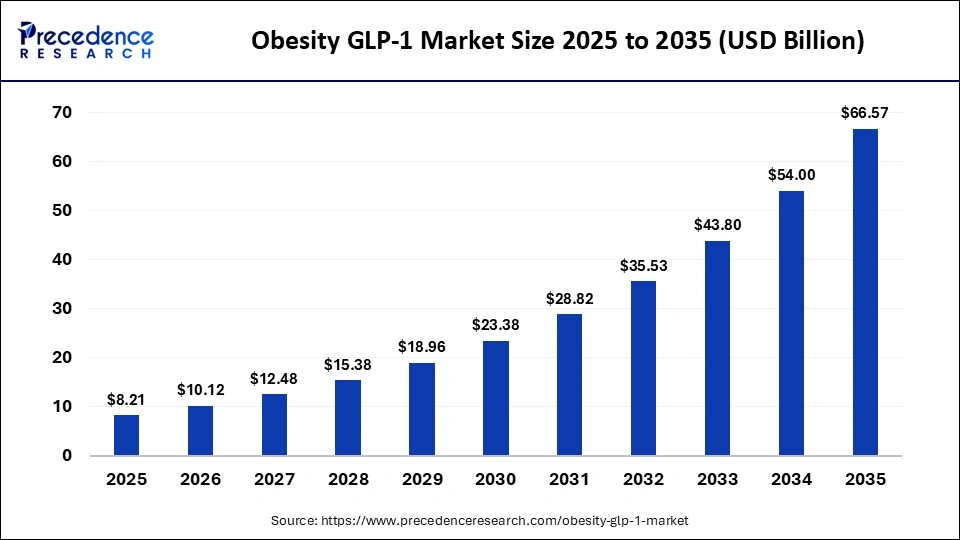
Strong clinical evidence, expanding regulatory approvals, growing awareness of medical obesity management, and continued innovation in GLP-1 therapies are creating significant opportunities for pharmaceutical companies.
Download a Sample Report: https://www.precedenceresearch.com/sample/7615
Compact Scope Table
| Report Coverage | Details |
|---|---|
| 2025 Value | USD 8.21 Billion |
| 2026 Value | USD 10.12 Billion |
| 2035 Value | USD 66.57 Billion |
| CAGR 2026-2035 | 23.28% |
| Leading Region | North America |
| Fastest-Growing Region | Asia Pacific |
| Leading Drug Type | Semaglutide |
| Fastest-Growing Drug Type | Tirzepatide |
| Leading Administration Route | Parenteral |
| Fastest-Growing Route | Oral |
| Leading Indication | Type 2 Diabetes |
| Fastest-Growing Indication | Obesity/Chronic Weight Management |
| Leading Distribution | Retail Pharmacies |
GLP-1 Therapies Are Redefining Weight Management
The rising prevalence of obesity is creating substantial demand for pharmacological approaches that can provide meaningful and sustained weight reduction.
Semaglutide held approximately 46% share in 2025, supported by extensive clinical evidence, established regulatory approvals, physician familiarity, and widespread patient adoption.
Meanwhile, tirzepatide is expected to grow at the fastest pace. Its combined GIP and GLP-1 mechanism and strong clinical performance in weight reduction are strengthening its position among next-generation metabolic therapies.
Oral Therapies Are Creating a New Growth Opportunity
Injectable treatments accounted for approximately 88% share in 2025, reflecting the established use of parenteral GLP-1 therapies.
However, oral formulations are expected to grow rapidly as patients increasingly seek convenient, needle-free options. Advances in drug-delivery technologies are improving the potential for effective oral GLP-1 treatment and could broaden adoption among patients who are hesitant about injections.
AI Is Supporting Personalized Treatment
Artificial intelligence is adding another layer of innovation to Obesity GLP-1 care.
AI-driven platforms can analyze patient characteristics, biomarkers, treatment response, and adherence patterns to support more personalized therapy strategies. Predictive analytics can also help healthcare professionals monitor outcomes and identify patients who may benefit from adjustments in treatment.
For pharmaceutical companies, AI can support demand forecasting, clinical research, drug development, and supply-chain optimization.
North America Leads While Asia Pacific Accelerates
North America accounted for approximately 60% of the global share in 2025, supported by high obesity prevalence, advanced healthcare infrastructure, strong pharmaceutical innovation, and broad awareness of GLP-1 therapies.
The North American sector is projected to reach approximately USD 40.27 billion by 2035, expanding at a 23.37% CAGR.
The U.S. remains the region’s largest contributor, with the sector expected to rise from USD 3.69 billion in 2025 to nearly USD 30.41 billion by 2035 at a 23.48% CAGR.
Asia Pacific is projected to grow at the fastest rate as healthcare access improves and obesity and diabetes prevalence increase across emerging economies.
Leading Companies Are Accelerating Innovation
The competitive landscape includes Novo Nordisk, Eli Lilly and Company, Amgen, Viking Therapeutics, AstraZeneca, Roche, Boehringer Ingelheim, Pfizer, Altimmune, and Structure Therapeutics.
Recent developments are intensifying competition. In February 2026, Pfizer reported positive Phase 2b results for its monthly injectable GLP-1 candidate, while Novo Nordisk announced broad U.S. availability of its Wegovy pill, expanding access to oral weight-management therapy.
The Road Ahead
The future of Obesity GLP-1 will increasingly focus on greater weight-loss efficacy, longer-acting treatments, oral formulations, personalized care, digital health integration, and broader access.
With the sector projected to reach USD 66.57 billion by 2035, pharmaceutical innovation and expanding treatment adoption are expected to make GLP-1 therapies an increasingly important part of long-term obesity and metabolic healthcare.
Buy this report: https://www.precedenceresearch.com/checkout/7615
About Us
Healthcare Prism is a dedicated healthcare insights and outreach platform, operating as an extension of Precedence Research. We share relevant perspectives, industry developments, emerging trends, and research-driven insights across the global healthcare sector. Our content is built on the knowledge, research standards, and expertise of Precedence Research, with a focus on making healthcare information clear, accessible, and useful for industry professionals, businesses, researchers, and healthcare stakeholders. Healthcare Prism serves as a focused platform to extend the reach of Precedence Research’s healthcare insights and connect them with a broader professional audience.
You can place an order or ask any questions, please feel free to contact us at [email protected]
Quick Contact:
Europe Region: +44 778 256 0738
North America Region: +1 8044 4193 44
APAC Region: +91 9356 9282 04 and +65 31065601
Visit Our Website: Precedence Research – Advisory, Research & Reports