
The global medical washers disinfectors sector is expanding rapidly as healthcare providers place greater emphasis on infection prevention, patient safety, regulatory compliance, and automated instrument processing. Valued at USD 3.80 billion in 2025, the sector is projected to reach USD 4.12 billion in 2026 and approximately USD 8.59 billion by 2035, expanding at a CAGR of 8.50% from 2026 to 2035.
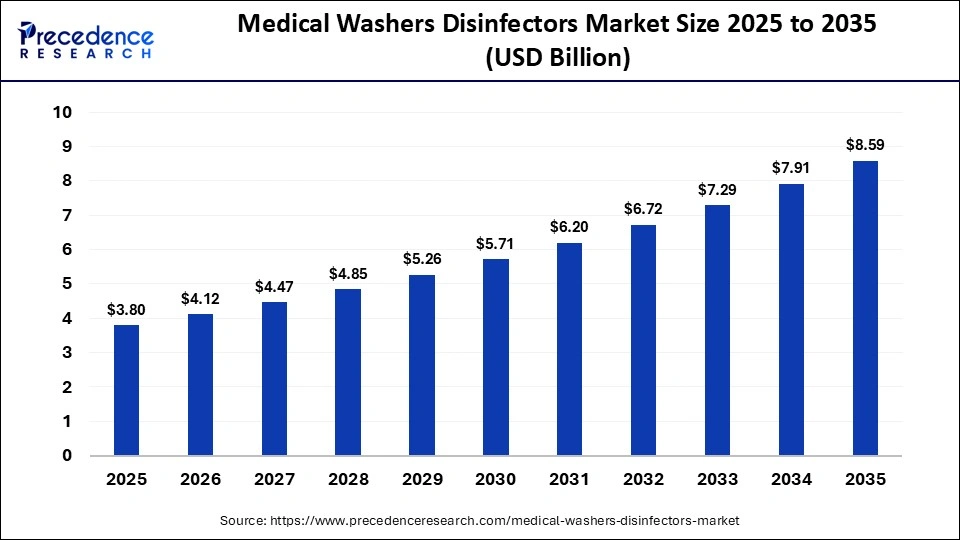
Rising surgical volumes, growing centralized sterile supply departments, expansion of ambulatory care, and increasing adoption of automated decontamination systems are supporting this growth.
Download a Sample Report: https://www.precedenceresearch.com/sample/7576
Compact Scope Table
| Report Coverage | Details |
|---|---|
| 2025 Value | USD 3.80 Billion |
| 2026 Value | USD 4.12 Billion |
| 2035 Value | USD 8.59 Billion |
| CAGR 2026-2035 | 8.50% |
| Leading Region | North America |
| Fastest-Growing Region | Asia Pacific |
| Leading Product Type | Medical Washer-Disinfectors |
| Fastest-Growing Product Type | Automated Endoscope Reprocessors |
| Leading Technology | Thermo-Disinfection Systems |
| Fastest-Growing Technology | Ultrasonic Cleaning Systems |
| Leading End User | Hospitals & Surgical Centers |
| Fastest-Growing End User | Ambulatory Care & Specialty Clinics |
| Leading Application | General Surgery Instrument Processing |
| Fastest-Growing Application | Endoscope Cleaning & Reprocessing |
Automation Is Strengthening Infection Control
Medical washer-disinfectors are becoming essential for standardized cleaning and disinfection of reusable surgical instruments, trays, endoscopes, and anesthesia components.
Medical washer-disinfectors held approximately 46% share in 2025, supported by rising surgical volumes and the need to reduce variability associated with manual cleaning.
Automated systems can provide validated cycles, consistent cleaning performance, staff protection, and traceable documentation. These benefits are particularly important for hospitals operating large centralized sterile processing departments.
AI and IoT Are Creating Smarter Systems
Artificial intelligence and Internet of Things technologies are transforming equipment management and operational monitoring.
Connected washers can track water temperature, cycle duration, detergent consumption, pressure, and other critical parameters in real time. AI and machine learning can use this information to identify unusual patterns, support predictive maintenance, and reduce unexpected equipment downtime.
Intelligent systems can also help healthcare facilities generate automated compliance documentation and improve visibility across sterile processing operations.
Endoscope Reprocessing Is a Major Growth Opportunity
The automated endoscope reprocessors segment is expected to grow at the fastest pace as hospitals and specialty centers face increasingly complex endoscope reprocessing requirements.
The growing number of endoscopic procedures, including colonoscopies and bronchoscopies, is increasing demand for standardized and validated high-level disinfection.
At the same time, the endoscope cleaning and reprocessing application is expected to experience rapid growth as healthcare providers adopt automation to improve infection prevention and operational consistency.
Hospitals Lead While Ambulatory Care Expands
Hospitals and surgical centers accounted for nearly 62% share in 2025, supported by high procedure volumes and demand for large-capacity instrument processing systems.
However, ambulatory care and specialty clinics are expected to expand at the fastest pace. The growth of outpatient surgery is creating demand for compact, efficient, and highly automated equipment capable of supporting rapid instrument turnover.
This decentralization is also encouraging manufacturers to develop scalable systems for smaller healthcare facilities.
Thermo-Disinfection Remains the Leading Technology
Thermo-disinfection systems accounted for approximately 51% share in 2025, supported by reliable thermal disinfection, automation, and compatibility with high-volume instrument processing.
Ultrasonic cleaning systems are expected to grow rapidly as advanced cavitation technology helps remove contaminants from complex instruments while reducing dependence on manual scrubbing.
Sustainability is also becoming more important. Manufacturers are developing systems that reduce water consumption, improve heat recovery, and optimize detergent use.
North America Leads While Asia Pacific Accelerates
North America held approximately 39% of the global share in 2025, supported by stringent infection-control requirements, advanced healthcare infrastructure, and high surgical volumes.
The U.S. represented a major contribution, with the sector projected to grow from USD 1.11 billion in 2025 to approximately USD 2.56 billion by 2035, advancing at a 8.72% CAGR.
Asia Pacific is expected to experience the fastest growth as surgical volumes increase, healthcare infrastructure expands, medical tourism develops, and hospitals invest in modern sterile processing technologies.
India is emerging as an important opportunity as healthcare providers shift from manual instrument processing toward automated, connected, and resource-efficient systems.
Leading Companies Are Advancing the Sector
Major companies including STERIS, Getinge, Olympus Corporation, Tuttnauer, Ecolab, MELAG, SHINVA Medical, Skytron, COLTENE, AT-OS, and Map Industries are strengthening their positions through advanced reprocessing equipment, connected systems, sustainability-focused technologies, and expanded product portfolios.
In November 2025, Getinge launched the Aquadis 44 washer-disinfector, featuring dynamic water filling and heat recovery designed to reduce resource consumption and operating costs.
Getinge’s earlier Aquadis Index also demonstrated the growing importance of connected high-capacity systems, with real-time monitoring and data access designed to improve sterile processing workflows.
The Road Ahead
The future of medical washers disinfectors will increasingly center on automation, AI, IoT connectivity, sustainable water and energy use, validated reprocessing, and decentralized healthcare delivery.
As infection prevention requirements become more demanding and surgical procedures continue to increase, healthcare providers will increasingly rely on intelligent and automated systems to deliver consistent instrument reprocessing.
With the sector projected to reach USD 8.59 billion by 2035, companies that combine clinical reliability, digital intelligence, operational efficiency, and sustainability are positioned to capture the strongest opportunities.
Buy this report: https://www.precedenceresearch.com/checkout/7576
About Us
Healthcare Prism is a dedicated healthcare insights and outreach platform, operating as an extension of Precedence Research. We share relevant perspectives, industry developments, emerging trends, and research-driven insights across the global healthcare sector. Our content is built on the knowledge, research standards, and expertise of Precedence Research, with a focus on making healthcare information clear, accessible, and useful for industry professionals, businesses, researchers, and healthcare stakeholders. Healthcare Prism serves as a focused platform to extend the reach of Precedence Research’s healthcare insights and connect them with a broader professional audience.
You can place an order or ask any questions, please feel free to contact us at [email protected]
Quick Contact:
Europe Region: +44 778 256 0738
North America Region: +1 8044 4193 44
APAC Region: +91 9356 9282 04 and +65 31065601
Visit Our Website: Precedence Research – Advisory, Research & Reports