
The global varicose veins treatment sector is expanding as the prevalence of venous disorders rises and patients increasingly prefer minimally invasive procedures. Valued at USD 1.59 billion in 2025, the sector is projected to reach USD 1.69 billion in 2026 and approximately USD 2.96 billion by 2035, expanding at a CAGR of 6.44% from 2026 to 2035.
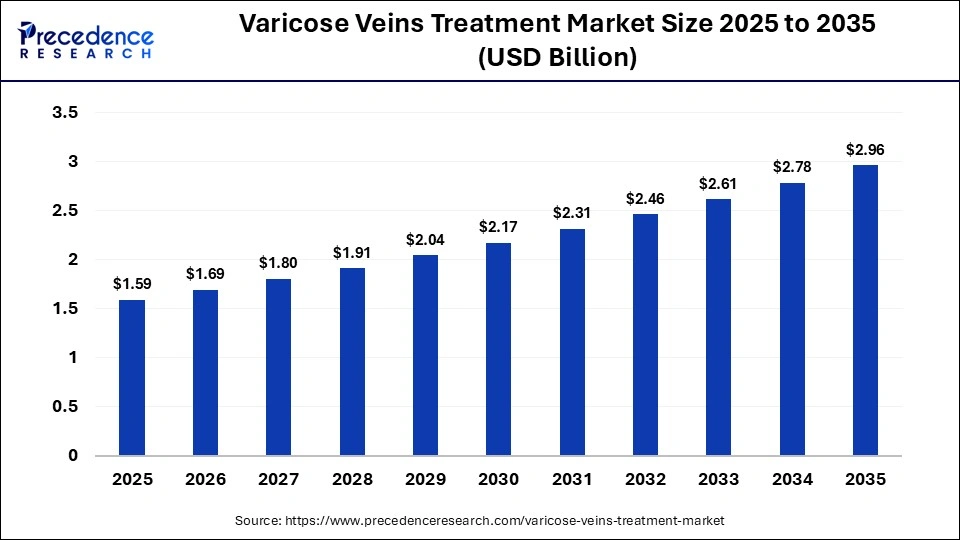
An aging population, sedentary lifestyles, rising awareness of vein health, technological advancements, and growing adoption of outpatient procedures are creating new opportunities for healthcare providers and medical device companies.
Download a Sample Report: https://www.precedenceresearch.com/sample/7895
Compact Scope Table
| Report Coverage | Details |
|---|---|
| 2025 Value | USD 1.59 Billion |
| 2026 Value | USD 1.69 Billion |
| 2035 Value | USD 2.96 Billion |
| CAGR 2026–2035 | 6.44% |
| Leading Region | North America |
| Fastest-Growing Region | Asia Pacific |
| Leading Treatment Type | Injection Sclerotherapy |
| Fastest-Growing Treatment Type | Endovenous Ablation |
| Leading End User | Hospitals |
| Fastest-Growing End User | Ambulatory Surgical Centers |
Minimally Invasive Treatment Is Driving Growth
Patients are increasingly choosing treatments that offer shorter recovery times, less discomfort, and fewer complications compared with traditional surgery.
Injection sclerotherapy held the largest share in 2025 because it is minimally invasive, relatively accessible, and effective for treating suitable small and medium-sized varicose veins.
Meanwhile, endovenous ablation is expected to grow at the fastest pace. Laser and radiofrequency technologies can close diseased veins with greater precision while supporting faster recovery. Increasing physician adoption of image-guided procedures is further strengthening this segment.
AI Is Improving Vein Treatment
Artificial intelligence is creating opportunities to improve diagnosis, treatment planning, and patient monitoring.
AI-assisted imaging can help physicians evaluate vein structure and disease severity while supporting the selection of appropriate treatment approaches. Predictive analytics may also help identify patients at higher risk of chronic venous insufficiency, allowing earlier intervention.
As healthcare providers adopt data-driven technologies, AI could improve procedural precision and clinical workflow efficiency.
Outpatient Care Is Expanding
Hospitals held the largest end-use position in 2025 because they offer advanced diagnostic facilities, vascular specialists, and comprehensive care for complex cases.
However, ambulatory surgical centers are expected to grow rapidly as more vein procedures shift toward outpatient settings. Shorter stays, lower treatment costs, convenient scheduling, and faster discharge are increasing the appeal of ASCs.
Specialty vein clinics are also becoming increasingly important as patients seek dedicated vascular services and personalized treatment.
North America Leads While Asia Pacific Accelerates
North America held the leading position in 2025, supported by advanced healthcare infrastructure, strong awareness of vein disorders, favorable reimbursement policies, and widespread adoption of minimally invasive procedures.
The U.S. continues to benefit from advanced laser and radiofrequency technologies, strong healthcare spending, and a well-established network of vascular specialists.
Asia Pacific is expected to experience the fastest growth as healthcare infrastructure improves, medical tourism expands, and patients gain greater access to specialized vascular treatment.
Companies Are Advancing Vein Care
Leading companies including Medtronic, Lumenis, AngioDynamics, Sciton, Quanta System, Dornier MedTech, Theraclion, and Intros Medical Laser are contributing to treatment innovation through energy-based systems, laser technologies, catheter-based procedures, and minimally invasive solutions.
Recent developments demonstrate the shift toward safer and more convenient procedures. In February 2026, InVera Medical received European CE Mark approval for its non-thermal InVera Infusion Device, designed for office-based treatment of diseased leg veins without tumescent anesthesia.
In February 2025, Aakash Healthcare and Medtronic launched a specialized vein clinic in New Delhi focused on advanced diagnosis and minimally invasive varicose vein treatment.
The Road Ahead
The future of varicose veins treatment will increasingly focus on minimally invasive procedures, non-thermal technologies, advanced imaging, outpatient care, AI-supported treatment planning, and improved patient comfort.
As awareness of venous health increases and treatment technologies continue to advance, healthcare providers and medical device companies are well positioned to benefit from expanding demand through 2035.
Buy this report: https://www.precedenceresearch.com/checkout/7895
About Us
Healthcare Prism is a dedicated healthcare insights and outreach platform, operating as an extension of Precedence Research. We share relevant perspectives, industry developments, emerging trends, and research-driven insights across the global healthcare sector. Our content is built on the knowledge, research standards, and expertise of Precedence Research, with a focus on making healthcare information clear, accessible, and useful for industry professionals, businesses, researchers, and healthcare stakeholders. Healthcare Prism serves as a focused platform to extend the reach of Precedence Research’s healthcare insights and connect them with a broader professional audience.
You can place an order or ask any questions, please feel free to contact us at [email protected]
Quick Contact:
Europe Region: +44 778 256 0738
North America Region: +1 8044 4193 44
APAC Region: +91 9356 9282 04 and +65 31065601
Visit Our Website: Precedence Research – Advisory, Research & Reports