
The global lab consumables sector was valued at USD 17.43 billion in 2025 and is projected to reach USD 18.97 billion in 2026 and approximately USD 40.70 billion by 2035, expanding at a CAGR of 8.85% from 2026 to 2035.
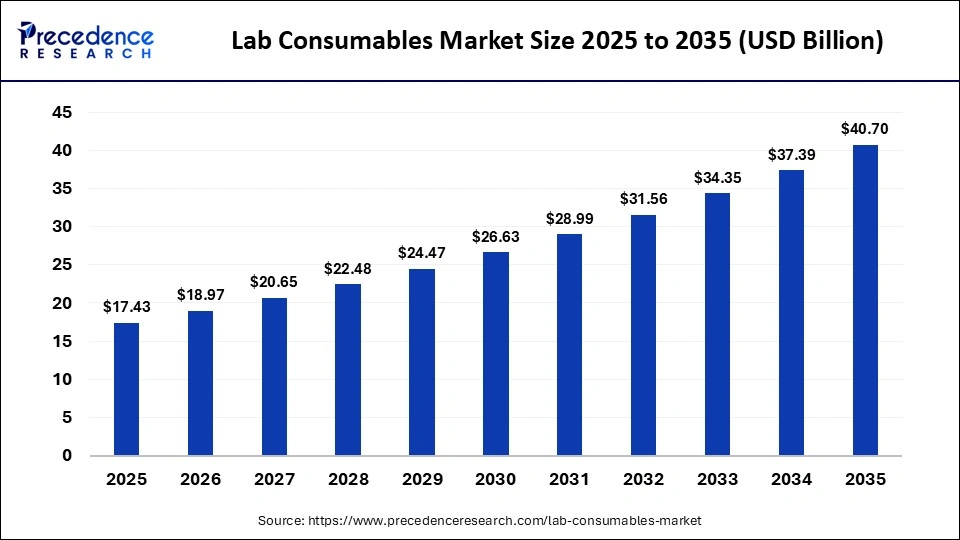
Growth is being fueled by increasing laboratory testing, expanding pharmaceutical and biotechnology research, rising demand for high-throughput screening, and the growing use of specialized consumables compatible with automated systems.
Download a Sample Report: https://www.precedenceresearch.com/sample/8029
Lab Consumables Overview
Lab consumables include pipettes and tips, syringes, needles, vials, containers, petri dishes, plates, centrifuge tubes, test tubes, filtration products, and other disposable or reusable laboratory materials. These products are essential across life science research, clinical diagnostics, pharmaceutical development, biotechnology, forensic testing, and academic research.
The rapid expansion of genomics, molecular diagnostics, proteomics, drug discovery, and personalized medicine is increasing the volume and complexity of laboratory work. As laboratories adopt automated workflows, the demand for precise, contamination-resistant, and automation-compatible consumables is also increasing.
AI Is Revolutionizing Lab Consumables
Artificial intelligence is transforming lab consumables through smarter inventory management, predictive demand forecasting, automated replenishment, and manufacturing quality control. AI systems can analyze consumption patterns to identify which products are used most frequently and help laboratories avoid stock shortages or unnecessary purchasing.
Machine learning can also improve manufacturing by identifying quality variations and optimizing production processes. In research and development, AI can accelerate the design of new materials that offer greater durability, sustainability, chemical resistance, and compatibility with automated laboratory equipment.
Powerful Trends Shaping Lab Consumables
Automation and High-Throughput Research
Laboratories are increasingly adopting robotic liquid handlers, automated sample processors, and high-throughput screening systems. This is driving demand for specialized pipette tips, microplates, tubes, and containers designed to meet strict dimensional and performance requirements.
Rapid Adoption of Single-Use Products
Disposable consumables remain highly important in clinical and pharmaceutical settings because they reduce cross-contamination risks and eliminate the need for repeated cleaning and sterilization. Their convenience is particularly valuable in high-volume diagnostic and research environments.
Sustainability Takes Center Stage
Environmental concerns are encouraging laboratories to reduce plastic waste. Manufacturers are developing recyclable plastics, biodegradable materials, reusable laboratory products, and innovative systems designed to extend consumable lifecycles without compromising performance.
Growth of Molecular and Genetic Testing
The expansion of PCR, next-generation sequencing, molecular diagnostics, and genomic research is increasing the need for high-purity and contamination-controlled consumables. Specialized tubes, plates, pipette tips, and vials are becoming increasingly important for reliable testing.
Disposable Consumables Maintain Strong Demand
The disposable segment dominated in 2025, supported by increasing clinical diagnostics, pharmaceutical research, vaccine development, and genomic testing. Disposable products provide convenience, reduce contamination risks, and integrate effectively with automated workflows.
The reusable segment is expected to expand at the fastest rate as laboratories seek to reduce plastic waste and improve sustainability. Advanced washing, cleaning, and sterilization technologies are making the reuse of selected laboratory products more practical.
Syringes and Needles Lead Product Demand
The syringes and needles segment held the leading position in 2025. High-volume use in diagnostics, research, drug development, vaccination activities, and sample handling continues to sustain demand.
The vials and containers segment is expected to grow strongly as biotechnology, vaccine development, molecular testing, and sample storage expand. Specialized containers are increasingly required to protect sample integrity and maintain compatibility with advanced laboratory workflows.
Plastic Remains the Leading Material
The plastic segment dominated in 2025 because of its affordability, lightweight design, durability, and resistance to breakage. Disposable plastic products also help laboratories save time and reduce sterilization requirements.
The glass segment is expected to experience strong growth due to its chemical inertness, thermal stability, and compatibility with sensitive laboratory applications. Borosilicate glass is particularly valuable where sample purity and resistance to chemical interaction are critical.
Life Science Research Drives Extensive Consumption
The life science research segment held the leading position in 2025. Expanding drug discovery, genomics, proteomics, biotechnology, and clinical research activities are generating continuous demand for laboratory products.
The clinical diagnostics segment is expected to grow rapidly as healthcare providers increase testing volumes for chronic diseases, infectious conditions, cancer, and genetic disorders. Expansion of independent diagnostic laboratories in developing economies is further increasing consumption.
Hospitals and Clinics Remain Major End Users
The hospital and clinics segment dominated in 2025 due to large-scale diagnostic testing requirements. Hospitals consume significant quantities of tubes, syringes, pipettes, containers, and disposable laboratory products for routine and specialized testing.
The pharmaceutical and biotechnology companies segment is expected to grow strongly through 2035. Increasing expenditure on drug discovery, biologics, vaccines, personalized medicine, and quality control is creating sustained demand for specialized consumables.
North America Maintains Its Leadership
North America held the leading position in 2025 due to its advanced research infrastructure, strong pharmaceutical and biotechnology ecosystem, high diagnostic testing volumes, and extensive adoption of precision medicine and genomics.
The United States remains a major contributor, supported by significant research funding, advanced molecular biology capabilities, and strong demand for high-quality and traceable laboratory products. Regulatory requirements are also encouraging laboratories to adopt standardized, sterile, and certified consumables.
Asia Pacific Emerges as a Powerful Growth Engine
Asia Pacific is expected to expand at the fastest rate during the forecast period. Increasing healthcare investment, expanding pharmaceutical manufacturing, rising diagnostic testing, and rapid development of biotechnology infrastructure are creating strong demand.
China is becoming an important contributor as laboratories adopt automated systems, molecular diagnostics, and sustainable laboratory materials. India, Japan, South Korea, and other regional economies are also strengthening research capabilities and healthcare infrastructure, supporting increased consumption of laboratory products.
Europe is expected to grow steadily due to its strong pharmaceutical and biotechnology research base, strict quality standards, and increasing focus on sustainable laboratory practices. The UK continues to benefit from investments in genomics, drug discovery, and personalized medicine.
Innovation Continues to Reshape Laboratory Workflows
In July 2025, Merck introduced the AAW Automated Assay Workstation in collaboration with Opentrons. The system is designed to automate routine laboratory procedures, reduce manual work, and improve consistency.
In May 2025, Danaher announced a collaboration with AstraZeneca focused on developing and commercializing diagnostic tools to support precision medicine. Such initiatives are expected to increase demand for advanced laboratory workflows and specialized consumables.
Future Outlook for Lab Consumables
The future of lab consumables is being shaped by automation, AI-enabled laboratory management, high-throughput research, sustainable materials, and increasing demand for precision diagnostics. Laboratories are moving toward products that provide greater accuracy, reliability, sterility, and compatibility with automated systems.
With the global sector projected to reach approximately USD 40.70 billion by 2035, continued expansion in life science research, clinical diagnostics, pharmaceutical development, and biotechnology is expected to create significant opportunities for manufacturers of innovative and sustainable lab consumables.
Buy this report: https://www.precedenceresearch.com/checkout/8029
About Us
Healthcare Prism is a dedicated healthcare insights and outreach platform, operating as an extension of Precedence Research. We share relevant perspectives, industry developments, emerging trends, and research-driven insights across the global healthcare sector. Our content is built on the knowledge, research standards, and expertise of Precedence Research, with a focus on making healthcare information clear, accessible, and useful for industry professionals, businesses, researchers, and healthcare stakeholders. Healthcare Prism serves as a focused platform to extend the reach of Precedence Research’s healthcare insights and connect them with a broader professional audience.
You can place an order or ask any questions, please feel free to contact us at [email protected]
Quick Contact:
Europe Region: +44 778 256 0738
North America Region: +1 8044 4193 44
APAC Region: +91 9356 9282 04 and +65 31065601
Visit Our Website: Precedence Research – Advisory, Research & Reports