
The global in vitro diagnostics quality controls sector was valued at USD 1,653.67 million in 2025 and is projected to reach USD 1,736.17 million in 2026 and approximately USD 2,713.92 million by 2035, expanding at a CAGR of 5.09% from 2026 to 2035.
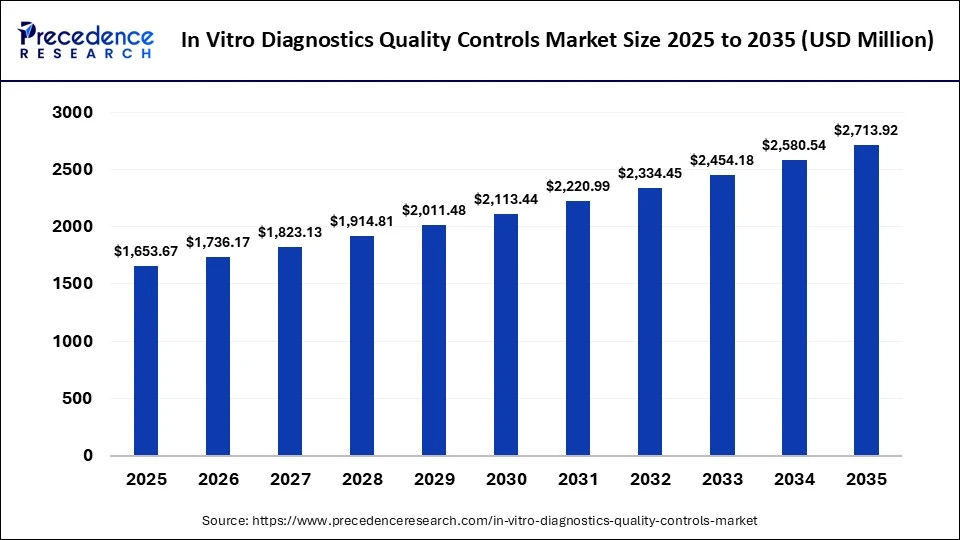
Growth is being driven by the increasing use of advanced diagnostic technologies, rising laboratory testing volumes, stricter quality requirements, and the growing need for accurate and reliable clinical results.
Download a Sample Report: https://www.precedenceresearch.com/sample/7971
In Vitro Diagnostics Quality Controls Overview
In vitro diagnostics quality controls include reference materials, reagents, controls, calibrators, data management solutions, and quality assurance services used to verify the reliability of laboratory testing. These solutions support clinical chemistry, immunoassays, molecular diagnostics, hematology, microbiology, coagulation testing, and other diagnostic disciplines.
Quality control is essential for reducing testing errors, improving reproducibility, supporting laboratory accreditation, and maintaining patient safety. The growing adoption of automated laboratory systems and complex molecular testing is further increasing the need for reliable quality control solutions across hospitals, independent laboratories, research institutes, and diagnostic centers.
AI Is Revolutionizing In Vitro Diagnostics Quality Controls
Artificial intelligence is transforming in vitro diagnostics quality controls by enabling automated trend analysis, predictive monitoring, and faster detection of testing abnormalities. AI systems can continuously evaluate instrument performance and identify unusual patterns before they affect diagnostic results.
Predictive analytics can also help laboratories anticipate equipment failures, optimize maintenance schedules, reduce reagent waste, and improve workflow efficiency. As laboratory automation expands, AI-powered quality control is expected to become increasingly important for maintaining consistency, minimizing human error, and supporting regulatory compliance.
Powerful Trends Transforming In Vitro Diagnostics Quality Controls
Growing Use of Third-Party Controls
Third-party controls are gaining popularity because they provide independent and unbiased verification of assay performance. Their compatibility across multiple analyzer platforms also gives laboratories greater flexibility and helps compare performance objectively.
Rapid Laboratory Automation
Automated analyzers and integrated laboratory platforms are increasing testing volumes while reducing manual intervention. This expansion is creating stronger demand for standardized controls capable of monitoring high-throughput workflows.
Cloud-Based Quality Data Management
Laboratories are increasingly using cloud-based systems to monitor quality control data in real time. These platforms support trend analysis, peer comparison, automated alerts, and centralized reporting across multiple facilities.
Rising Molecular and Genetic Testing
The expansion of PCR, next-generation sequencing, and genetic testing is increasing the need for highly sensitive quality control materials. These sophisticated assays require consistent validation to maintain analytical accuracy and reproducibility.
Quality Control Products Continue to Lead
The quality control products segment accounted for the largest share of 56% in 2025. These products are widely used to monitor laboratory instruments, verify assay performance, and maintain consistent diagnostic results.
The segment benefits from increasing testing volumes and stricter quality requirements. Reagents, controls, and reference materials remain essential components of laboratory workflows, supporting continued demand across multiple diagnostic disciplines.
The data management solutions segment is expected to grow at the fastest rate. Growing laboratory automation and increasing volumes of QC data are encouraging healthcare organizations to adopt informatics platforms that simplify real-time monitoring, automated flagging, and performance analysis.
Third-Party Controls Strengthen Laboratory Reliability
The third-party controls segment led with a 58% share in 2025. Independent controls help laboratories verify diagnostic performance without relying exclusively on manufacturer-specific materials. Their flexibility across multiple platforms makes them attractive to laboratories managing diverse analyzer environments.
The OEM controls segment is also expected to expand steadily as diagnostic manufacturers develop integrated quality solutions designed specifically for their instruments. Greater automation and direct integration with analyzers are supporting wider adoption.
Immunoassays Lead While Molecular Diagnostics Accelerate
The immunoassay diagnostics segment held the largest share of 29% in 2025. Immunoassays are extensively used for detecting hormones, tumor markers, autoimmune conditions, infectious diseases, and other conditions, creating continuous demand for reliable calibration and quality monitoring.
The molecular diagnostics segment is expected to grow at the fastest pace. Increasing adoption of PCR and next-generation sequencing for infectious disease, cancer, and genetic testing is creating greater demand for advanced controls capable of monitoring highly sensitive molecular assays.
Hospitals Remain the Leading End User
The hospitals segment held the largest share of approximately 38% in 2025. Hospitals conduct high volumes of clinical testing across hematology, chemistry, immunoassays, molecular diagnostics, and microbiology, making quality control essential for reliable patient results.
The clinical diagnostic laboratories segment is expected to experience strong growth as independent laboratories expand their testing capabilities and introduce automated diagnostic systems. Increasing demand for faster and more accurate testing is encouraging laboratories to strengthen quality assurance programs.
North America Maintains Its Leadership
North America accounted for approximately 41% of the share in 2025, supported by advanced laboratory infrastructure, high testing volumes, stringent quality requirements, and widespread adoption of modern diagnostic technologies.
The United States remains the primary contributor, benefiting from a large network of hospitals, diagnostic laboratories, biotechnology companies, and research institutions. Greater adoption of third-party controls and advanced laboratory information systems is further supporting regional growth.
Asia Pacific Emerges as a Powerful Growth Engine
Asia Pacific is expected to expand at the fastest rate during the forecast period. Growing healthcare expenditure, increasing laboratory testing, expanding diagnostic infrastructure, and rapid adoption of automation are creating new opportunities across the region.
China is a major contributor due to the expansion of healthcare infrastructure, rising diagnostic testing volumes, and increasing adoption of digital and AI-supported laboratory technologies. Japan, Australia, South Korea, and India are also strengthening their diagnostic capabilities through laboratory modernization and healthcare investment.
Europe is advancing through stringent IVDR compliance requirements, increasing laboratory automation, and greater emphasis on diagnostic accuracy. Germany remains an important contributor because of its advanced healthcare infrastructure and strong focus on laboratory quality and precision diagnostics.
Recent Developments
In December 2025, Leica Biosystems launched a pathology portfolio comprising the Aperio GT 180 DX scanner, Aperio CS5 DX scanner, and Aperio iQC DX software for applications across diagnostic laboratories.
In October 2025, Fujifilm launched the FW500 clinical chemistry analyzer, designed to support diagnostic laboratories with improved precision and operational efficiency.
In May 2025, Codix Pharma opened a new production facility in Nigeria focused on manufacturing in vitro diagnostic kits for African healthcare providers.
Future Outlook for In Vitro Diagnostics Quality Controls
The future of in vitro diagnostics quality controls is being shaped by laboratory automation, AI-powered analytics, cloud-based data management, molecular diagnostics, and growing adoption of independent third-party controls. These technologies are helping laboratories improve accuracy, reduce errors, and manage increasingly complex testing environments.
With the global sector projected to reach approximately USD 2,713.92 million by 2035, continued investment in laboratory modernization, diagnostic innovation, and quality assurance technologies is expected to strengthen demand worldwide.
Buy this report: https://www.precedenceresearch.com/checkout/7971
About Us
Healthcare Prism is a dedicated healthcare insights and outreach platform, operating as an extension of Precedence Research. We share relevant perspectives, industry developments, emerging trends, and research-driven insights across the global healthcare sector. Our content is built on the knowledge, research standards, and expertise of Precedence Research, with a focus on making healthcare information clear, accessible, and useful for industry professionals, businesses, researchers, and healthcare stakeholders. Healthcare Prism serves as a focused platform to extend the reach of Precedence Research’s healthcare insights and connect them with a broader professional audience.
You can place an order or ask any questions, please feel free to contact us at [email protected]
Quick Contact:
Europe Region: +44 778 256 0738
North America Region: +1 8044 4193 44
APAC Region: +91 9356 9282 04 and +65 31065601
Visit Our Website: Precedence Research – Advisory, Research & Reports